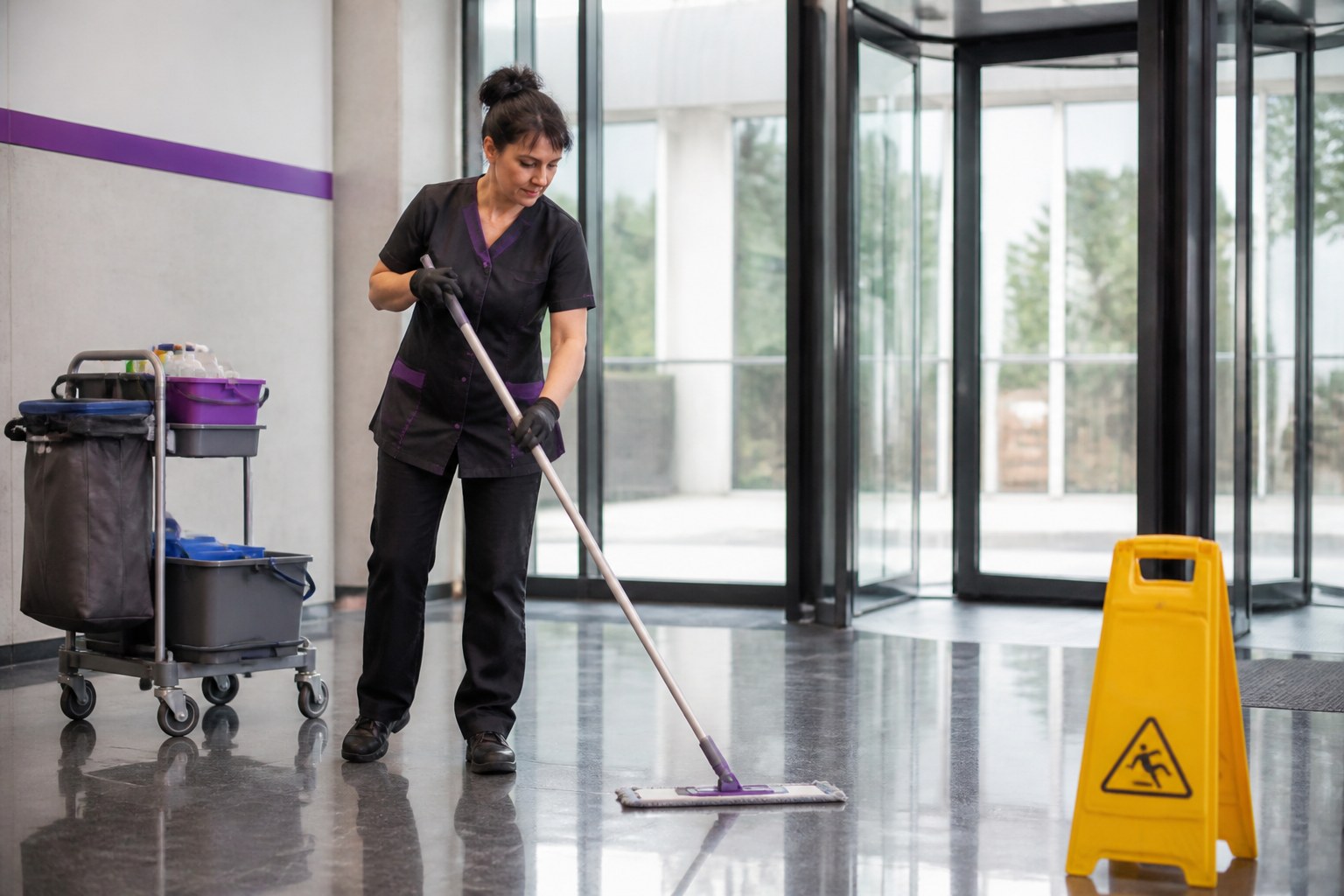
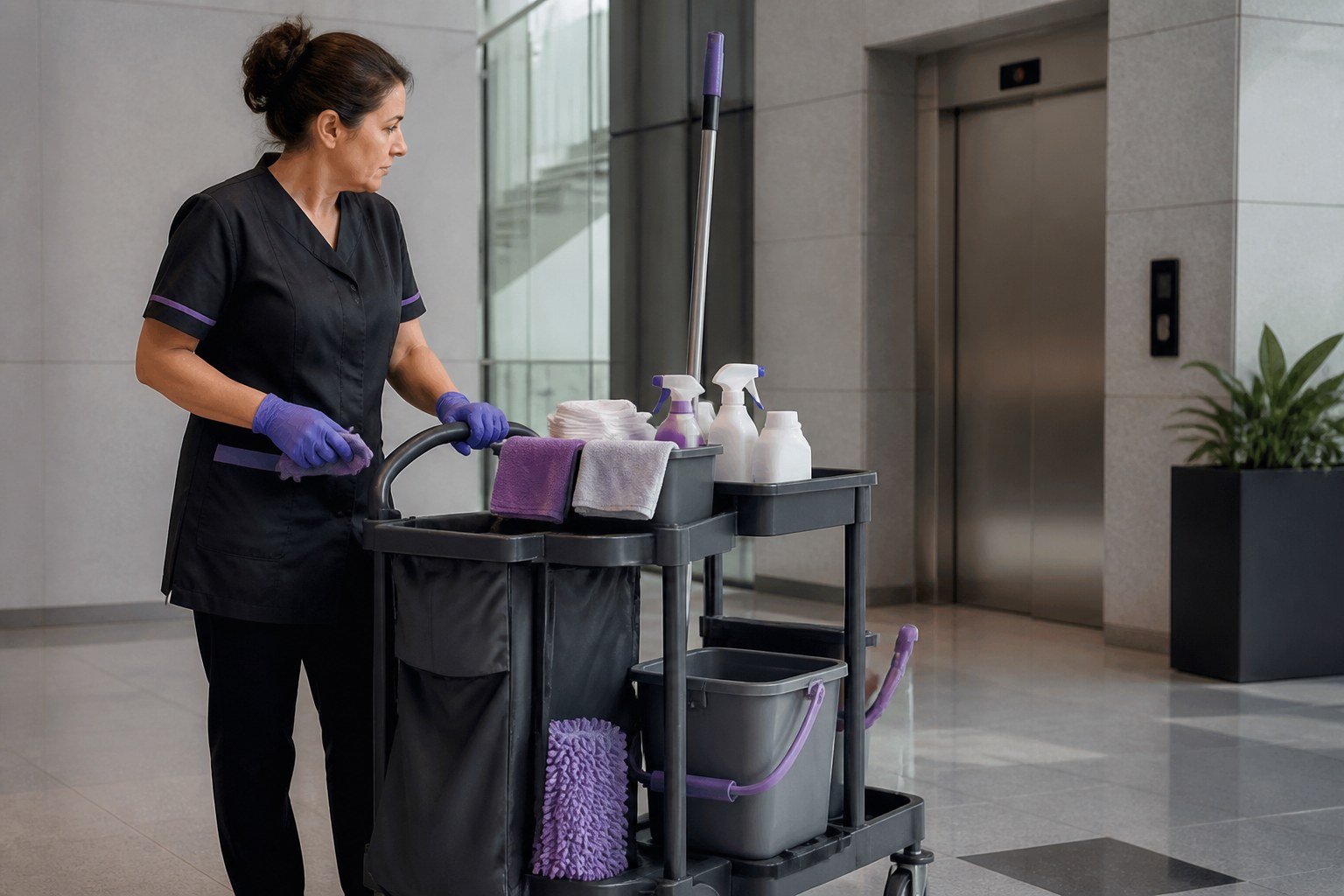
Building cleaner work focuses on keeping indoor spaces clean, safe and usable. The occupational field includes cleaning entrances, corridors, stairways, offices, public buildings, sanitary areas and other shared or commercial spaces. The exact duties depend on the workplace and the working arrangement, so your application should describe the tasks you have actually performed rather than relying only on the job title.
Typical responsibilities include removing dust and dirt, cleaning floors and surfaces, emptying waste containers, cleaning sanitary facilities and preparing rooms for regular use. Some assignments also involve using vacuum cleaners, mops, floor-cleaning machines, cleaning solutions and other equipment. The work requires attention to surfaces, materials and hygiene standards. A careful cleaner selects suitable methods and avoids damage caused by incorrect products or equipment.
Building cleaning is practical work that often follows a defined route or schedule. Reliability matters because cleaning activities support the daily operation of a building. Applicants therefore need to show that they work consistently, complete assigned areas and report problems such as damage, blocked facilities or missing supplies. Physical activity, standing, walking, bending and moving equipment form part of many cleaning tasks.
Working environments differ. A candidate may have experience in commercial buildings, public facilities, residential buildings, industrial premises or other properties. Mentioning the type of environment, the areas cleaned and the equipment used gives a clearer picture of your experience. Applicants seeking building cleaner jobs in Germany should present themselves for opportunities throughout Germany rather than limiting their profile to one preferred city.
Which Qualifications and Experience Strengthen Your Profile
Relevant practical experience is one of the most important parts of a building cleaner profile. Employers and placement teams need to understand what you have done in previous roles, how independently you worked and which cleaning environments you know. State the period of employment, the type of building, your main duties and the equipment or methods used.
Experience with routine cleaning strengthens an application when it is described precisely. Useful details include floor care, surface cleaning, sanitary cleaning, waste handling, replenishing supplies and maintaining an orderly work area. If you worked with machines or concentrated cleaning products, name the equipment or product category only when you know it accurately. Do not list methods that you have not used.
Reliable work performance is as important as technical familiarity. Building cleaners work in occupied buildings, shared areas and spaces that need dependable maintenance. Punctuality, careful handling of property, consistent quality and respectful conduct support a strong candidate profile. Your references or employment records should reflect your actual responsibilities where such documents are available.
Formal qualifications and practical experience are not the same thing. A certificate may document training, while employment history demonstrates how you apply cleaning knowledge in daily work. Do not present an unsupported certificate as mandatory. Instead, include relevant vocational training, internal instruction, occupational safety training or other documented preparation that you genuinely completed.
Safe working practice deserves particular attention. Cleaning work involves equipment, wet floors, storage areas and cleaning substances. Applicants should describe experience with safe preparation, orderly storage, protective work practices and warning signs where these formed part of their previous duties. Accuracy is more valuable than an impressive but unverified list of skills.
German Language Skills and Workplace Communication
German language skills form part of your candidate profile for building cleaner work in Germany. Communication supports the practical side of the job: understanding instructions, identifying areas that need attention, discussing completed tasks and reporting problems. It also helps you understand workplace rules and safety information.
Cleaning work often takes place while other people use a building. You may need to communicate briefly with colleagues, supervisors, visitors or workers from other departments. Clear communication reduces misunderstandings about access, cleaning schedules, wet floors, equipment and damaged items. It also supports respectful cooperation in shared working areas.
Describe your language knowledge accurately. If you have completed a German course or hold a language certificate, include the information in your application. Language levels may be stated using the Common European Framework of Reference, such as A2, B1, B2 or C1, when that description reflects your actual knowledge. Do not claim a level that you cannot use in workplace communication.
Language preparation should include more than grammar. Practise vocabulary for rooms, surfaces, equipment, cleaning products, hazards, time schedules and simple instructions. Applicants with limited German experience should still provide a truthful description of their current skills and explain any relevant learning already completed. English or another language does not replace the need to develop German communication for work in Germany.
Documents to Prepare Before Applying
An initiative application for building cleaner opportunities should begin with a clear and consistent document file. Your CV should show your contact details, work history, education or training, language knowledge and relevant practical skills. List cleaning-related employment in reverse chronological order and explain the main tasks instead of providing only employer names and job titles.
For each relevant role, include the period of employment, the type of workplace, the areas cleaned and the tools or methods used. If your employment history contains gaps, present the dates honestly and explain training or other relevant activity where appropriate. A readable CV helps the reviewing team understand your experience without having to reconstruct it from incomplete information.
Collect education and training records, employment references and certificates that support your profile. Relevant evidence includes documents about cleaning work, occupational safety instruction, equipment training or language learning. Keep the information consistent across your CV and supporting documents. Differences in dates, job titles or responsibilities create avoidable questions.
Foreign-language documents may require translation in a specific procedure. Whether a translation is needed, and whether it must follow a formal certification process, depends on the procedure concerned. Do not assume that every document requires the same treatment. Keep the original documents and obtain further guidance when a particular process requires translated evidence.
A professional photograph is not a general requirement for an application in Germany. Focus first on accurate content, readable formatting and complete evidence. A short motivation statement is useful when it explains your cleaning experience, German learning, availability and interest in working in Germany. It should add information rather than repeat every line of the CV.
Building Cleaner Application Preparation Checklist
Application area
What to prepare
Why it matters for your profile
Practical experience
Work periods, building types, cleaning tasks, equipment and safety practices
Shows what you have actually done and how your experience matches building cleaning work
Language and communication
Accurate German information, course records or certificates where available
Helps assess your ability to understand instructions, safety information and workplace communication
Documents and certificates
CV, education and training records, references and relevant evidence of experience
Creates a consistent basis for reviewing your qualification and professional history
Availability and mobility
Your realistic availability and openness to employment opportunities throughout Germany
Supports consideration for Germany-wide opportunities in your occupational group
Recognition and Qualification Evidence
Professional recognition and application evidence are separate matters. Recognition is a formal process in which a competent authority compares a foreign professional qualification with a German reference occupation. Application evidence, by contrast, helps assess your experience, training and suitability for work in your occupational group.
Regulated professions are occupations in which professional practice or specific activities are legally protected. People who want to work in a regulated profession generally need the required recognition or professional authorisation. Non-regulated professions are not protected in the same way. Many occupations in the dual training system and numerous academic occupations fall into this category.
The status of a profession must be assessed carefully. This article does not classify building cleaner work as regulated or non-regulated because the relevant legal assessment depends on the occupation and situation. Do not assume that a cleaning-related role automatically requires formal recognition, and do not assume that no qualification evidence will ever be relevant.
Where a recognition procedure applies, the competent body examines whether the foreign qualification matches the German reference profession and whether substantial differences exist. With complete documents, the competent body generally examines the file within approximately three to four months. Possible outcomes for non-regulated professions include full recognition, partial recognition or no recognition. Where substantial differences exist, an adaptation qualification or another prescribed measure addresses those differences in some cases.
For your application, provide every relevant qualification and employment record even when you are unsure whether formal recognition applies. A clear description of practical experience gives reviewers a reliable basis for assessing your profile. Recognition requirements and requirements for working in Germany are separate issues, so one should not be used as a substitute for the other.
Working Conditions to Understand Before Employment
Before employment begins, read the employment contract carefully. The document should identify the contracting parties and address the start date, any fixed-term arrangement, probationary period, workplace, duties, pay, working time, leave and notice periods. These details define the practical framework of the employment relationship.
Pay is normally stated as a gross amount. Gross pay is not the same as the net amount transferred to your account. Taxes and social insurance contributions are deducted according to your personal circumstances. Social insurance in Germany includes health, long-term care, pension, unemployment and accident insurance. For a social-insurance-covered job, registration is generally handled through the employer.
Working time in the contract is not identical to the statutory maximum daily working time. Under the Working Time Act, daily working time generally must not exceed eight hours. It extends to up to ten hours when the average does not exceed eight hours on working days within the specified reference period. The contract and applicable workplace rules provide the details relevant to your employment.
Holiday entitlement also matters when you assess an employment contract. The statutory minimum is calculated using the legal concept of working days, which assumes a six-day week. A contract or collective agreement provides more holiday when it contains a higher entitlement. Check how the stated holiday is calculated for the working pattern described in your contract.
Ask for clarity about the workplace, duties, schedules, equipment, protective measures and additional payments before accepting employment. Do not calculate your available income from gross pay alone. Rent, deposit, transport and other living costs affect the amount that remains after deductions and regular expenses, especially when moving to Germany.
Applying Through a Germany-Wide Candidate Profile
East Talent does not publish a specific building cleaner vacancy on this candidate page. You apply proactively for employment opportunities in your occupational group rather than applying for a named position at a particular employer. The purpose of your profile is to show the professional information needed to assess your suitability for future placement opportunities.
Start with a precise CV and a consistent set of supporting documents. Describe cleaning environments, daily tasks, equipment, safety practices and the length of your experience. Add your German language information and identify any training or certificates that support your application. If references are available, ensure that they confirm your actual work history.
Your application should present both practical ability and reliability. Explain how you organise cleaning routes, complete tasks, handle equipment and report problems when these responsibilities belong to your experience. Avoid general claims such as “hard-working” without examples. Concrete duties give your profile greater value than unsupported adjectives.
Applicants must remain open to employment opportunities throughout Germany. A Germany-wide profile creates a broader basis for matching your occupational experience with suitable employment opportunities. State any genuine restrictions clearly, but do not present one preferred city as the expected destination when applying through a Germany-wide candidate process.
Before submitting your application, check dates, translations, contact details and language information. Keep copies of all submitted documents. Use the application form to present your occupational group, experience and readiness for employment in Germany accurately.
Apply now. Apply for jobs in Germany through our application form.
Create your profile
Registration with East Talent
Four short steps. A CV is optional and can be provided in your native language.
Step 1 of 4Profession
East Talent
International recruitment with proprietary software
East Talent combines international recruitment with structured digital processes for handling candidate profiles, attracting employers and evaluating job opportunities.