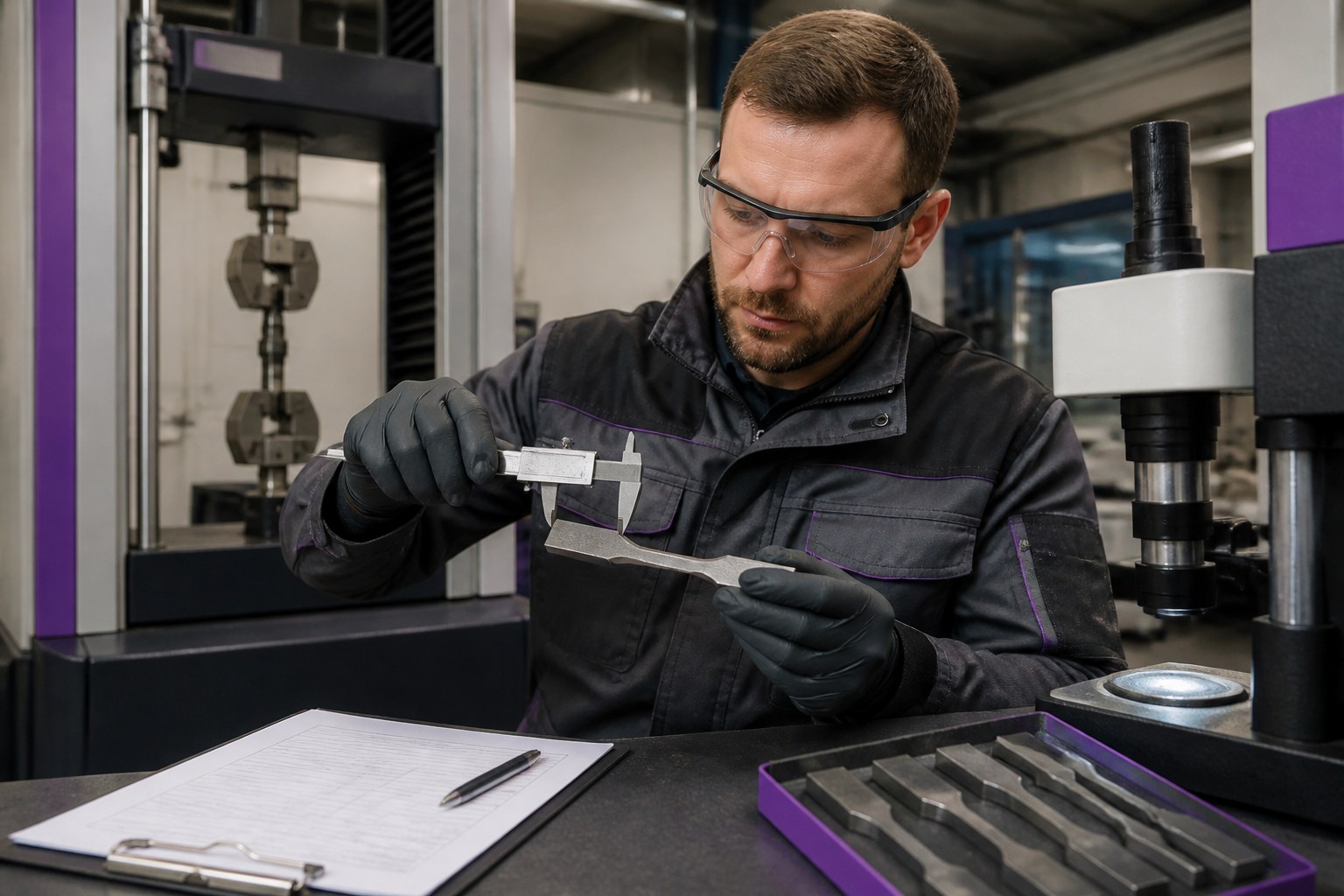
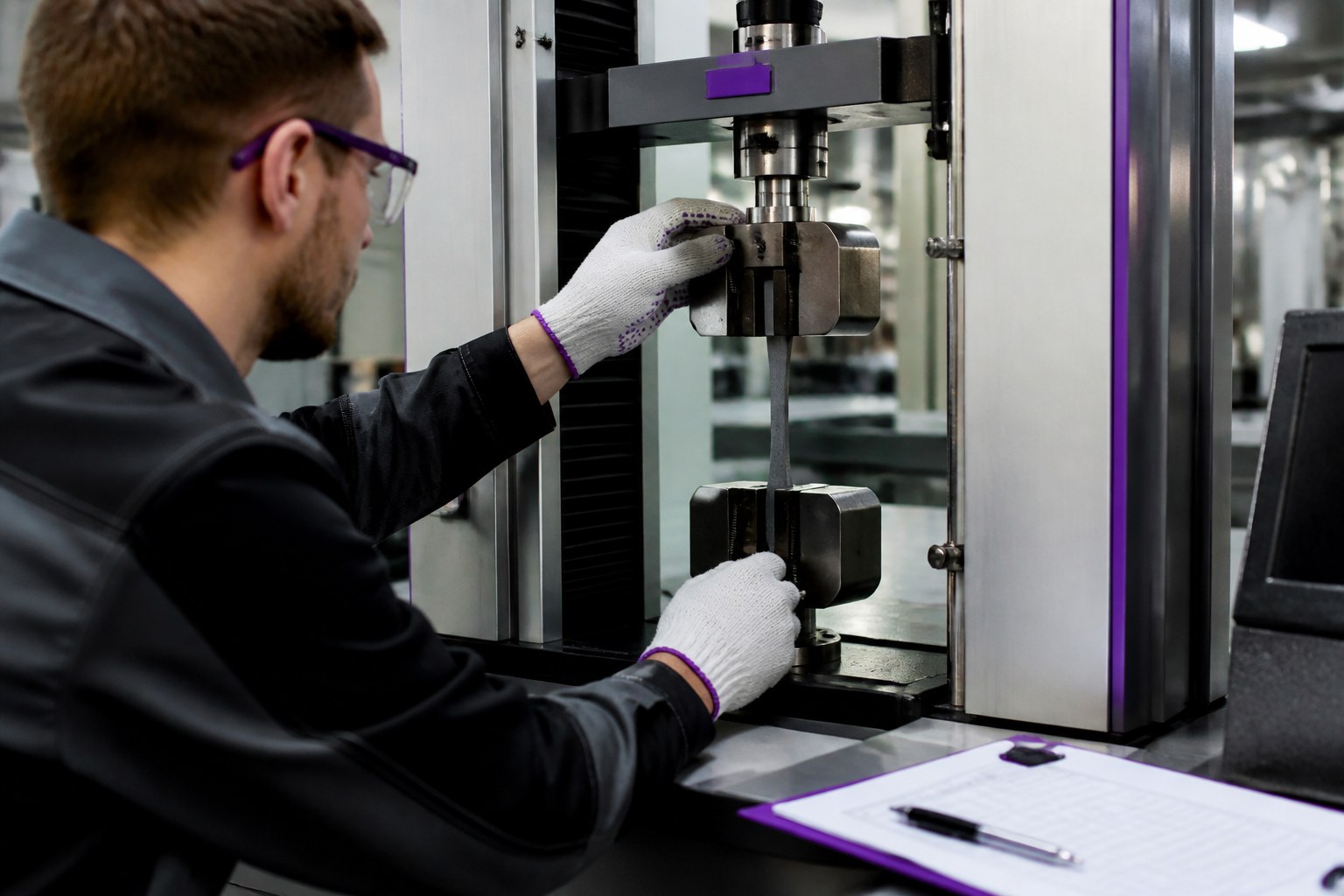
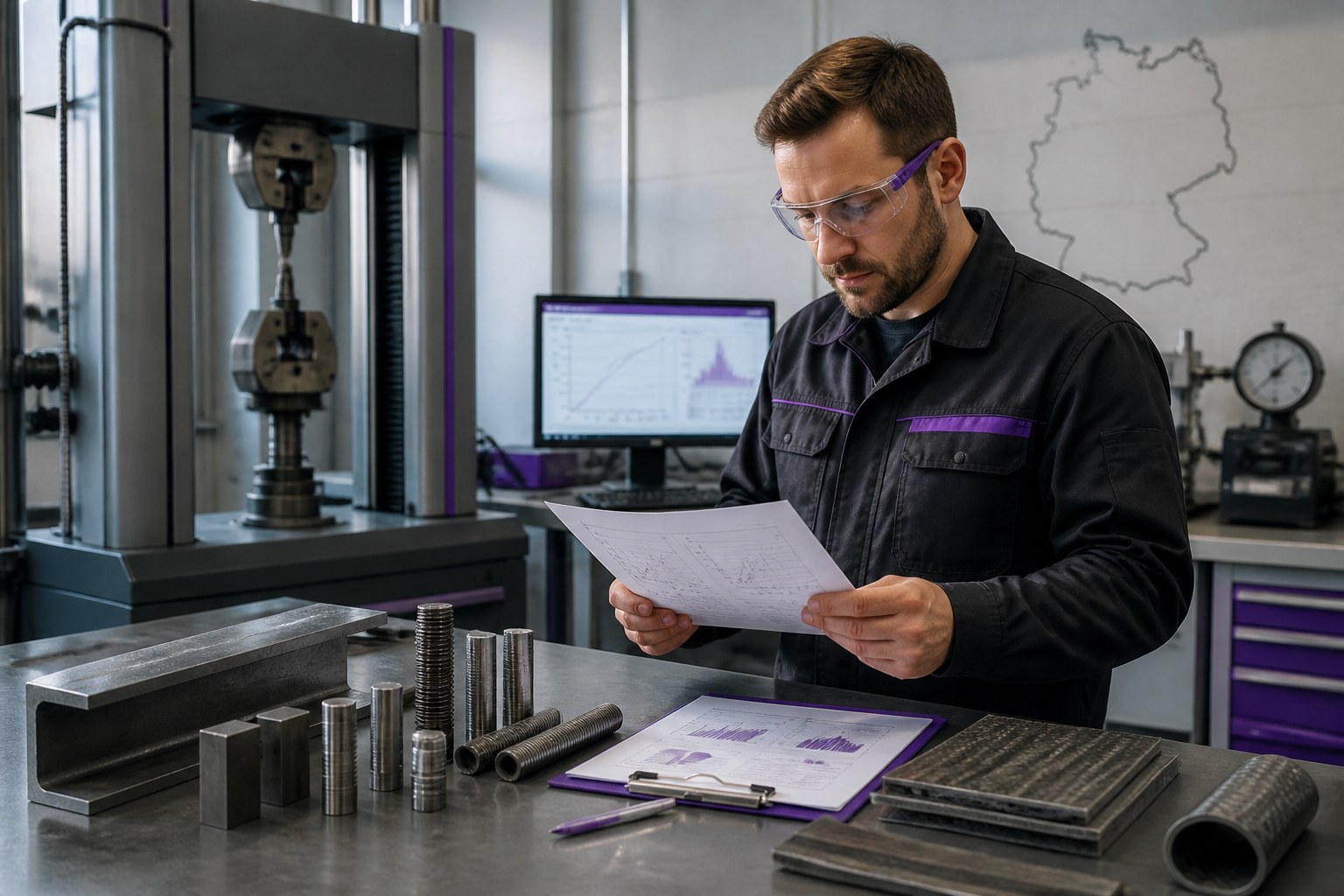
Materials testers examine the properties, quality and performance of materials, components and finished products. Their work supports reliable production and quality control in industrial, laboratory and technical environments. Depending on the field, the materials examined include metals, plastics, composites, building materials or other industrial products.
Typical tasks include preparing test specimens, selecting suitable testing methods, operating measuring and testing equipment, recording measurements and comparing results with technical requirements. Materials testers also document deviations, maintain clear test records and communicate relevant findings to quality, production or engineering colleagues.
The daily work combines practical handling with careful documentation. A tester must follow defined procedures, work precisely and identify results that require further examination. The exact tasks differ between laboratory testing, production-related inspection and specialised materials analysis, so your application should describe your actual experience rather than rely on a generic job title.
The work also requires a clear understanding of the relationship between a test procedure and the result it produces. Sample identification, correct preparation, controlled test conditions and complete records support traceability. When a result differs from an expected value, the tester records the deviation and passes reliable information to the responsible technical team rather than making unsupported conclusions.
Materials testers work at the interface between hands-on technical activity and documented quality decisions. This makes attention to detail important in both routine and unusual situations. Your profile becomes more informative when it explains the complete sequence of your work: receiving or identifying the sample, preparing it, performing the test, recording the measurement and reporting the result.
Which Qualifications Matter for Materials Tester Jobs
Relevant vocational training, technical education or academic study provides an important foundation for materials tester jobs in Germany. The appropriate background depends on the materials testing field and the technical environment in which you have worked. Training related to materials technology, laboratory work, quality control, mechanical engineering or another closely connected discipline is relevant when it matches your practical experience.
Employers and recruiting processes also examine practical exposure to testing work. Your profile should show the types of materials or components you examined, the testing activities you performed and the level of responsibility you held. Laboratory or industrial experience strengthens your application when it is described precisely and supported by employment records or references.
Knowledge of testing methods, measurement principles, technical documentation and quality procedures is relevant across the profession. Do not infer a universal qualification profile from one vacancy. Instead, present your complete technical background so that your profile remains suitable for different materials testing environments throughout Germany.
Your educational history should be understandable even when the original qualification comes from another country. List the name of the qualification, the institution, the period of study and the main technical subjects. Practical training, laboratory instruction and supervised industrial work deserve separate mention because they clarify how your formal education connects with your professional experience.
A qualification alone does not describe your level of independence. Explain whether you carried out tests independently, worked from established instructions, supported senior specialists or coordinated parts of the testing process. This distinction helps reviewers assess your experience accurately without overstating your responsibilities.
Technical Skills and Working Methods
Materials testing requires accuracy at every stage. Sample preparation must follow the applicable working procedure, because an incorrectly prepared specimen affects the reliability of the result. Your application should therefore explain whether you prepared, marked, measured or otherwise processed test specimens yourself.
Describe the equipment and methods you have actually used. Relevant details include mechanical testing equipment, dimensional measuring tools, laboratory instruments, visual inspection methods and systems used to record results. The description should remain factual: name the equipment or method only when you have practical experience with it.
Test documentation is as important as the measurement itself. A strong profile shows that you record results clearly, identify deviations, follow quality procedures and protect the traceability of samples and measurements. Accuracy, concentration, safe equipment handling and consistent working methods are skills to document. If a method or instrument is new to you, state that honestly and distinguish existing experience from skills you are prepared to develop.
Mention the type of measurement or inspection you performed when this information is available. A reviewer needs to understand whether your experience focused on dimensions, visible defects, mechanical behaviour, laboratory values or another characteristic. Avoid listing technical terms without explaining your actual task with the method or instrument.
Good working methods also include checking equipment condition and following workplace safety instructions. Include calibration checks, equipment preparation, cleaning, sample storage or protective procedures when these activities formed part of your duties. These details demonstrate disciplined laboratory or industrial practice without requiring claims about equipment you have not used.
German Language Skills for the Candidate Profile
German language skills are relevant because materials testers work with technical instructions, safety information, measurement records and colleagues from production, quality management and engineering. Clear communication supports the correct execution of test procedures and the accurate reporting of deviations.
There is no single universal German language threshold for every materials tester role. The relevant level depends on the working environment, the documentation involved and the communication required for the position. Your candidate profile should therefore state your current level accurately rather than claiming a level that you have not achieved.
Use recognised CEFR descriptions such as A2, B1, B2 or C1 where they reflect your knowledge. Include certificates when available and distinguish between general German, technical vocabulary and your ability to understand spoken instructions. Continued language development strengthens your readiness for employment in Germany.
Describe your practical communication ability as well as your certificate. For example, state whether you understand routine technical instructions, record findings in German, discuss a deviation with colleagues or read safety information independently. This gives a more useful picture of your readiness than an unexplained language label.
Language development should continue during the qualification and document assessment process. Build vocabulary related to materials, measurements, samples, defects, equipment and quality procedures. Accurate technical communication supports safe work and reduces misunderstandings when test results must be explained to another department.
Recognition of Foreign Qualifications
The recognition question depends on the professional classification of the role and on the procedure connected with your planned employment. Regulated professions are legally protected and require the relevant professional recognition or licence. Non-regulated professions are not protected in the same way, and formal German professional recognition is generally not required to work in them.
Many materials testing activities fall within technical or industrial work, but the exact classification must be assessed for the qualification and professional activity concerned. Do not assume that a job title alone determines the recognition position. Qualification evidence may still be important for related to working in Germany procedures even when the profession itself is non-regulated.
The responsible authority compares a foreign qualification with the relevant German reference occupation and assesses whether the training is equivalent or whether substantial differences exist. Complete certificates, training records and supporting documents make this assessment easier. The possible result for a non-regulated profession includes full recognition, partial recognition or no recognition. Where substantial differences exist, an adjustment qualification or another recognised measure addresses those differences in the relevant case.
Prepare a consistent description of your education and professional history before the assessment begins. Differences between the dates or titles shown on your CV, certificates and employment records create avoidable questions. If a document is unavailable, explain the situation clearly and provide the supporting evidence that you do have.
Recognition of a qualification and assessment of professional experience are related but distinct matters. Your practical testing history remains important because it explains the work you have performed, while the recognition procedure focuses on the qualification and the relevant professional classification. Present both areas separately and accurately.
Documents to Prepare Before Applying
Prepare an application file that presents your professional history in a clear and verifiable form. The core document is a structured CV showing your education, training, employment history, technical skills and language knowledge. Describe each position with the employer, job title, period of employment and actual responsibilities.
Include relevant vocational certificates, school or university records and evidence of professional experience. Employment references, work certificates or other reliable records help explain the scope of your materials testing work. Add language certificates where available and identify the level using an accurate CEFR description.
Documents issued in another language may require translation into German or English for a particular procedure. Whether a certified or otherwise formalised translation is required depends on the procedure, so do not apply one translation rule to every document. A job application photo is not a general requirement in Germany. Prioritise complete, readable and relevant professional information.
Use clear file names and keep a simple list of the documents included. Check that scans show all pages, stamps and signatures where these are part of the document. Poor image quality or missing pages makes it harder to verify your qualifications and experience.
Your employment evidence should show more than the existence of a previous job. Where possible, it should clarify the period of employment, position, main duties and technical area. If one document does not provide all of this information, combine it with other reliable records rather than adding unsupported details yourself.
How to Present Materials Testing Experience
A job title such as materials tester, laboratory technician or quality inspector does not fully explain your experience. Describe the work behind the title. State which materials, components or product groups you examined and whether your work took place in a laboratory, production environment, inspection area or another technical setting.
Explain your responsibilities in action-based language. Examples include preparing test specimens, operating measurement equipment, carrying out defined tests, recording values, checking results, identifying deviations and preparing technical reports. Mention cooperation with quality departments, production teams or engineers when that cooperation formed part of your actual work.
Specific descriptions make your profile easier to assess. Identify the equipment, methods and documentation systems you used without claiming experience that you do not have. Where results were recorded or reported, explain your responsibility for traceability and accuracy. If your work involved safety procedures, calibration checks or quality documentation, include those duties when they accurately reflect your experience.
Use measurable information where it is available and truthful, such as the number of test types performed, the categories of samples handled or the scope of your reporting duties. Avoid unsupported performance claims. A precise account of your real responsibilities is more valuable than a broad list of technical terms.
Organise each position around four questions: what material or product did you examine, which procedure or equipment did you use, what did you record, and who received the result? This structure makes your experience readable for reviewers who are comparing technical profiles from different educational and industrial backgrounds.
If your experience covers several sectors, show the connection between them. Sample preparation, accurate measurement, deviation reporting and traceable documentation remain relevant even when the materials or products change. At the same time, identify sector-specific experience honestly so that your profile is not interpreted as broader than it is.
Vocational certificates, technical education records and relevant academic documents
Shows the formal foundation of your technical profile and supports qualification assessment
Materials testing experience
Employers, job titles, employment periods, materials examined and actual responsibilities
Allows your practical experience to be assessed accurately and verifiably
Technical methods and equipment
Testing methods, sample preparation tasks, measuring instruments and documentation systems you have used
Shows your hands-on capabilities without relying on a generic job title
German language skills
Accurate CEFR level such as A2, B1, B2 or C1 and available language evidence
Explains your readiness for technical instructions, safety communication and workplace cooperation
Employment and education history
A consistent timeline with readable supporting documents and relevant translations where required
Creates a complete application file and reduces uncertainty when your documents are reviewed
Working Conditions to Check Before Employment
Before accepting employment, read the employment contract carefully. It should identify the contracting parties, the start date, any fixed-term arrangement, the probation period, the workplace, the duties, the remuneration, working time, holiday entitlement and notice periods. These details define the conditions under which you perform materials testing work.
Pay particular attention to the difference between gross and net pay. Gross pay is the amount agreed before deductions. Taxes and social insurance contributions reduce the amount paid to you, and the resulting net amount depends on your personal tax and social insurance circumstances. Do not calculate your expected net income from gross pay alone.
The contract or applicable collective arrangements may also contain provisions on working time, holiday, supplements or bonuses. The exact terms depend on the employment relationship and applicable rules. Review the workplace and duties carefully so that you understand whether the role focuses on laboratory testing, industrial inspection, production quality or another materials testing environment.
The working environment affects your daily responsibilities. A laboratory position may involve controlled sample preparation and instrument-based analysis, while production-related testing involves closer coordination with manufacturing and quality teams. Ask for a clear explanation of the duties that apply to your employment relationship and compare them with your documented experience.
Consider practical conditions that affect your available income and daily routine, including commuting, accommodation, deposits, transport and other living costs. These expenses reduce the amount left after pay and deductions. Remaining open to employment throughout Germany therefore requires realistic financial planning as well as professional flexibility.
Preparing for Employment Anywhere in Germany
When you apply through East Talent, you are not applying for one named position or one specific employer at this stage. East Talent reviews your professional profile and identifies suitable employment opportunities in Germany. Suitable candidates are subsequently introduced to companies whose requirements match their qualifications and experience.
Applicants must therefore remain open to employment opportunities throughout Germany. A geographically flexible profile presents more of your professional options and avoids limiting the assessment to one preferred location. State any genuine location constraints clearly, but prepare for a nationwide search rather than expecting employment in one particular city.
Present your experience in a way that supports different materials testing environments. Emphasise transferable capabilities such as accurate measurement, sample preparation, technical documentation, quality awareness and safe equipment handling. These capabilities help explain your value across laboratory, industrial and production-related settings without suggesting experience you do not possess.
Geographic flexibility also affects your preparation. Keep your documents ready for review, maintain reachable contact details and consider how you will respond to questions about relocation, workplace routines and the technical environment. A clear answer does not require a promise about a particular city; it requires an honest explanation of the locations and conditions you are prepared to consider.
Review your professional priorities before applying. Decide which materials, testing activities and work environments match your experience, then communicate those priorities without restricting the assessment to one local market. This approach gives reviewers a reliable picture of both your technical profile and your mobility.
A Practical Preparation Plan for Applicants
Start by assessing your actual materials testing experience. List the materials, components, test methods, instruments and reporting duties connected with each position. Separate independent responsibilities from activities performed under supervision.
Next, collect your certificates and employment evidence. Check that names, dates, job titles and periods of employment are consistent across your documents. Prepare readable scans and identify documents that require translation for a relevant application or recognition procedure.
Record your German language level accurately and add available certificates. Then review whether recognition information is relevant to your qualification and intended professional activity. Keep recognition questions separate from related to working in Germany requirements, because these are different areas of assessment.
Finally, prepare a clear English or German application file as appropriate. The file should contain a structured CV, relevant certificates, evidence of experience, language information and a concise description of your technical skills. Submit complete information through the application form and update your documents when your experience or language level changes.
After assembling the file, read your CV as a technical reviewer would. Check whether each employment period is understandable, whether the methods and instruments are named accurately and whether the description distinguishes routine support from independent work. Remove generic claims that do not add evidence and replace them with specific responsibilities.
Prepare a short professional summary for the application form. It should identify your technical background, main materials testing experience, German level and document status. A concise summary helps the initial review, while the detailed CV and certificates provide the evidence behind it.
Starting Your Application for Materials Tester Jobs
A strong candidate profile for materials tester jobs in Germany combines relevant technical training or education, practical testing experience, accurate documentation and clearly stated German language skills. Your application should show what you have tested, which methods and equipment you have used and how you recorded or communicated results.
East Talent reviews professional qualifications, professional experience, German skills and the documents required for the assessment. Suitable candidates are introduced to companies in Germany whose requirements match their profiles. Because the process is not tied to one named vacancy at the initial application stage, remain open to employment opportunities throughout Germany.
Four short steps. A CV is optional and can be provided in your native language.
Step 1 of 4Profession
East Talent
International recruitment with proprietary software
East Talent combines international recruitment with structured digital processes for handling candidate profiles, attracting employers and evaluating job opportunities.