Hotel receptionists are the first point of contact for many guests. Their work combines personal service, administration, communication and practical problem-solving. The role requires professional behavior from the first welcome through the guest’s departure.
Typical responsibilities include welcoming guests, completing check-in and check-out procedures, answering questions about hotel services and the surrounding area, managing reservations and updating guest information. Receptionists also respond to telephone and email enquiries, communicate requests to housekeeping or other hotel departments, and explain procedures clearly.
Problems are part of front-desk work. A guest may report a room issue, request a change, arrive earlier than expected or need help after a booking problem. A receptionist listens carefully, records relevant information and coordinates an appropriate response. Calm communication is important when the reception area is busy.
The exact combination of duties differs between workplaces. Some receptionists spend more time on reservations and administration, while others have a stronger focus on face-to-face guest service. Applicants should therefore describe the tasks they have actually performed rather than using a general job title without supporting detail.
Skills and Experience Relevant to Hotel Reception Work
A strong hotel receptionist profile combines service orientation with reliable administrative work. Guest contact alone is not enough: receptionists must also organize information, follow procedures and communicate accurately with colleagues.
Relevant practical skills include welcoming and assisting guests, handling reservations, maintaining accurate records and using computer-based booking or front-office systems. Experience with payment or cash handling, where applicable, should be stated truthfully and explained briefly. Applicants should also mention experience with telephone calls, email communication, complaint management and coordinating requests between departments.
Employers and professional reviewers look for evidence of reliability, punctuality, clear communication and organized work. Receptionists often manage several requests at once, so prioritization matters. A good profile shows how the applicant maintained service quality during busy periods without overstating responsibilities.
Experience in hotels, tourism, hospitality, restaurants or related service environments strengthens an application when the duties involved regular customer contact and organized operational work. Applicants without hotel experience should explain transferable responsibilities, such as welcoming customers, processing bookings, resolving service problems or working with digital records.
Hotel operations also involve changing work patterns. Applicants should present their actual experience with early, late, weekend or other shift-based work clearly. Readiness for hotel operating schedules is relevant, but applicants should not claim availability for working patterns they have not discussed or understood.
German and Other Language Skills
German is an important part of a hotel receptionist’s candidate profile in Germany. Reception work involves welcoming guests, explaining services, answering telephone calls, recording information and coordinating with colleagues. These tasks require more than memorized phrases because guests ask varied questions and service problems need clear explanations.
Applicants should describe their German ability honestly and give practical examples. Explain whether you have handled spoken guest contact, telephone calls, written messages or workplace discussions in German. If your experience is limited, state the areas in which you are currently comfortable and the areas you are developing.
Language skills should be documented using a recognized Common European Framework of Reference for Languages level where available, such as A2, B1, B2 or C1. Do not list a level that you cannot support. A language certificate, course record or other evidence may help reviewers understand your profile, but the certificate should match your actual ability.
Other languages are also relevant in international hospitality. List each language separately and distinguish speaking, listening, reading and writing ability where this gives a clearer picture. English, in particular, supports communication with international guests, but it does not replace the need to describe German skills for everyday reception work.
Language development should remain part of your preparation. Practice hotel vocabulary, dates, times, directions, payment explanations, booking changes and polite responses to complaints. Role-play telephone conversations and check-in dialogues so that your communication remains clear when you need to respond quickly.
Qualifications and Recognition for Hotel Receptionists
Relevant vocational training in hospitality, hotel operations or tourism supports a hotel receptionist profile. Tourism studies, hospitality courses and documented practical experience also provide useful evidence of preparation. Your CV should identify the qualification, institution, dates and main content instead of listing only a short course name.
Hotel receptionist work is addressed here as a non-regulated occupational field. In a non-regulated profession, German professional recognition is not automatically required in the same way as professional authorization for a regulated occupation. This does not mean that every residence or employment-related requirement is automatically satisfied. related to working in Germany qualification requirements must be examined separately for the individual applicant.
Recognition may still be relevant when you want your foreign hospitality or tourism qualification formally assessed. The responsible authority examines whether the foreign qualification corresponds to a German reference occupation and whether substantial differences exist. The result for a non-regulated profession may be full recognition, partial recognition or no recognition.
If substantial differences are identified, an adjustment qualification or another designated qualification measure addresses the gaps in cases where this route applies. Recognition and residence matters are separate questions: a recognition result does not by itself determine an individual residence decision.
Prepare certificates, transcripts or other qualification evidence in an orderly file. Keep the original information, dates and names consistent across your CV and documents. If certificates are not in German or English, a German or English translation may be required or useful depending on the procedure. A universal certification requirement should not be assumed.
Documents to Prepare for Your Application
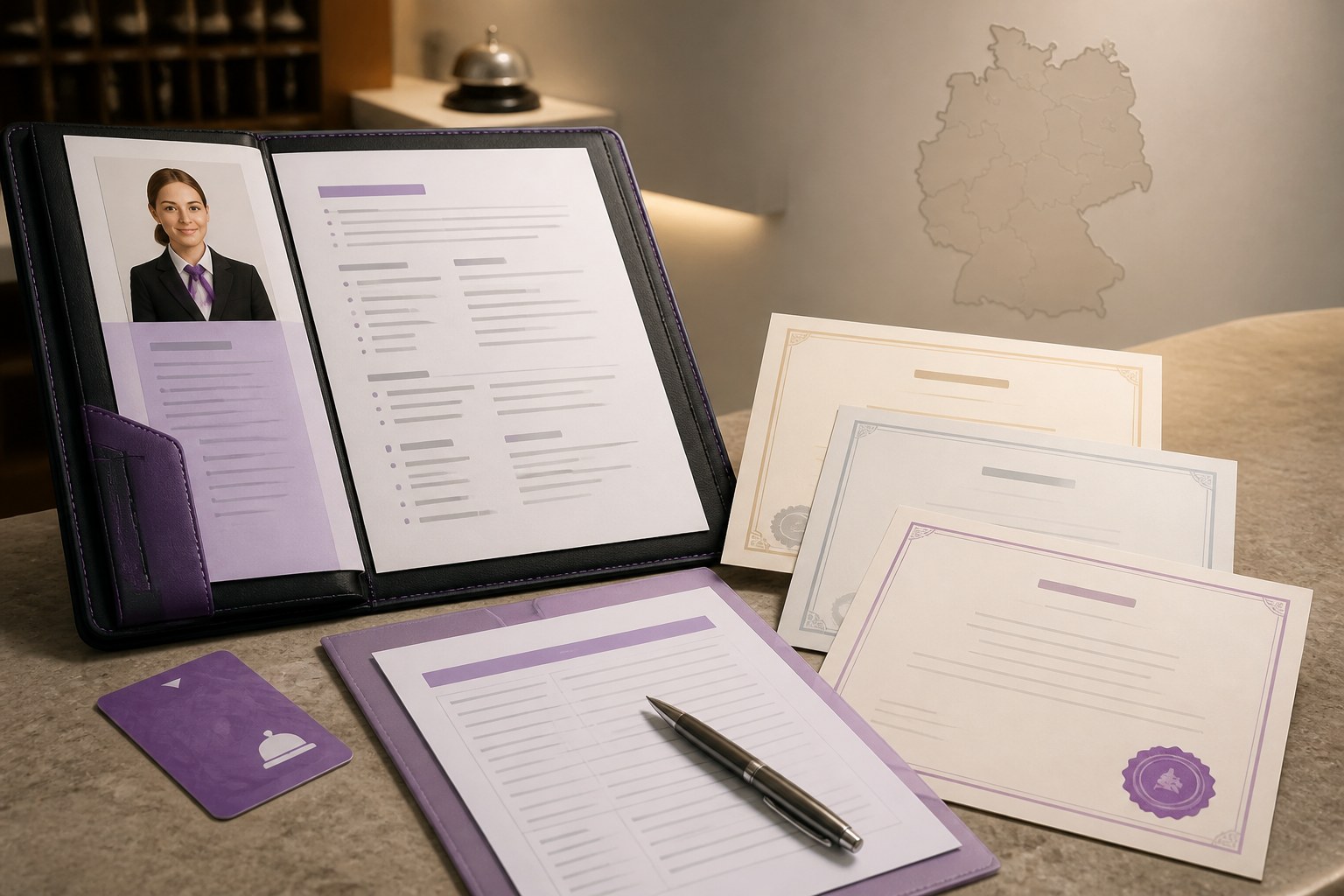
An initial professional review is easier when your documents are complete, readable and logically organized. Prepare an English or German CV that presents your experience in reverse chronological order or another clear structure. Use consistent dates and identify each employer, position and main responsibility.
Your document file should include relevant education and training certificates, evidence of employment or professional experience, language evidence and identity-related documents required for the relevant application process. Employment references, service letters or other evidence of experience help clarify what you actually did in previous roles.
Your CV should include contact details, education, work history, language skills and relevant technical abilities. For every hospitality position, state the type of environment, the period of employment and the tasks you performed. Mention reservation systems, guest communication, payment handling, complaint management and cooperation with housekeeping or other departments when these duties formed part of your work.
Foreign-language certificates may require translation into German or English depending on the procedure. Whether a translation must be certified or follow another formal requirement depends on the relevant process. Keep both the original document and the translation available, and do not alter names, dates or qualification titles.
A photograph is not a general requirement for an application. Focus first on accurate information, a clear structure and evidence that directly explains your hotel reception experience. Review every document for inconsistent spelling, unexplained employment gaps and translation errors before submitting it.
Hotel Receptionist Applicant Preparation Overview
Application area
What to prepare
What your profile should show
Professional experience
A dated work history with employers, positions and responsibilities
Experience with guest contact, reception tasks, reservations or related service work
Education and certificates
Hospitality, hotel, tourism or other relevant training documents
The qualification title, institution, dates and practical relevance
German and other languages
Language evidence and CEFR levels such as A2, B1, B2 or C1 where available
Your ability to communicate with guests, use the telephone and coordinate at work
Guest-service skills
Examples of welcoming guests, answering questions and handling problems
Clear communication, reliability, organization and calm problem-solving
Mobility and documents
CV, employment evidence, translations where relevant and identity-related documents
Readiness to consider opportunities throughout Germany and provide complete information
How to Present Your Hotel Receptionist Profile
An initiative application through East Talent is an application for employment opportunities in your occupational group, not for a named hotel position or a specific employer. The purpose of your profile is to show whether your qualifications, experience, language skills and documents support professional consideration for hotel reception work in Germany.
Start with a precise professional summary. State your years of relevant experience only when the dates in your work history support the statement. Identify the environments in which you worked, such as hotels, guest accommodation, tourism services or related hospitality settings.
Describe responsibilities with action-based detail. For example, explain whether you welcomed guests, processed arrivals and departures, managed reservations, answered calls, handled payment procedures, recorded complaints or coordinated room-related requests. Avoid copying a generic list of duties that does not reflect your own experience.
Include the systems and tools you have actually used. Name reservation or front-office software only when you can explain your level of experience. If you worked with cash registers, payment terminals, booking platforms or internal communication systems, describe the task and your responsibility accurately.
State your German and other language skills with CEFR levels where available and add practical context. Also explain your readiness to work throughout Germany. Applicants must remain open to employment opportunities across Germany rather than limiting their profile to one preferred city or region.
East Talent reviews the professional information and documents provided by applicants. Suitable candidates may subsequently be introduced to companies whose needs match the candidate profile. The initial application should therefore present your occupational group clearly without claiming experience, qualifications or language ability that you do not possess.
Working Conditions You Should Understand
Hotel reception is a guest-facing service role carried out in an operational environment. You coordinate with housekeeping and other departments, follow established service procedures and respond to changing guest needs. The work requires attention during direct conversations as well as during administrative tasks behind the desk.
Hotel operations involve working patterns that reflect guest arrivals, departures and service coverage. Discuss the expected schedule and responsibilities before accepting an employment offer. Your understanding should include the workplace, duties, working time and any arrangements affecting daily organization.
Before accepting an offer, review the employment contract carefully. It should provide information about the contracting parties, the start date, any fixed term, the probationary period, the workplace, the position, remuneration, working time, leave and notice periods. Additional provisions may arise from collective agreements or workplace agreements where they apply.
Pay attention to the difference between gross and net pay. Gross pay is the amount agreed before deductions. Taxes and social-security contributions reduce the amount paid to you, and the resulting net amount depends on your individual circumstances. Additional payments or premiums depend on the employment relationship and applicable arrangements.
Your practical budget should be based on the amount you actually receive, not only on the gross figure. When moving to Germany, rent, a deposit, travel and other living costs affect the money available after employment-related deductions. Check the full financial situation before making relocation decisions.
The following overview helps you prepare the evidence most relevant to an initial review:
Preparing to Work in Germany
International applicants should create one orderly document file before beginning an application. Keep your CV, certificates, employment evidence, language records and identity documents together, using clear file names and consistent personal details. This reduces delays caused by missing or contradictory information.
Understand your professional profile separately from your immigration position. Recognition concerns the assessment of a foreign qualification. Residence and employment requirements concern whether you are permitted to enter, stay and work under the rules applicable to your individual situation. These areas are connected in practice but they are not the same decision.
Do not assume that a non-regulated occupation removes every qualification or related to working in Germany requirement. The relevant conditions depend on the applicant’s circumstances and the applicable process. Obtain individual information from the responsible official sources when residence or employment authorization becomes relevant.
Prepare to explain your work history clearly in English or German. Be ready to discuss guest service, reservations, computer systems, communication, complaint handling and shift experience. Language practice should focus on real reception situations rather than only general vocabulary.
Applicants must remain open to employment opportunities throughout Germany. A nationwide profile gives professional reviewers a more accurate basis for considering suitable opportunities and avoids presenting a location preference as a guaranteed placement.
A Practical Checklist Before You Apply
Use this checklist before submitting your initiative application:
• Prepare a clear English or German CV with consistent dates, employers, positions and responsibilities.
• Describe hotel, tourism, hospitality or related customer-service experience accurately.
• Explain your reception duties, including guest contact, reservations, telephone work, problem-solving and department coordination where applicable.
• List German and other languages separately and document CEFR levels such as A2, B1, B2 or C1 when evidence is available.
• Organize education and training certificates, employment evidence, language records and relevant identity documents.
• Check whether foreign-language certificates need translation for the relevant procedure.
• Keep descriptions truthful and avoid claiming systems, payment duties or supervisory responsibility that you did not perform.
• Remain open to employment opportunities throughout Germany.
• Be ready to provide further documents or clarify your professional history during the review.
A well-prepared profile gives reviewers a practical picture of your suitability for hotel reception work. It also helps you identify missing evidence before professional discussions and later employment steps.
Create your profile
Registration with East Talent
Four short steps. A CV is optional and can be provided in your native language.
Step 1 of 4Profession
East Talent
International recruitment with proprietary software
East Talent combines international recruitment with structured digital processes for handling candidate profiles, attracting employers and evaluating job opportunities.