Working as a Plumber or Sheet-Metal Worker in Germany
Plumber and sheet-metal worker jobs in Germany are suitable for applicants with practical trade experience, technical understanding and clearly documented vocational skills. These occupations involve work with pipe systems, fittings, metal components, ventilation-related structures and technical installations in construction and other working environments.
This article helps you prepare an application for employment opportunities in your professional field. You are not applying for a specific advertised position or a named employer at this stage. East Talent reviews your professional background, experience, German skills and supporting documents before suitable candidates are considered for employment opportunities.
Applicants must remain open to opportunities throughout Germany. Limiting your profile to one city or region reduces the range of employment opportunities considered. A complete and accurate professional profile gives your experience the clearest basis for assessment.
Your professional field should be stated precisely. Plumbing experience, sheet-metal experience and combined experience with both trades represent different strengths within the technical construction sector. A clear description helps distinguish installation work from repair, maintenance, fabrication and assembly activities.
The quality of your application depends on evidence rather than on a job title alone. Certificates, employment records, practical task descriptions and language information create a complete picture of your background. Prepare these details before submitting your application so that your experience is easy to understand and verify.
What These Skilled Trades Involve
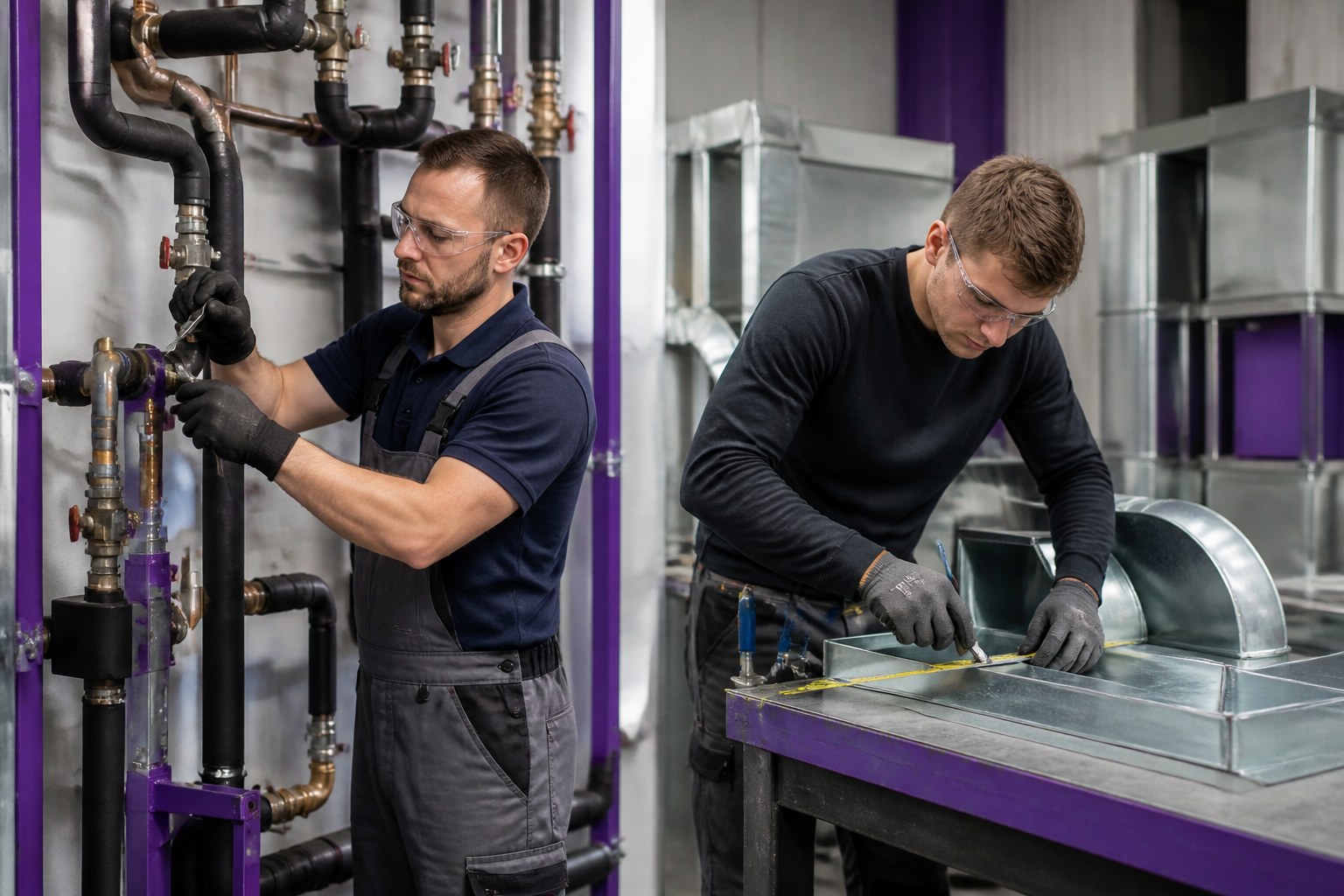
Plumbing work focuses on installing, maintaining and repairing pipe systems and related technical components. Depending on the professional background, tasks include preparing pipes and fittings, connecting components, checking installations and carrying out repair or maintenance work. Accuracy matters because incorrectly fitted connections affect the function and safety of a technical system.
Sheet-metal work involves measuring, cutting, shaping and fitting metal components. Sheet-metal workers handle materials for technical structures and, depending on their experience, work with ductwork, protective coverings, fittings and other formed metal parts. Precise measurements and clean joints are central to the quality of the finished result.
The two occupations overlap in practical working environments, but they require different technical strengths. A plumber should present experience with pipe systems, fittings, installation and repair work. A sheet-metal worker should describe experience with measuring, forming, joining and fitting metal components. Applicants with experience in both areas should identify each area separately in their CV.
Both occupations involve practical work rather than purely theoretical activity. Tools, measurements, materials, installation plans, technical instructions and safe working methods form part of the daily professional environment. Your application should therefore show not only the job title you held but also the tasks you performed and the systems or materials you handled.
Plumbing tasks often require careful preparation before assembly begins. Measuring pipe lengths, selecting suitable fittings, preparing connection points and checking the finished installation all form part of reliable work. Describe the type of systems and components you handled when this information belongs to your professional history.
Sheet-metal tasks also depend on a sequence of accurate manual operations. The material must be measured, marked, cut or formed and then fitted to the intended structure. Information about materials, forming methods, joining techniques and the use of measuring tools gives your practical experience more value than a general statement such as “metalwork experience.”
Your previous working environment also provides useful context. State whether your work took place in workshops, on construction sites, in industrial facilities or during maintenance assignments when these details accurately describe your experience. This information helps reviewers understand the conditions in which you developed your skills.
Qualifications and Experience Applicants Should Prepare
A vocational qualification or comparable professional training provides an important foundation for your candidate profile. Include the name of your training, the institution, the period of training and the qualification awarded. If your education followed a different structure, describe the content and practical focus clearly rather than relying only on a translated job title.
Relevant practical experience strengthens your profile. State the employers, positions, dates and main responsibilities for each period of employment. For plumbing-related work, describe installation, maintenance, repair, pipe preparation, connections and technical checks when these tasks formed part of your work. For sheet-metal work, describe measuring, cutting, bending, forming, joining and fitting activities when applicable.
Technical understanding is important in both fields. Your profile should identify the materials, tools, equipment and types of installation you have handled. Mention experience with technical drawings, measurements, assembly instructions or quality checks when these activities belong to your professional history. Do not list skills that you have not used in practice.
Safe working practices also belong in a complete professional profile. Describe the safety procedures and protective equipment used in your previous work without claiming certificates or authorisations that you do not hold. Clear information about your practical responsibilities allows your background to be assessed more accurately.
The table below provides a preparation overview for the main parts of your application.
When describing qualifications, use the original name of the certificate as well as a clear English explanation where appropriate. This approach avoids confusion when the original professional designation does not have a direct equivalent. Include information about the duration and practical content of training if those details appear in your records.
Experience with tools and materials deserves specific attention. For example, identify the types of pipe, fittings, sheet metal, ductwork or joining methods you used. The description must remain factual and correspond with your employment records. Detailed but accurate information gives your professional profile a stronger basis than broad claims about all types of trade work.
Relevant technical drawings and written instructions also belong in your application. Explain whether you read, interpreted or worked from such documents, and distinguish this from experience with measurement or inspection only. This distinction helps present your actual level of responsibility clearly.
Applicant Preparation Overview
Preparation area
What to document
Why it matters for your application
Professional qualification
Training certificates, vocational education and relevant technical qualifications
Shows the foundation of your professional profile and supports any recognition assessment
Work experience
Employers, positions, dates, duties and practical experience in plumbing or sheet-metal work
Allows your technical background and responsibilities to be assessed clearly
Language and application documents
German skills, CV, certificates and relevant supporting records
Supports communication, document review and preparation for employment in Germany
German Skills and Supporting Documents
German skills form part of your candidate profile. They support communication with colleagues, understanding of work instructions, coordination on construction or technical sites and correct response to safety information. Enter your German level accurately. If you have a recognised language result, state the level using the Common European Framework of Reference for Languages, such as A2, B1, B2 or C1.
Your application should include a clear CV with personal details, education, employment history, technical skills and language information. Present employment history in reverse chronological order or another consistent structure. Each entry should show the employer, position, dates and practical duties.
Prepare vocational certificates, training records and relevant school or education documents. Important certificates support the assessment of your professional background and provide evidence for recognition procedures where recognition is relevant to your case. Keep copies of the original documents and organise them in a logical order.
Documents issued in another language may require a German or English translation for a particular procedure. Whether a certified or otherwise formalised translation is required depends on the relevant procedure. Do not assume that one translation format applies to every document or every application.
A professional application is accurate and consistent. The dates in your CV should match the dates shown on certificates and employment records. If a period contains training, temporary work or a career break, identify it clearly instead of leaving unexplained gaps.
German language ability also affects practical workplace communication. Applicants should describe whether they use German in conversations, written instructions, technical explanations or safety-related situations. A certificate provides useful evidence, while an honest description of actual communication ability gives additional context.
Organise documents so that a reviewer can follow your professional development without searching through unrelated files. A sensible order is the CV, qualification records, employment evidence, language evidence and other supporting documents. Use clear file names and check that scans are complete and readable.
Do not replace missing evidence with unsupported statements. If an employment record or certificate is unavailable, explain the situation clearly and provide the documents that exist. Accurate disclosure is more useful than a complete-looking file containing information that cannot be verified.
How Recognition of a Foreign Qualification Fits In
A competent authority examines whether a foreign vocational qualification matches the relevant German reference occupation. The assessment compares the content and level of the foreign qualification with the professional requirements of that reference occupation. The result depends on the qualification and the documents submitted.
For non-regulated occupations, formal German professional recognition is not required in the same way as it is for regulated professions. Plumbing and sheet-metal work must nevertheless be assessed in the context of the specific professional activity and the purpose for which recognition is being requested. The absence of a general professional licensing requirement does not automatically remove qualification-document requirements connected with rules for working in Germany or another formal procedure.
Recognition and employment-related requirements are separate matters. A recognition decision does not itself determine every residence or employment requirement, and requirements for working in Germany must be checked separately for your personal situation. Avoid treating a recognition result as a complete immigration decision.
Complete documentation supports the assessment. Provide certificates, training records, employment evidence and translations where the relevant procedure requires them. Missing or unclear documents make it harder to establish the content and duration of your training and experience.
If substantial differences are identified, the result may include partial recognition or no recognition for a non-regulated occupation. Depending on the case, an adaptation qualification or another specified qualification measure addresses identified differences. The competent authority determines the applicable outcome based on the submitted evidence.
The authority assesses the evidence submitted for your own qualification. A translated job title does not replace the underlying training documents, and employment experience does not automatically change the content of a vocational qualification. Submit both types of evidence when they are available so that training and professional practice remain distinguishable.
Keep all correspondence and decisions together after a recognition procedure begins. Record the date of any submission and retain copies of documents sent to the authority. This organisation supports later communication and prevents important information from being lost among unrelated application files.
The recognition result should be read together with the documents and reasoning issued by the competent authority. If the decision identifies differences or requests additional evidence, follow the stated instructions and keep proof of any further submission. Do not describe a qualification as fully recognised unless the official result supports that description.
What to Check Before Accepting Employment
Before accepting employment, read the written employment contract carefully. It should identify the contracting parties, the start date, any fixed term, the probationary period, the workplace, the duties, the remuneration, working time, holiday entitlement and notice periods. These details define important parts of your working relationship.
Check that the professional duties described in the contract correspond with the experience and qualifications presented in your application. A plumber should understand whether the duties focus on installation, maintenance, repair or related technical work. A sheet-metal worker should identify whether the work concerns forming, fitting, ductwork, coverings or other metalwork tasks.
Remuneration is normally stated as gross pay. Net pay is the amount remaining after the applicable tax and social-security deductions. The net amount therefore differs from the gross amount and depends on your individual tax and social-security circumstances. Do not calculate your available income from gross pay alone.
Social insurance in Germany includes health, long-term care, pension, accident and unemployment insurance. For social-insurance-covered employment, registration is generally handled through the employer. Contractual or collectively agreed rules may also affect pay, working time, holiday entitlement or additional payments.
Review the workplace and working-time provisions carefully. Plumbing and sheet-metal work often takes place in practical technical environments, so the contract should provide a clear description of the workplace and duties. Keep a copy of the signed contract and ask for clarification before signing any provision you do not understand.
The workplace description is especially relevant when your professional background covers several activities. Clarify whether the role involves workshop fabrication, installation at construction sites, maintenance visits or a combination of these tasks. The working environment affects the tools, protective equipment and daily responsibilities involved.
Consider the practical financial effect of employment in Germany when reviewing remuneration. Gross pay does not show the amount available after deductions, accommodation, transport and other living costs. A realistic budget should include recurring expenses as well as initial costs connected with relocation and settling in.
Never sign a document that contains terms you do not understand. Ask for an explanation of unclear duties, working-time arrangements, deductions or notice provisions and keep the final signed version for your records.
How to Present Your Experience Professionally
Your CV should make your practical experience easy to assess. For every relevant position, state the employer, job title, start and end dates and the main tasks. Use specific descriptions such as installing pipe connections, maintaining technical systems, measuring sheet metal, forming components or fitting ductwork when those activities accurately describe your work.
Separate professional skills from general statements. Instead of writing only “experienced tradesperson,” identify the materials, tools, systems and tasks you know. Include experience with measurements, technical drawings, assembly instructions, inspection work and maintenance only where your employment history supports those statements.
List your vocational education and certificates in a separate section. Include the original qualification name, issuing institution and completion date. Add relevant supplementary training, safety training or technical certificates when they directly relate to your professional activities.
Language information should be clear and realistic. State German and other relevant languages separately and identify a CEFR level where available. Do not claim a higher level than you can use in workplace communication. Practical language ability affects your understanding of instructions, coordination and safety communication.
Prepare digital copies of your CV, certificates, employment records and language evidence. Use consistent file names and check every document before submitting it. The East Talent candidate application should contain complete, accurate information about your plumbing or sheet-metal experience and professional preparation.
Use action-based descriptions that show what you actually did. “Prepared and connected pipe sections” provides more information than “worked with pipes.” Likewise, “measured and fitted ductwork components” identifies a practical responsibility more clearly than “sheet-metal experience.” Keep each statement concise and factual.
If your experience covers both trades, create separate subsections or clearly labelled bullet points. This prevents plumbing tasks from being mixed with sheet-metal tasks and makes your strongest area visible immediately. Include the duration of each relevant activity when your records support that information.
Review spelling, dates and technical terms before submission. A consistent CV communicates care and makes comparison with certificates and employment records easier. The final document should present your actual experience rather than a list of duties copied from a general occupation description.
Prepare for Opportunities Throughout Germany
Applicants should remain open to employment opportunities throughout Germany rather than limiting their profile to one preferred city or region. Openness to different locations gives your professional experience a broader basis for consideration and reflects the national scope of the candidate process.
Start by documenting your work history. Record every relevant employer, position, employment period and responsibility. Then organise vocational certificates, school or training records, language information and other supporting documents. If you have already started a recognition procedure, record its status and keep the available correspondence and decisions together.
Next, review your CV for consistency. Employment dates, qualification names and descriptions of duties should be accurate. Explain periods that are not covered by employment or training entries. A clear timeline helps the reviewer understand your professional development.
Finally, submit complete information through the East Talent application form. Your profile should show whether your main experience is in plumbing, sheet-metal work or both. It should also show your practical strengths, German skills, qualifications and readiness for employment opportunities throughout Germany.
Before submitting, compare your CV with every supporting document. Check names, dates, qualification titles and employer details. Correct inconsistencies before they create questions during the review. If information is uncertain, explain it instead of presenting an assumption as a fact.
Prepare to describe your practical work in clear terms. You should be able to explain the installations, materials, tools and responsibilities that shaped your experience. This preparation helps present your professional background consistently in written information and later communication.
Your openness to locations throughout Germany is an important part of the candidate profile. Do not limit the application to a single preferred area if you want the broadest consideration of your professional experience. Present your qualifications, experience and documents first, then evaluate employment details carefully when suitable opportunities are discussed.
Create your profile
Registration with East Talent
Four short steps. A CV is optional and can be provided in your native language.
Step 1 of 4Profession
East Talent
International recruitment with proprietary software
East Talent combines international recruitment with structured digital processes for handling candidate profiles, attracting employers and evaluating job opportunities.