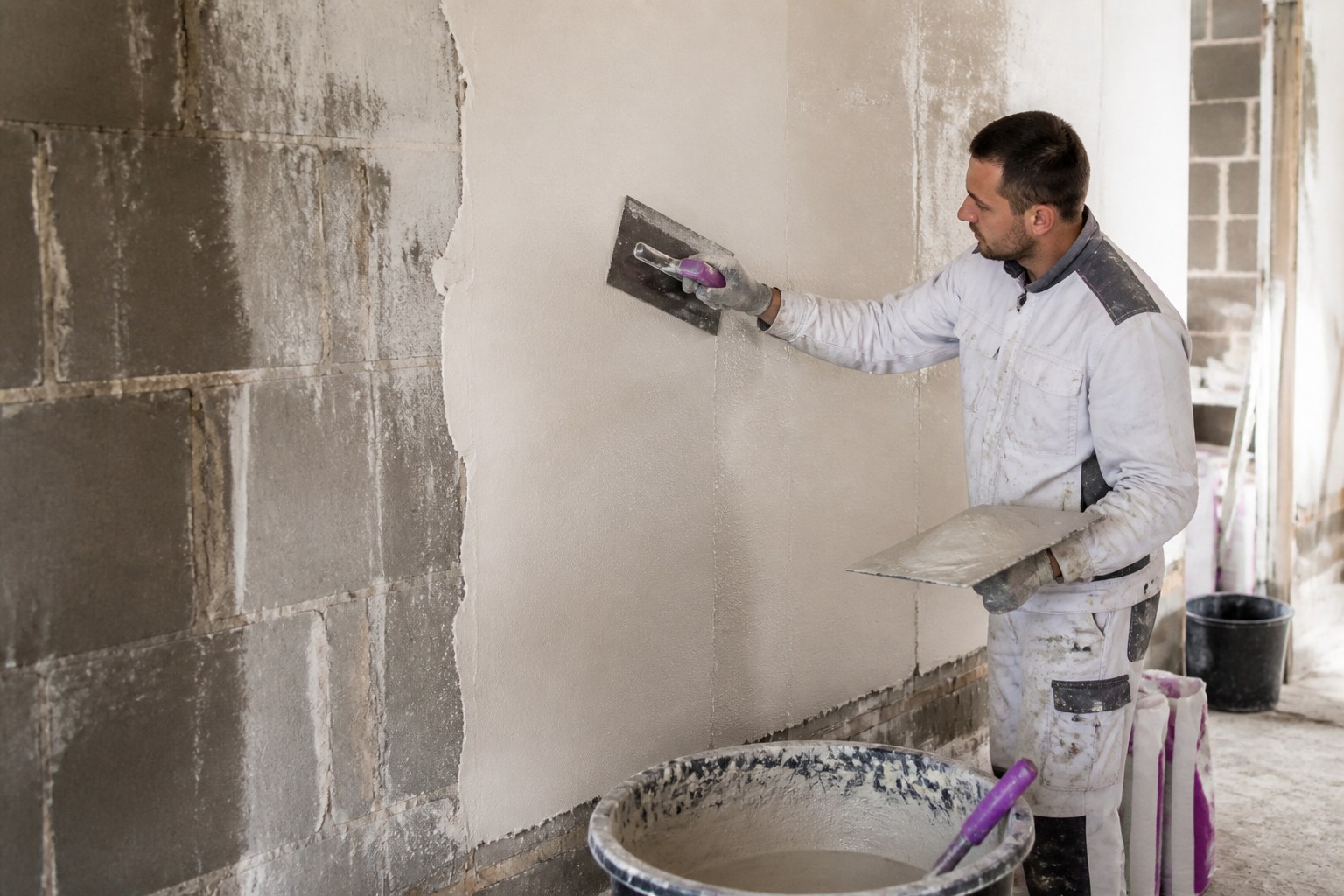
Plasterers and stucco workers prepare, coat and finish interior and exterior surfaces. Their work combines manual skill, material knowledge and close attention to the final appearance of walls and ceilings. Depending on the occupational profile, tasks include preparing substrates, mixing materials, applying plaster and creating smooth, textured or decorative finishes.
Surface preparation is a central part of the job. A plasterer checks whether a surface is clean, stable and suitable for the planned coating. Dust, loose material, uneven areas and other defects require appropriate preparation before plaster or stucco is applied. Good preparation supports adhesion and reduces visible defects in the finished surface.
Preparation also includes protecting areas that should remain clean and organising the work so that materials and tools are available at the correct stage. A worker assesses the condition of the substrate before beginning the application instead of covering defects without addressing them. This practical judgement is important in renovation work as well as in new construction.
The application stage requires controlled movements and consistent thickness. Workers use tools such as trowels, floats, straightedges and other hand tools to spread and level material. Finishing work includes smoothing surfaces, forming edges, correcting irregularities and checking whether the result meets the required standard.
Different surfaces require different working methods. Walls, ceilings, corners, reveals and repaired areas each present their own technical challenges. Applicants should therefore describe the range of surfaces they have worked on and explain whether their experience focused on rough plaster, fine plaster, repair work, decorative finishes or several of these areas.
Plasterers and stucco workers also coordinate their work with other construction activities. They keep work areas orderly, protect completed surfaces and communicate about the condition of substrates, materials and defects. Applicants should therefore present both their practical craft experience and the types of surfaces and finishing work they have handled.
The finished result is judged through visible quality as well as through the durability of the work. Straight lines, clean transitions, even textures and properly finished corners show the worker's level of care. A strong application explains how these results were achieved rather than describing the occupation only with a general construction job title.
Qualifications and Experience That Strengthen Your Profile
A completed vocational qualification in plastering, stucco work, finishing or a related construction occupation strengthens an application profile. Training provides evidence of structured technical preparation and helps explain which methods, materials and tools a candidate has learned to use.
Practical experience is equally important for this occupational group. Your application should describe the type of work you performed, the surfaces you treated, the materials you used and the degree of responsibility you held. A short job title alone does not show the full value of your experience.
Describe your employment history with the employer, position, period of employment and main responsibilities. Include work involving interior plaster, exterior surfaces, repairs, decorative finishes, insulation-related surface work or other relevant activities when these form part of your professional background.
Reliable workmanship is a significant part of a strong profile. Employers need workers who follow the planned procedure, maintain consistent quality and complete tasks carefully. East Talent reviews qualifications, professional experience, German skills and supporting documents when assessing candidates for this occupational group.
If your professional background includes several construction occupations, explain the proportion of your work devoted to plastering and stucco. This helps distinguish primary craft experience from occasional related tasks. Also state whether you worked independently, followed detailed instructions or supervised parts of a project.
Experience with renovation and repair work deserves particular attention because these tasks require assessment of existing surfaces. Explain how you removed loose material, repaired defects, prepared old substrates or matched new finishes with surrounding areas. Such descriptions make your practical experience easier to evaluate.
Your profile becomes stronger when your qualifications and work history support each other. A certificate without practical detail gives limited information about your current abilities, while work experience without supporting evidence leaves the background less clearly documented. Present both elements together and explain any gaps or changes in your occupational history accurately.
Skills Relevant to Plastering and Stucco Work
Strong plasterer and stucco worker profiles combine technical ability with dependable work habits. Surface preparation requires careful observation: you need to identify unevenness, weak areas, moisture-related concerns or contamination before applying a new layer. The application itself requires control of pressure, material quantity and working speed.
Material knowledge supports better decisions during daily work. Candidates should be able to explain which plastering or finishing materials they have used and which tools they handled. Experience with mixing, application, smoothing, texturing, edging and repair work gives recruiters a clearer picture of your professional range.
Accuracy matters at every stage. Straight edges, clean transitions, even surfaces and consistent finishing quality are visible results of careful work. Applicants should describe tasks that demonstrate precision rather than relying only on general statements such as “construction work” or “wall work.”
Basic technical information is also relevant. Workers need to understand instructions, measurements, material information and task sequences. Safe handling of tools and materials, awareness of the work environment and cooperation with colleagues support reliable performance on construction sites.
Physical reliability is part of the practical demands of this occupation. Plastering work involves standing, reaching, carrying materials and repeated manual movements. State your experience accurately and avoid presenting skills that you have not actually developed.
Problem-solving is another relevant skill. Surfaces are not always uniform, and previously completed work may contain cracks, weak sections or differences in texture. Explain how you identified problems, selected a suitable repair method and checked the result after completing the work.
Applicants should also distinguish between skills they perform independently and tasks carried out under supervision. This distinction gives a more accurate picture of responsibility and helps prevent misunderstandings during the assessment of your profile. Include experience with measuring, material preparation, tool maintenance, cleaning and final inspection where these tasks formed part of your work.
German Language Skills and Workplace Communication
German is relevant to plastering and stucco work because daily tasks involve coordination, instructions and safety communication. You need to understand information about surfaces, materials, work sequences and quality corrections. Communication with colleagues also helps prevent mistakes when several trades work in the same area.
Language skills are part of your candidate profile, not a condition taken from an invented vacancy. Record your German level accurately and distinguish between general language ability and practical workplace communication. If you understand spoken instructions well but still need practice with technical vocabulary, describe this honestly.
Where applicable, document your level using the Common European Framework of Reference for Languages, such as A2, B1, B2 or C1. Language certificates provide supporting evidence, while your practical ability to understand instructions and discuss work remains important.
Prepare vocabulary related to surfaces, measurements, tools, defects, protective equipment and materials. This preparation helps you explain your experience and communicate more precisely during professional discussions.
Workplace communication also includes confirming instructions, reporting a defect and asking for clarification when a task is unclear. A candidate who communicates early about an uneven substrate or missing material supports both quality and safe coordination. These communication habits are relevant even when practical craft skills are strong.
Include any language course or certificate in your documents, but do not use a certificate to describe abilities that you do not yet possess. A realistic account of speaking, listening, reading and technical vocabulary gives a more useful picture of your readiness for professional work in Germany.
Recognition of Foreign Qualifications
Plastering and stucco work must be assessed in the context of the relevant German occupational profile. Regulated professions are legally protected and require the relevant professional recognition or licence for professional practice. Non-regulated professions are not protected in the same way.
For a non-regulated occupation, formal German professional recognition is generally not required to work in the occupation. This does not automatically remove the importance of qualification documents. Evidence of training and experience remains relevant when your professional profile is assessed, and related to working in Germany requirements must be examined separately.
During an official recognition procedure, the competent authority compares a foreign qualification with the relevant German reference occupation. The result for a non-regulated profession may be full recognition, partial recognition or no recognition. Where substantial differences exist, an adjustment qualification or another recognised qualification measure addresses those differences in cases where this route applies.
Keep recognition questions separate from residence questions. A professional recognition result and an immigration or residence decision are different matters. Your documents should therefore show your training, experience and identity clearly so that the relevant assessment is based on complete information.
The authority needs a clear connection between the qualification presented and the occupation being assessed. Certificates should therefore be accompanied by understandable information about the training programme, duration and professional focus when those details are available. Employment evidence adds context by showing how the qualification was used in practice.
Recognition documentation does not replace a detailed candidate profile. Even when a qualification is assessed, practical experience, current technical abilities and German communication remain important parts of preparation for employment. Keep records of later training and relevant work experience so that your professional development is visible.
Applicant Preparation Checklist for Plasterer and Stucco Worker Jobs
Preparation area
What to provide or explain
Why it matters for your application
Professional experience
Employers, positions, periods of employment and plastering or stucco tasks
Shows the depth and practical focus of your construction experience
Training and qualifications
Vocational certificates, training records and relevant education
Supports your description of professional preparation
Technical skills and tasks
Surface preparation, material application, smoothing, finishing, repairs and tool use
Helps assess the type of work you perform and your technical range
German language skills
Accurate language level and workplace communication abilities
Shows how you handle instructions, coordination and technical discussions
Supporting documents
Readable certificates, employment evidence, language records and required translations
Provides a reliable basis for reviewing your candidate profile
Documents to Prepare for Your Application
A clear CV is the core document for an application as a plasterer or stucco worker. Present your personal details, education, professional experience, language skills and relevant technical abilities in a structured format. Make the main plastering and stucco activities easy to identify.
Your employment history should include employers, positions, periods of employment and responsibilities. Explain whether you prepared substrates, mixed materials, applied plaster, completed decorative work, repaired surfaces or checked finishing quality. Specific task descriptions give your experience more value than unexplained job titles.
Organise vocational certificates, training records and relevant school or university certificates. Important certificates support your description of professional preparation. If documents are issued in another language, translations into German or English become relevant where the particular procedure requires them. A certified or otherwise formalised translation is not universally required for every application.
Language certificates should be included when available, together with an accurate statement of your current German ability. A cover letter or motivation letter may form part of an application process, but it is not a universal requirement. An application photograph is also not a general obligation.
Keep digital scans and readable copies of your documents. Check that names, dates and employment periods are consistent across your CV, certificates and other records. Incomplete or contradictory information makes it harder to assess your professional profile.
Employment references, project records or other evidence of completed work provide useful context when they are available and authentic. Do not submit documents that exaggerate your responsibilities or technical abilities. If an employment period cannot be documented, explain the period clearly instead of leaving unexplained gaps.
Use clear file names and organise documents in a logical order. A reviewer should identify your CV, qualifications, employment evidence and language records without searching through unrelated files. This simple preparation improves the readability of your application and supports an efficient review.
Working Conditions and Contract Details to Understand
Before accepting employment, read the employment contract carefully. It should identify the contracting parties and provide information about the start date, any fixed term, probationary period, workplace, duties, pay, working time, leave and notice periods.
Pay is normally stated as a gross amount. Gross pay is not the same as the net amount transferred to your account. Taxes and social insurance contributions affect the amount paid out, and the exact result depends on your personal circumstances. Ask for clarification when contract wording, supplements or bonuses are unclear.
The contract should also make your duties understandable. Check whether the described work matches your plastering and stucco experience and whether the workplace and working arrangements are clearly stated. Collective agreements or company agreements may contain additional provisions on pay, working time or leave.
Working conditions in construction require attention to tools, materials, protective measures and coordination with other workers. Discuss practical questions through the appropriate employment process and keep copies of documents you sign.
Applicants must remain open to employment opportunities throughout Germany. East Talent does not limit the candidate profile to one preferred city or region, so geographic flexibility is part of preparing for possible employment in the country.
Construction work also involves practical planning around equipment, access to the work area, material delivery and coordination with other trades. Ask for explanations of unclear contract terms and record important information in writing. This approach helps you understand the employment relationship before work begins.
When comparing the gross amount with your expected available income, include the financial costs of living and relocating. Rent, deposits, travel and other living expenses affect the amount that remains available after employment-related deductions. A realistic assessment therefore considers the complete personal situation rather than the gross figure alone.
How to Prepare for Employment in Germany
Start by documenting your actual plastering and stucco experience. List the tasks you performed, the materials and tools you used, the surfaces you treated and the type of finishing work you completed. Include the duration and context of each important period of employment.
Next, organise certificates and supporting documents. Place vocational qualifications, employment evidence, language records and relevant school or university certificates in a logical order. Prepare translations when the relevant recognition or application procedure requires them, while avoiding unnecessary claims about certification.
Record your German language ability honestly and identify the workplace situations you already handle confidently. Improve vocabulary for tools, measurements, surfaces, defects, materials and safety instructions. This preparation supports both application communication and future workplace coordination.
Check recognition questions separately from related to working in Germany requirements. The appropriate authority assesses professional qualifications, while requirements for working in Germany follow their own rules. Treat both topics as separate preparation tasks.
Finally, submit a complete application profile for your occupational group rather than presenting only a short job title. East Talent reviews the information provided by candidates before suitable profiles are introduced to matching companies. Applicants should apply proactively and remain open to employment throughout Germany.
Prepare to explain one or two typical work processes in clear language. For example, describe how you inspect a substrate, prepare the surface, mix the material, apply the layer and check the finish. This shows practical understanding more effectively than a list of tools without context.
Before submitting your profile, review names, dates, contact details and document references. Make sure your stated German level matches your current ability and that every listed qualification is supported by an available document or a clear explanation. Accurate preparation creates a reliable basis for professional assessment.
Applying Through East Talent
Applicants use the East Talent application form to apply proactively for employment in their occupational group in Germany. This process is not an application for a specific advertised position or a named employer.
For plasterer and stucco worker profiles, the relevant information includes professional qualifications, practical experience, German language skills and supporting documents. Describe your craft experience in enough detail to show the type and quality of work you perform.
East Talent reviews the submitted profile and may introduce suitable candidates to matching companies in Germany. A complete and accurate application gives the assessment a reliable basis. Do not add skills, certificates or language levels that you cannot support.
Applicants must be open to jobs throughout Germany. State your professional strengths clearly, organise your documents and use the application form to present your experience as a plasterer or stucco worker.
Use the application to explain the work you perform best, the construction environments you know and the responsibilities you have held. Mention relevant experience with interior or exterior surfaces, repair work, decorative finishes and quality checks. This detail helps distinguish your professional focus from general construction experience.
The application is also the right place to present your language skills and document status accurately. If a qualification document, translation or language certificate is still being prepared, describe its status clearly rather than implying that the document already exists. Transparent information supports a more reliable assessment.
A strong submission combines technical detail with realistic expectations. Remain open to employment opportunities across Germany, keep your records available and respond clearly when further information about your qualifications or experience is requested.
Create your profile
Registration with East Talent
Four short steps. A CV is optional and can be provided in your native language.
Step 1 of 4Profession
East Talent
International recruitment with proprietary software
East Talent combines international recruitment with structured digital processes for handling candidate profiles, attracting employers and evaluating job opportunities.