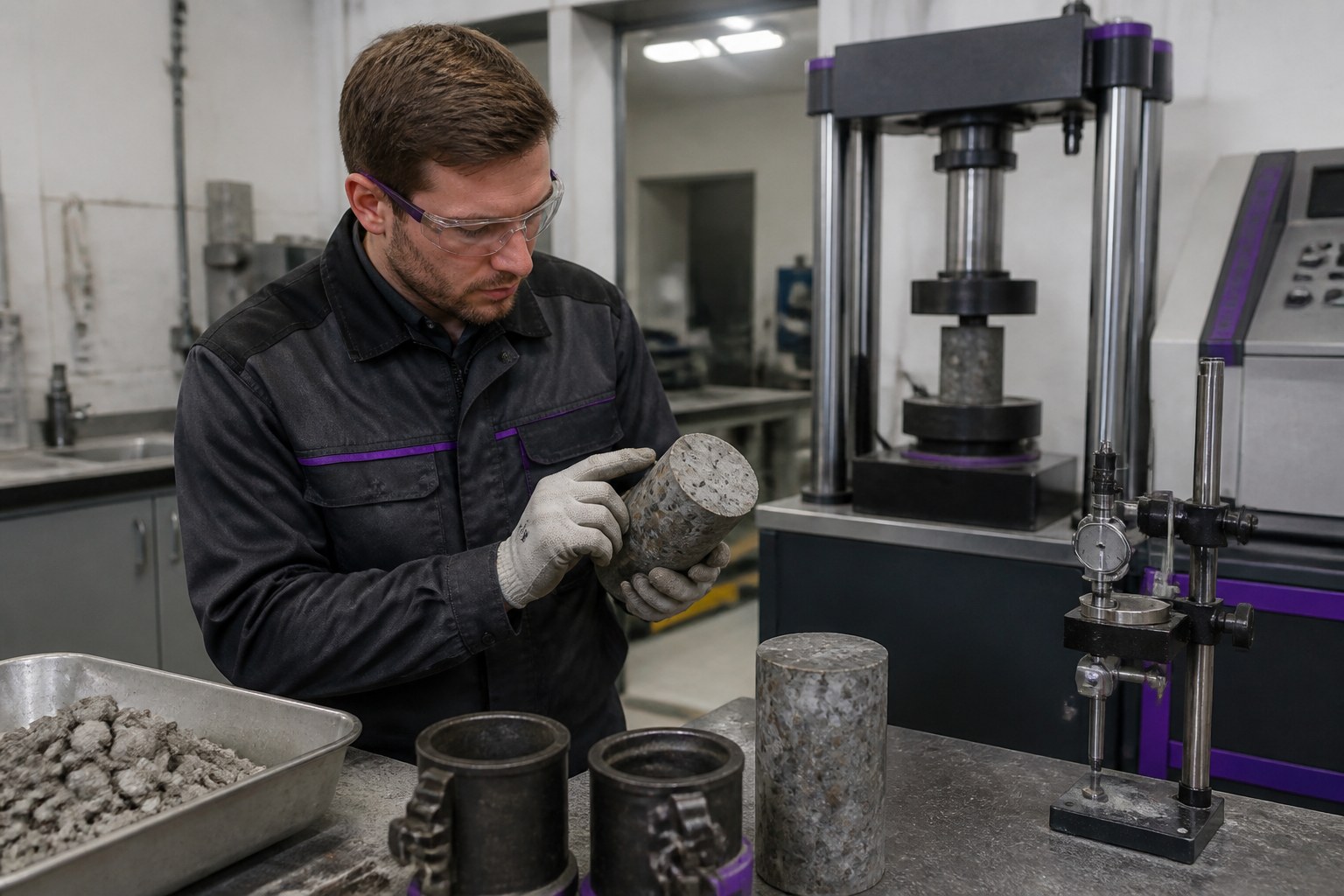
Construction materials testers examine materials used in building, civil engineering and infrastructure projects. Their work connects laboratory testing, quality control and practical construction processes. Depending on their professional background, they work with materials such as concrete, aggregates, asphalt, soil or other construction products.
Typical responsibilities include preparing samples, carrying out documented tests, recording observations and results, checking whether procedures are followed and communicating technical findings. The exact tasks differ between occupational profiles and workplaces, so your application should describe the work you have actually performed rather than relying on a broad job title.
A construction materials tester must work carefully because test results support decisions about material quality, production processes and construction work. Accurate sample identification, clean documentation and consistent procedures are therefore important parts of the professional profile. Your application should show how you handled these responsibilities in practice.
For applicants, the most important preparation areas are technical education, testing-related experience, knowledge of quality procedures, German skills and complete documentation. East Talent reviews these parts of your candidate profile before suitable candidates are presented to companies in Germany. The application is an initiative application for employment opportunities in your professional group, not an application for one named vacancy.
Applicants should also remain open to employment opportunities throughout Germany. This geographic flexibility gives your professional profile a broader basis and avoids limiting the assessment to one preferred city or region.
Which Qualifications Are Relevant
A relevant technical qualification gives your application a clear professional foundation. Depending on your background, this includes vocational training, technical education, laboratory-related studies, construction materials education or another documented qualification connected with construction, materials testing or quality control.
Present the exact name of your qualification, the institution where you obtained it, the period of study or training and the final certificate. If your education included subjects such as construction materials, laboratory methods, material properties, measurement, quality assurance or construction technology, list those subjects where they are relevant and documented.
Training content provides useful context for your professional profile. A certificate title alone often gives limited information about the practical and theoretical subjects covered. Detailed curricula, transcripts or training records clarify whether your education included laboratory procedures, testing methods, technical measurement, material behaviour and quality documentation.
There is no single qualification that defines every candidate in this occupational group. Some applicants build their profile through formal vocational training, while others have technical studies or practical experience supported by additional courses. Do not describe a short course as equivalent to a completed vocational qualification or degree. Accurate classification makes your profile easier to assess.
Keep original certificates and, where available, transcripts or detailed training records. Documents in another language may require translation for a particular procedure. Whether a certified or otherwise formal translation is required depends on the procedure and should not be assumed in advance.
If your qualification has several related components, organise them chronologically and explain their connection. This presentation helps reviewers distinguish basic education, specialist training and later professional development without overstating the level of any individual certificate.
Experience and Technical Skills Employers Review
Your practical experience should show what you tested, how you worked and which responsibilities you held. Describe construction-materials testing, laboratory work, site-based quality control, sample preparation, measurement, documentation and cooperation with technical teams when these activities form part of your background.
A clear employment history includes the employer, job title, dates and main duties for each relevant position. Explain the technical environment in which you worked. For example, distinguish between laboratory testing, production quality control, construction-site sampling and administrative documentation. These details provide more useful evidence than a general statement such as “responsible for quality.”
Mention the procedures and equipment you genuinely used, but do not add technical methods merely because they are common in the sector. Your CV should reflect your own experience with testing instruments, sample handling, result recording, internal quality procedures and reporting. If you worked under documented standards or company procedures, describe that fact without claiming responsibility for tasks you did not perform.
Explain the complete sequence of your work where relevant. This includes receiving or collecting a sample, identifying and preparing it, performing the assigned test, recording the result, checking the documentation and reporting an observation or deviation. A description of this sequence shows practical understanding more clearly than a list of equipment names.
Experience does not replace evidence of education or training. A strong candidate profile connects both: it shows the qualification behind your professional knowledge and the practical responsibilities that demonstrate how you applied it. Reference letters, employment certificates or other evidence of experience support this connection.
Accuracy is particularly important when describing technical responsibility. Separate tasks that you performed independently from tasks completed under supervision or as part of a team. This distinction gives reviewers a realistic picture of your experience and supports a reliable assessment of your professional level.
German Skills for Construction Materials Testing
German is part of your candidate profile because construction materials testing involves instructions, records, technical communication and workplace coordination. You need to present your actual German skills clearly and consistently in your CV and application.
Technical language matters alongside general communication. Relevant areas include understanding work instructions, recording test results, describing deviations, reading safety or process information and discussing findings with colleagues. The level of German you use in practice should match the evidence in your profile rather than an unsupported claim.
You may state language skills using the Common European Framework of Reference for Languages, such as A2, B1, B2 or C1, when you have a reliable basis for that description. Include certificates where available and distinguish between certified language knowledge and practical language experience.
Prepare technical vocabulary before applying. Useful subject areas include concrete, aggregates, asphalt, soil, samples, measurements, test results, deviations, equipment and quality procedures. Language preparation is stronger when it connects directly with your previous work instead of focusing only on general conversation.
Do not present one universal German level as a requirement for every construction materials tester candidate. Language expectations belong to the professional context and the candidate profile, not to an invented specific vacancy. Improving technical German before applying strengthens your ability to explain your experience and understand later workplace information.
Keep your language information consistent across your CV, certificates and application form. If your speaking, writing, reading and listening abilities differ, describe those differences accurately rather than using one broad statement that does not reflect your practical communication.
Recognition of Foreign Qualifications
Recognition of a foreign qualification and employment-related requirements are separate questions. Recognition examines whether a foreign professional qualification corresponds to a German reference qualification or whether substantial differences exist. Residence procedures involve their own requirements and should not be inferred from the recognition result.
Regulated professions are legally protected, and professional practice in those professions requires the relevant recognition or professional authorisation. Non-regulated professions are not legally protected in the same way. In a non-regulated profession, work is generally possible without formal German professional recognition, but qualification evidence still matters for employment or residence procedures.
The regulatory classification of a specific construction materials testing role depends on the actual professional activity and the applicable procedure. Do not assume that a job title alone decides the issue. Organise your certificates, detailed training information and employment evidence so the relevant authority or reviewing organisation has a reliable basis for assessment.
Where an authority identifies substantial differences, an adaptation qualification or another specified qualification measure addresses those differences, depending on the case. Recognition results must be assessed individually. A recognition procedure therefore does not guarantee a particular employment outcome or residence decision.
Prepare a complete file for any assessment. Include certificates, transcripts, course descriptions and evidence of professional experience where these documents are available. Consistent dates and job descriptions make it easier to connect your formal qualification with the work you performed after graduation.
If documents are missing, state that fact clearly and identify which evidence is unavailable. Replacing missing certificates with an unsupported description weakens the reliability of the application. A transparent explanation gives reviewers a better basis for deciding which additional information is necessary.
Construction Materials Tester Candidate Preparation Checklist
Profile area
What to document
Why it matters for your application
Qualification and training
Vocational training, technical education, studies, relevant courses and certificates connected with construction materials, laboratory work, testing or quality control
Shows the documented technical foundation of your professional profile
Testing-related experience
Employers, positions, dates, testing environments, materials handled, responsibilities, procedures and evidence of practical work
Makes your professional experience traceable and distinguishes actual responsibilities from general job titles
Language and application documents
German skills, clear CV, education certificates, employment evidence and relevant translations where required by the procedure
Helps reviewers assess communication ability, qualifications and the completeness of your application
Documents to Prepare for Your Application
Prepare your documents before submitting an initiative application. A clear CV should present your personal details, education, professional experience, language skills and relevant technical abilities. List employment history in reverse chronological order or another consistent structure that makes your career easy to follow.
Add certificates for vocational training, technical education, university studies and relevant courses. Include employment references, work certificates or other evidence that supports your construction-materials testing experience. If a document is unavailable, explain the situation accurately rather than replacing it with an unsupported statement.
Language information belongs in the CV and application. State the language, your level and the basis for the information. Keep translations together with the original documents when translations are available or required by the relevant procedure. Whether a translation must be certified depends on that procedure.
A professional application does not require a photograph as a general obligation. Focus first on complete, accurate and relevant information. Check that dates, job titles, qualifications and language information are consistent across your CV, certificates and other documents.
Use clear file names and a logical order for digital documents. A useful structure separates the CV, education certificates, employment evidence, language certificates and additional technical records. This organisation reduces confusion when several documents relate to the same period or qualification.
Your CV should also explain periods that are not immediately clear, such as longer training phases, changes between technical fields or gaps between positions. A short factual explanation is sufficient. The aim is to create a traceable professional history rather than a document that hides relevant information.
How to Present Your Testing Experience Clearly
Use specific descriptions instead of broad claims. State whether you worked in a laboratory, at a construction site, in production quality control or across several environments. Explain your role in sample collection, preparation, testing, measurement, documentation and reporting.
For every relevant position, record the employer, location, job title, employment dates and main responsibilities. Describe the materials and technical processes that were genuinely part of your work. If you supervised colleagues, trained others, checked records or communicated results, include those responsibilities with an accurate description of their scope.
Your profile should also explain the connection between your qualification and your experience. A certificate without practical context provides limited information, while an experience list without evidence of training leaves important questions unanswered. Present both parts as one coherent professional history.
Use measurable detail where it is already documented, such as the types of samples handled, the testing environment or the reporting process used. Do not invent quantities, performance results or levels of responsibility. Specific qualitative information provides value even when no numerical production data is available.
Complete and consistent information matters because East Talent reviews your qualifications, professional experience, German skills and required documents before presenting suitable candidates to companies in Germany. Candidates who are open to opportunities throughout Germany should state that availability clearly in their application.
Your professional positioning should remain broad enough to reflect your real experience. A candidate with both laboratory and site experience should show both areas instead of presenting only one narrow job title. This gives reviewers a more accurate basis for matching the profile with suitable employment opportunities.
What to Check Before Accepting Employment
When a suitable employment opportunity is presented, read the employment contract carefully before accepting it. The contract should identify the parties, the start date, any fixed term, the probationary period, the workplace, your duties, working hours, remuneration, holidays and termination rules.
Pay attention to the description of your professional duties. Confirm that the stated work corresponds with the construction materials testing profile you presented and that the workplace and reporting arrangements are clear. Ask for clarification about unfamiliar contractual wording before making a decision.
Remuneration is normally stated as gross pay. Gross pay is not the same as the amount transferred to your bank account because taxes and social insurance contributions are deducted according to your individual circumstances. Social insurance includes health, long-term care, pension, accident and unemployment insurance in the German system.
The statutory minimum holiday entitlement is 24 working days under a six-day working week, which corresponds to 20 working days under a five-day working week. An employment contract or collective agreement may provide more holiday. Working-time rules and the regular contractual working week are also separate matters, so review both the contract and the applicable rules.
If the workplace requires relocation, compare the gross remuneration with your expected living costs. Rent, a deposit, transport and everyday expenses affect the amount remaining after relocation. This calculation is personal and depends on the location, household situation and contractual income, so no universal net amount applies to every candidate.
Keep a copy of the contract and related written information. If a term is unclear, request an explanation before signing rather than relying on an informal promise. Clear written conditions help you compare the professional opportunity with your personal requirements and relocation plans.
Be Open to Jobs Throughout Germany
Applicants using the initiative application should remain open to employment opportunities throughout Germany. Do not build your entire plan around one preferred city or region unless you have a clear personal reason that you have already communicated. Geographic flexibility forms part of realistic preparation for employment in this occupational group.
A broader geographic profile does not mean accepting unclear conditions. You still need to understand the employer, workplace, duties, working hours, remuneration, holidays and other contractual terms before accepting employment. Location and employment quality are separate questions.
Plan the practical side of mobility as well. Relocation involves housing, a deposit, transport and other living costs, which affect the amount of money available after moving. Consider these expenses when evaluating an employment opportunity, without assuming a particular salary or location.
Consider how the location affects your daily journey, access to housing, transport connections and contact with essential services. These practical factors influence the real effort and cost of relocation. Preparing questions in advance helps you evaluate an opportunity without confusing geographic flexibility with unconditional acceptance.
Prepare a short explanation of your preferred working environment, technical strengths and geographic availability. This helps reviewers understand where your experience fits while keeping your profile open to suitable opportunities across Germany.
State any firm personal limits honestly, such as family responsibilities or a need for a particular type of workplace. Clear communication supports a realistic assessment while still allowing your profile to remain open to opportunities in different parts of Germany.
How to Prepare Your Candidate Profile
Start by documenting your technical education, vocational training, studies and relevant courses. Then describe your construction-materials testing experience with employers, dates, responsibilities, materials, testing environments and quality procedures. Keep every statement accurate and support important claims with certificates or evidence of experience.
Record your German skills clearly, organise education and employment documents, and prepare relevant translations where the procedure requires them. If you have questions about recognition, separate those questions from employment-related requirements and seek an assessment based on your individual documents.
Before submitting your initiative application, check that your CV, certificates, experience evidence and language information tell the same professional story. A complete profile gives East Talent a sound basis for reviewing your suitability for construction materials tester jobs in Germany.
Use a final checklist before sending your documents. Confirm that contact details are current, employment dates do not conflict, certificates are readable, language information is supported and your technical responsibilities are described precisely. Remove generic claims that you cannot support with experience or documentation.
Keep your profile updated when you complete additional training, gain new testing experience or improve your German skills. A current candidate profile presents your professional development more clearly than a document that reflects only an earlier stage of your career.
### Apply now
Apply for jobs in Germany through our application form.
Create your profile
Registration with East Talent
Four short steps. A CV is optional and can be provided in your native language.
Step 1 of 4Profession
East Talent
International recruitment with proprietary software
East Talent combines international recruitment with structured digital processes for handling candidate profiles, attracting employers and evaluating job opportunities.