Childcare work in Germany combines daily care, educational support, observation and cooperation with families and colleagues. The exact professional title and responsibilities depend on the childcare setting and the candidate’s qualification, but applicants need a clear profile that demonstrates relevant preparation for working with children.
This guide explains the main points to prepare before applying through a candidate profile: professional education, practical experience, German communication skills, qualification recognition, documents and employment conditions. It does not refer to a specific vacancy or employer. Applicants apply proactively for childcare employment opportunities and should remain open to positions throughout Germany.
A strong application shows more than an interest in children. It connects your training and experience with the responsibilities of childcare work and presents your documents in a clear, reliable format.
Typical Responsibilities in Childcare Work
Childcare professionals support children during everyday routines and create an environment in which children receive attentive supervision and age-appropriate encouragement. Daily work involves responding to individual needs, maintaining reliable routines and contributing to a safe and respectful atmosphere.
Relevant activities include supporting play, creative work, movement and learning activities. Professionals observe how children behave and develop, recognise changes in their needs and share relevant observations with colleagues. Depending on the setting and professional role, documentation forms part of the work because observations support communication and educational planning.
Cooperation is another important part of the professional profile. Childcare workers communicate with colleagues about routines, activities and observations. They also communicate with families in a professional and respectful manner. This requires patience, reliability and the ability to explain information clearly.
Applicants should describe the age groups and settings in which they have worked. Experience with daily routines, group activities, individual support, observation or communication with families gives a clearer picture of practical competence than a general statement that they enjoy working with children.
Which Qualifications and Experience Matter
The relevant professional profile begins with education and training. Applicants should name their childcare qualification, the institution where they completed it, the period of training and the main areas covered. School-based education, vocational training, higher education and additional professional courses should be presented accurately and in chronological order.
Practical experience complements formal training. A CV should identify the employer or organisation, the position, the employment period and the main duties. Describe the children’s age group, the type of care provided, educational activities, observation or documentation work and cooperation with families when these tasks formed part of your role.
Childcare roles do not all have the same professional or legal profile. A particular qualification is therefore not automatically a legal requirement for every activity involving children. The relevance of your education depends on the professional role, the duties and the applicable recognition or authorisation rules.
Experience does not replace accurate information about formal education. At the same time, a certificate alone does not show how you worked in practice. The strongest candidate profile presents both elements and explains how training was applied in real childcare situations.
Applicants should also identify additional knowledge that relates directly to childcare, such as educational methods, child development, first-aid training or experience with structured observation, but only when these statements are supported by actual training or work experience.
Why German Skills Matter in Childcare
German is part of the professional profile because childcare depends on continuous communication. Professionals need to understand instructions, explain routines to children and exchange information with colleagues. Clear communication also supports safe responses when a child needs help or when a daily situation changes.
Communication with families requires particular care. Families need understandable information about daily activities, observations and relevant events. Applicants should therefore present their German skills honestly and explain how they use German in professional or everyday situations.
Written communication also matters. Depending on the role, childcare professionals record observations, contribute to internal documentation or communicate information to colleagues. A candidate who can describe both spoken and written language ability gives a more complete picture of professional readiness.
Language skills should be listed in the CV using recognised levels such as A2, B1, B2 or C1 when an assessment or certificate supports that description. Do not claim a level that you cannot demonstrate. If your German is still developing, include current courses, completed examinations and practical experience using the language.
German skills do not stand alone. They work together with professional knowledge, patience and the ability to communicate with children at an age-appropriate level. The application should make this connection visible.
How to Prepare Foreign Childcare Qualifications
Applicants with qualifications from outside Germany need to establish which professional profile their education relates to and whether recognition or professional authorisation is relevant. The responsible authority depends on the profession and the applicable rules. Recognition should therefore be treated as a separate professional and administrative issue, not as an automatic result of submitting a CV.
German law distinguishes between regulated and non-regulated professions. Regulated professional activities generally require the relevant recognition or professional authorisation before the activity is performed in Germany. Non-regulated professions are not protected in the same way, so formal German recognition is not automatically required for every role. This distinction does not automatically remove qualification requirements for residence or employment purposes.
During a recognition procedure, the competent authority compares the foreign qualification with the corresponding German reference profession. It examines whether the qualifications are equivalent and whether substantial differences exist. Complete documentation is important because the authority assesses the submitted evidence rather than an incomplete description of the candidate’s background.
If substantial differences are identified, the applicable procedure may provide for an adaptation qualification or another compensatory measure. The result depends on the profession, the documents and the competent authority’s assessment. Applicants should keep official decisions and correspondence together with their certificates.
Prepare clear copies of diplomas, transcripts, training descriptions and employment evidence. If documents are not in German or English, a translation may be required or useful for the relevant procedure. Whether a certified or otherwise formalised translation is needed depends on that procedure and should not be assumed universally.
Childcare Candidate Profile: What to Prepare
Profile area
What to document
Why it matters for your application
Qualifications and training
Childcare diplomas, vocational or academic education, relevant courses and training periods
Shows your formal preparation and helps clarify which professional profile your education supports
Childcare experience and responsibilities
Employers or organisations, positions, dates, age groups, routines, activities, observation and family communication
Demonstrates how you have applied childcare knowledge in practical work
German skills and supporting documents
Language levels, certificates where available, employment references, qualification documents and required translations
Supports assessment of communication ability, experience and the evidence behind your professional profile
Documents to Prepare for Your Application
A well-organised application begins with a clear CV. Present your personal details, education, professional history, language skills and relevant additional abilities in a format that is easy to follow. Use consistent dates and avoid unexplained gaps where possible.
For each childcare position in your professional history, state the organisation, job title, start and end dates and main responsibilities. Replace broad descriptions such as “worked with children” with accurate details about age groups, daily routines, activities, observation, documentation and communication.
Education and training certificates help document your professional background. Include relevant school, vocational and higher-education qualifications, as well as additional courses that relate directly to childcare. Employment references or other evidence of experience provide further support for the duties listed in your CV.
Language evidence should be included when available. State the language, level and type of evidence, such as a completed course or examination. If certificates or references require translation, organise the original document and the translation together and follow the requirements of the relevant procedure.
An application may also include a motivation letter when the process requests one. It should explain your professional background, your interest in childcare work in Germany and the type of professional contribution you want to make. A photograph is not a general requirement for an application.
Do not submit documents with inconsistent names, dates or job titles. Accurate information helps the reviewing team understand your profile and reduces the need for clarification.
Working Conditions to Understand in Germany
Before accepting employment, applicants should understand the main terms of the actual employment contract. A contract should address the parties, start date, any fixed term, probationary period, place of work, duties, remuneration, working hours, holiday entitlement and notice periods.
Pay is normally stated as a gross amount. Taxes and social insurance contributions are deducted according to the individual circumstances of the employee, so the net amount paid into a bank account is not identical to the agreed gross amount. Applicants should use the contract and their personal circumstances as the basis for evaluating income.
Working hours depend on the employment relationship and applicable rules. The statutory working-time framework sets limits for daily working time, but these limits are not the same as the regular weekly hours agreed in a contract. Childcare work may also involve structured daily routines, preparation, documentation and cooperation outside direct activities with children.
Employees in Germany receive paid annual leave. The amount stated in the contract or an applicable collective agreement may exceed the statutory minimum. Social insurance in a social-insurance-covered employment relationship includes health, long-term care, pension, accident and unemployment insurance. Registration is generally handled through the employer.
When reviewing a contract, check whether the stated workplace, duties, hours, pay and holiday arrangements match the information presented during the employment process. Keep a copy of the signed documents and ask for clarification before signing anything that you do not understand.
How to Apply Through a Candidate Profile
East Talent’s candidate model is based on proactive applications for employment opportunities in Germany. You do not apply to a named vacancy or to a specific employer at this stage. Instead, you submit a professional profile for childcare employment, and suitable candidates may later be introduced to appropriate companies in Germany.
The information in your profile must therefore be complete and accurate. Include your childcare education, practical experience, duties, German skills and available documents. State clearly whether you have already started or completed a recognition procedure and provide supporting evidence where available.
Your application should reflect the professional group you want to join. If your experience covers several childcare settings or age groups, describe each area precisely. If your career includes other work, include it where it explains transferable responsibility, communication or organisational experience, but keep childcare-related information prominent.
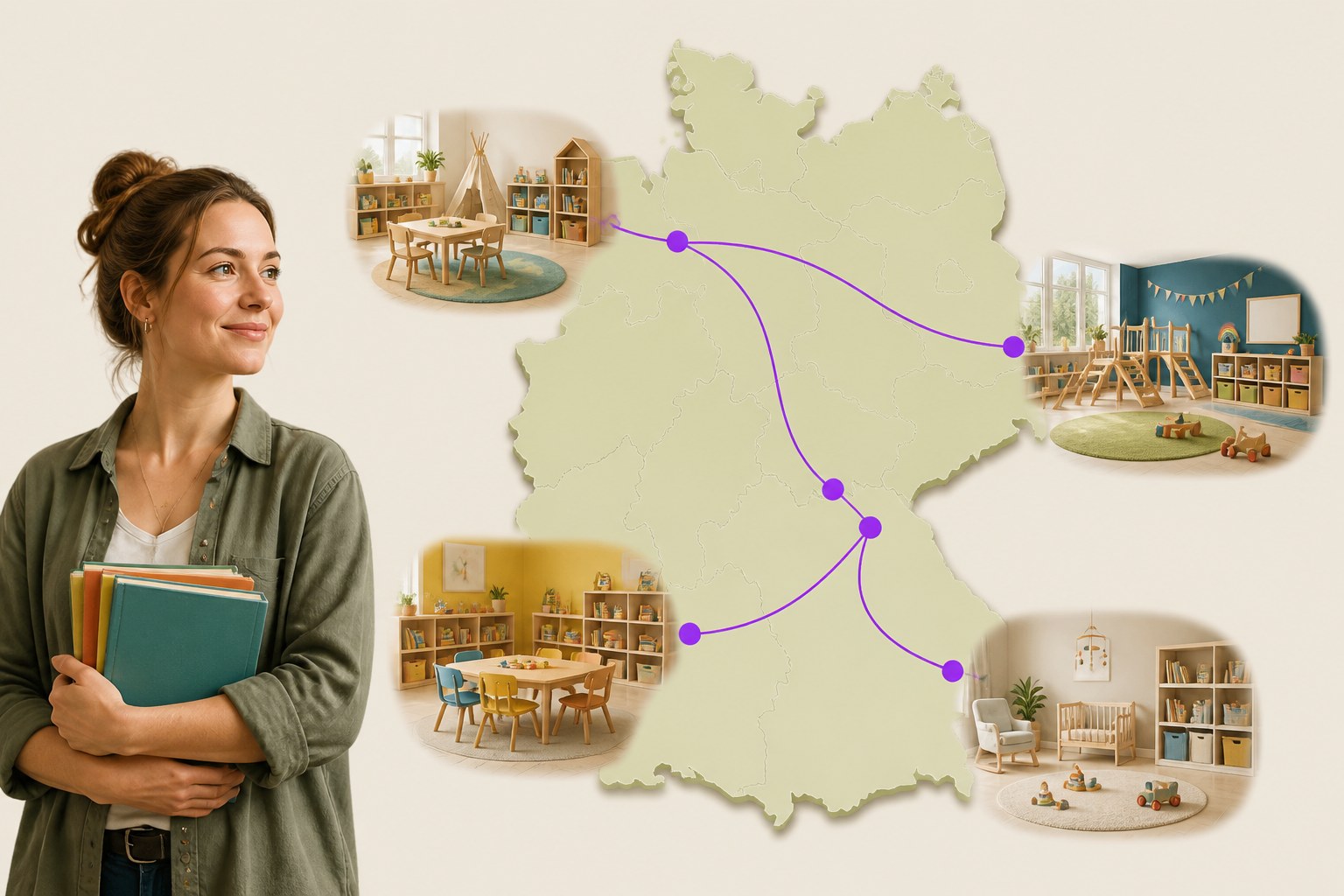
Applicants must remain open to employment opportunities throughout Germany. The application is not tied to one city or one employer, and geographical flexibility is part of presenting a usable candidate profile. Do not state a preferred location in a way that suggests you are unavailable for opportunities elsewhere.
The information submitted is used to assess professional suitability, experience, language skills and the documents relevant to further consideration. Accuracy is more valuable than exaggerated claims because the profile needs to represent your real qualifications.
How to Strengthen Your Childcare Application
Build your CV chronologically and make the childcare connection visible from the first page. Start with your most relevant qualification and follow it with practical experience. Use clear headings and consistent date formats so that your professional development is easy to understand.
Describe duties with concrete examples. Explain whether you supported routines, planned or delivered activities, observed development, documented information, worked with groups or communicated with families. Do not claim responsibilities that were not part of your role.
Create a document folder containing certificates, transcripts, employment references, language evidence and translations. Use clear file names and check that every document belongs to the correct person. Keep original documents available if an authority or future employment process requires them.
Record your German skills accurately and update them when you complete a course or examination. Prepare examples of situations in which you used German for communication, instructions or documentation. This helps you explain your practical language ability rather than presenting only a certificate.
Prepare a short explanation of your professional goals. State which childcare activities you perform confidently, which areas you want to develop and why you want to work in Germany. Also explain your mobility clearly and show that you are prepared to consider employment opportunities throughout the country.
Before submitting your profile, check spelling, dates, contact details and translations. A careful final review prevents avoidable inconsistencies and presents your professional history with greater credibility.
Start Your Childcare Career in Germany
A useful childcare candidate profile combines relevant education, documented practical experience, reliable communication skills and organised supporting documents. Recognition questions must be assessed according to the specific profession and competent authority, while employment conditions must be reviewed in the actual contract.
Applicants who present their duties clearly, state their German skills honestly and remain open to employment opportunities throughout Germany give their profile a stronger basis for further consideration. The objective is not to apply for an invented vacancy, but to present a complete professional background for suitable childcare employment opportunities.
Four short steps. A CV is optional and can be provided in your native language.
Step 1 of 4Profession
East Talent
International recruitment with proprietary software
East Talent combines international recruitment with structured digital processes for handling candidate profiles, attracting employers and evaluating job opportunities.