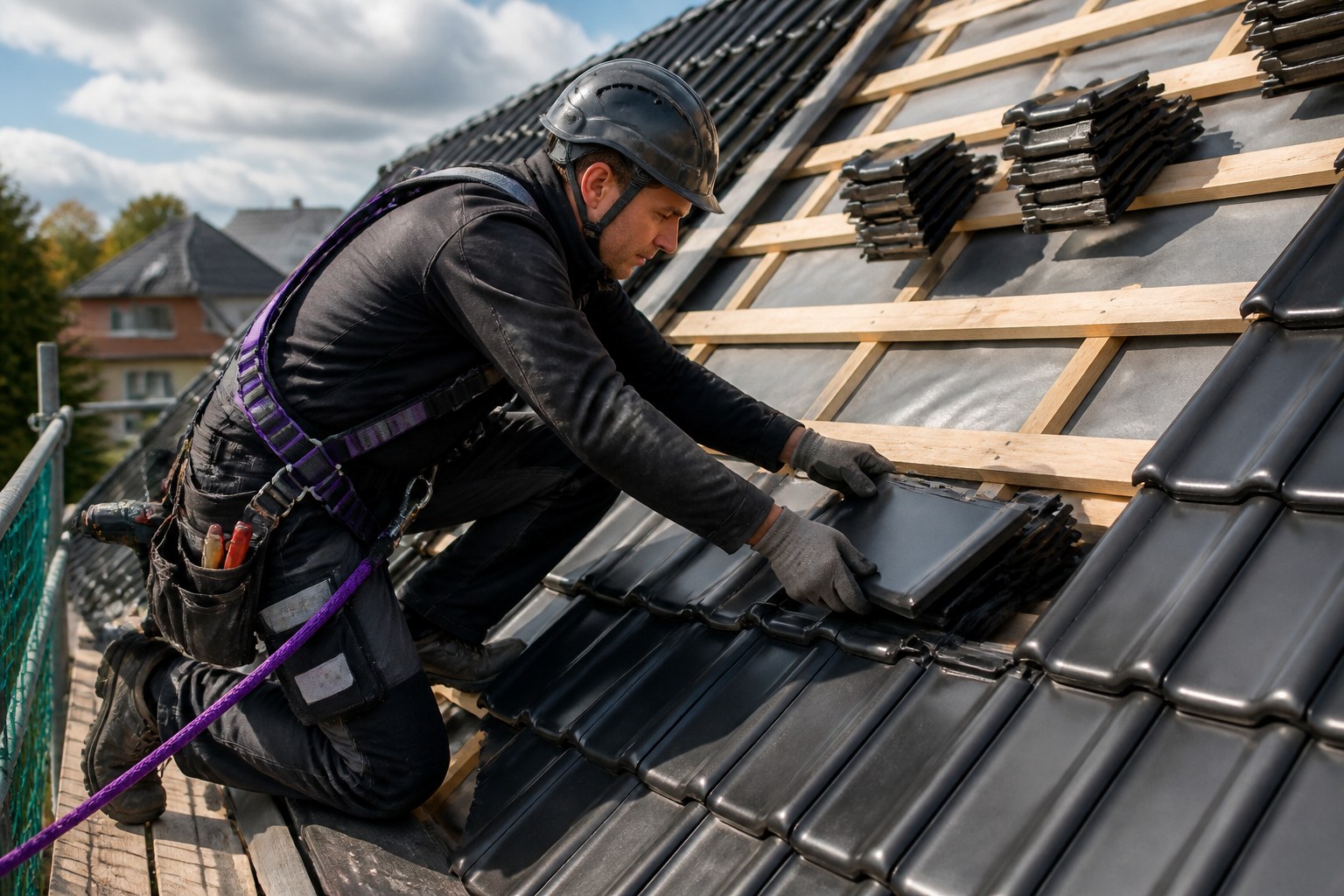
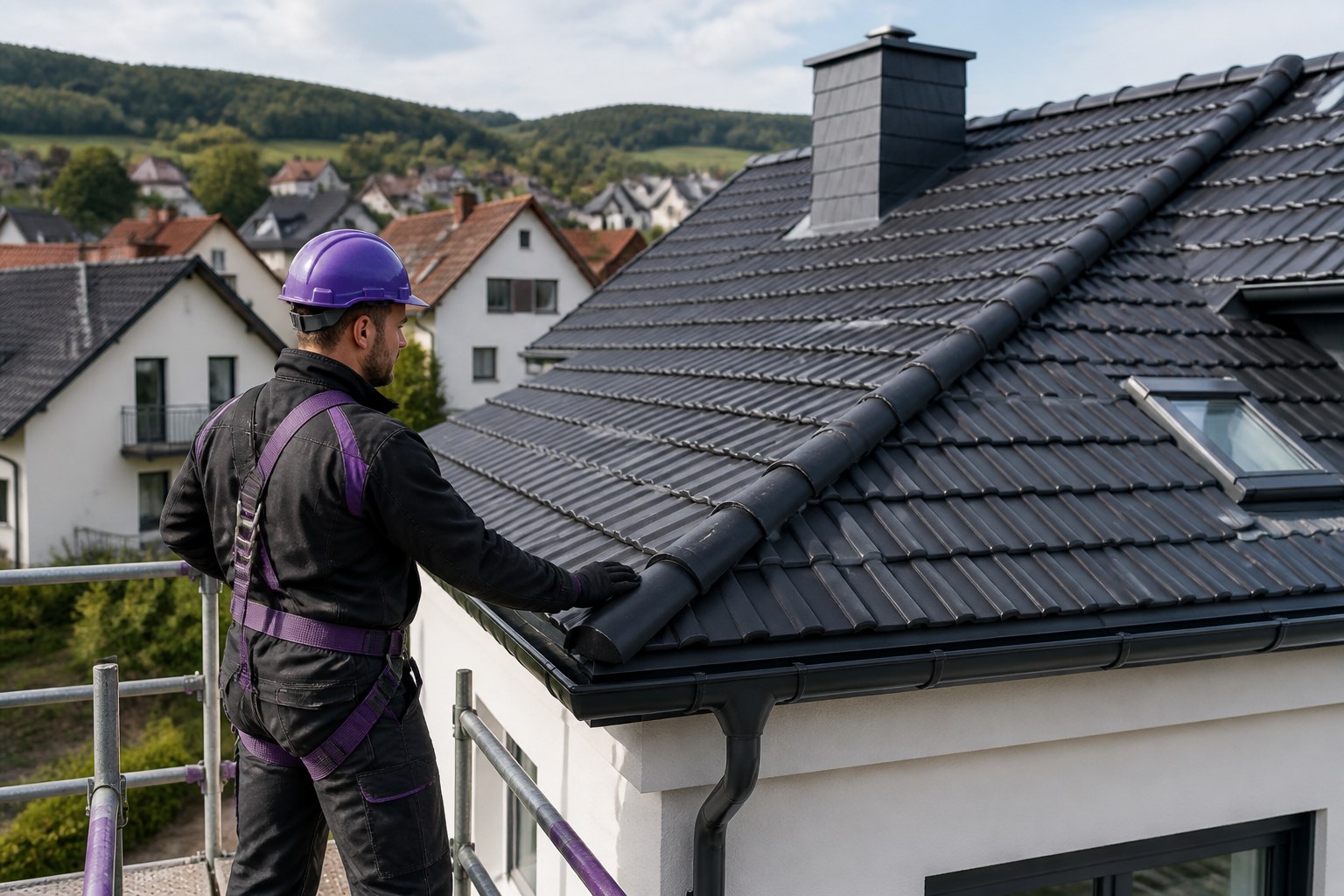
Roofer jobs in Germany focus on constructing, repairing, maintaining and inspecting roofs. The work covers pitched and flat roofs and includes preparing surfaces, handling roofing materials, installing or replacing roof elements and checking completed work.
Roofing projects involve several stages. Roofers prepare roof surfaces and structures, measure and cut materials, position and secure components, and inspect alignment, connections, waterproofing, drainage and the general finish. The exact duties differ between occupational settings and projects.
Your candidate profile should therefore describe actual roofing experience instead of relying only on a job title. Explain which roof types, materials, tools and construction tasks you have worked with. Distinguish experience in roof covering, roof structure work, insulation, waterproofing, repair and maintenance.
Roofing requires careful preparation and reliable execution. Work at height, changing weather, physical activity and coordination with other construction workers make safety-conscious behaviour and clear communication essential. Small defects in connections, coverings or drainage affect the durability of a roof.
When you apply through East Talent, you apply proactively for employment in your occupational group. You do not apply for a named vacancy or a particular employer at this stage. Your information is assessed as part of your professional profile for potential employment opportunities in Germany.
State whether your experience is mainly in new construction, renovation, repair, maintenance or a combination of these areas. Include the scale of previous work where you have reliable information, and avoid claims that you cannot document.
Skills and Experience Relevant to Roofing Work
A strong roofer profile presents formal training and practical ability. If you completed vocational education in roofing, construction or a related field, list the qualification, training institution, dates and main subjects. If your background developed mainly through practical work, describe it precisely and provide available evidence.
Relevant experience includes roof coverings, roof structures, insulation, waterproofing, flashing, drainage elements and other roofing activities in your professional history. Describe whether you installed, repaired, replaced, measured, adjusted or inspected each material or component. Do not list techniques you have not actually performed.
Mention materials and tools you know, such as roof tiles, sheet materials, membranes, timber components, insulation products, hand tools and power tools. The purpose is to show your existing competence, not to claim every roofing skill.
Explain your experience with protective equipment, site rules, material handling, work preparation and coordination with colleagues. Experience working from scaffolding, access equipment or other protected work areas is relevant when it forms part of your background. Reliability, physical readiness and careful workmanship should be connected to actual tasks.
Your CV should connect each period of employment with specific responsibilities. State the employer or project where available, your position, dates, tasks and the type of buildings or roofs. A precise description is more useful than a general statement such as “worked in construction.”
Also describe cooperation with other trades, including work sequences, material deliveries, measurements, access arrangements and reporting defects. If your experience includes general construction, separate it clearly from roofing work so that the depth of your roofing background remains visible.
How to Present Your Roofing Qualification
Present your roofing background so that an assessor understands the level and content of your training. Include vocational certificates, apprenticeship records, technical school documents, further training certificates and other relevant records that you possess.
Your work history should show how the training was used in practice. For important roles, describe the roofing work, materials, responsibilities and duration. Photographs of completed work support a practical description when appropriate, but they do not replace formal documents or employment evidence.
The legal treatment of a profession and requirements connected with residence or employment are separate issues. A profession that is not regulated in Germany is not subject to the same professional licensing rules as a regulated profession. This does not automatically remove qualification documentation requirements connected with a particular situation.
Keep qualification documents, work evidence and personal information consistent. Differences between dates, job titles and certificates create avoidable questions. Use the same spelling of names and dates across your CV and supporting documents.
When a certificate uses a different occupational title from your CV, explain the relationship instead of silently changing the title. The original document remains important because it shows the exact qualification awarded. Recognition focuses on the content and level of the qualification, not only on the job title.
Keep syllabuses, training records or detailed certificates when available. Practical experience remains important because employment evidence shows how you applied your training. Identify missing documents honestly so that further steps are based on complete information.
Why German Skills Matter on Construction Sites
German is an important part of a roofer’s candidate profile because construction work depends on direct communication. You need to understand instructions, discuss tasks with supervisors and colleagues, identify materials and respond to changes in the work process.
Language skills also support safe work. Safety information, warnings, site rules and equipment instructions require clear understanding. German helps you ask questions when a task is unclear and report hazards, damage or delays accurately. Communication matters especially when several people work nearby or weather conditions change the planned sequence.
Record your German skills honestly in your CV. If you completed a language course, include the course or certificate and the date. You may describe your level using the Common European Framework of Reference, such as A2, B1, B2 or C1, when that classification reflects your actual knowledge.
Do not present a language level that you cannot use in practical communication. Listening comprehension and work-related vocabulary deserve particular attention because roofing takes place in noisy and changing environments. English or other languages provide useful background information, but they do not replace German skills for workplace communication.
Prepare vocabulary connected with roof parts, materials, measurements, tools, protective equipment and common instructions. You also need language for reporting a problem, confirming a measurement and explaining that a task is complete. Describe both formal language evidence and your actual experience using German.
Documents to Prepare for Your Application
Prepare a complete and readable application file before submitting your profile. The central document is a clear CV with your contact details, work history, education, language skills and relevant technical abilities.
Add vocational certificates, training records and relevant school or higher-education documents. Employment references, confirmation letters, project records or other reliable evidence support your description of roofing experience. List language courses and certificates separately from technical qualifications.
Foreign-language documents may require translation into German or English depending on the relevant procedure. Whether a certified or another formal translation is required depends on that procedure, so one translation format does not apply in every case.
Scan documents clearly and use consistent file names. Check that pages are complete, dates are readable and names on certificates correspond with the name in your CV. Keep the original documents safely available for later procedures.
Organise the files so that a reviewer can understand them without searching through unrelated material. A practical order is the CV, qualification documents, work evidence, language records and other supporting documents. Submit complete multi-page documents rather than isolated pages.
If a former employer cannot provide a reference, use other reliable employment evidence when available and state the source and period clearly. Never create an employment certificate, alter a date or present another person’s project as your own work.
Check the application form before submission. Contact details must be current, employment dates must match the CV and documents must open correctly. If information is missing, explain the gap briefly. An honest incomplete record is more useful than inaccurate details.
Roofing Candidate Preparation Checklist
Use the following checklist before applying for roofer employment opportunities in Germany. It focuses on information that helps assess your occupational profile and is not a universal list of legally mandatory requirements.
Review each area before submitting your application. The aim is to show what you have actually learned and performed, not to claim every roofing skill. A focused and truthful profile provides a clearer basis for qualification assessment and later discussions about suitable employment opportunities.
What to Prepare for a Roofer Application
Preparation area
What to include
Why it matters
Qualification and training
Vocational certificates, training records and relevant qualifications
Shows the professional background available for assessment
Practical experience
Employers or projects, roofing tasks, responsibilities and length of experience
Presents hands-on ability in a clear and verifiable way
Language and documents
German skills, CV, certificates and translations where required by the relevant procedure
Supports workplace communication and review of the candidate profile
Safety and work practice
Experience with protective equipment, site rules, tools and coordinated construction work
Shows how you approach reliable and safety-conscious roofing work
Recognition and Additional Qualification Steps
Recognition procedures compare a foreign professional qualification with a relevant German reference qualification. The responsible authority examines the submitted documents and determines whether the qualifications are equivalent or whether substantial differences exist.
Recognition is not an automatic result of work experience or a certificate. The outcome depends on the content and level of the qualification, the available evidence and the comparison carried out by the responsible authority.
For non-regulated professions, possible results include full recognition, partial recognition or no recognition. Where substantial differences are identified, an adaptation qualification or another designated qualification measure addresses those differences in the relevant case.
The procedure requires complete documentation. When all required documents have been submitted, the responsible authority generally examines the application within about three to four months. This describes the examination period stated for the procedure and does not promise a particular result or cover every possible delay.
Recognition and residence matters remain separate. An assessment of professional equivalence is not an automatic decision about employment permission or residence. Those matters require separate examination under the applicable rules.
Collect documents that establish the identity, content and duration of your training. Missing pages, unclear translations or unexplained gaps delay the point at which the documents are ready for examination. A request for additional evidence means that the authority needs more information for its comparison; it does not mean that your background has been rejected.
Additional qualification steps address identified differences in training or professional content. Their form depends on the assessment and applicable procedure. Keep records of every completed course, examination or practical measure for the next review of your qualification.
Working Conditions to Understand Before Starting
Before starting employment, read the employment contract carefully. It should identify the contractual parties, start date, any fixed term, probationary period, work location, duties, pay, working time, holiday entitlement and notice periods.
Pay is normally stated as gross pay. Gross pay is not the amount transferred to your bank account because taxes and social-security contributions are deducted according to your personal circumstances. Net pay therefore requires an individual calculation and must not be inferred from gross pay alone.
A contract or applicable collective agreement may contain additional rules on pay, working time, holidays, premiums or other conditions. Check which provisions apply to your employment relationship and keep a copy of the signed documents.
German law provides paid annual leave. The statutory minimum is 24 working days on the basis of a six-day working week, corresponding to 20 working days with a five-day working week. A contract or collective agreement provides more leave when it contains a higher entitlement.
Working time rules are separate from the regular weekly hours agreed in a contract. The Working Time Act generally limits daily working time to eight hours, with an extension to ten hours when the statutory averaging condition is met.
Roofing involves physical activity, outdoor conditions and safety responsibilities. Ask for clear information about duties, working time, work location and protective arrangements before signing. Outdoor work exposes you to changing temperatures, rain, wind and strong sunlight, so workwear, protective equipment, breaks and safe access arrangements matter.
Travel time and the distance between accommodation, the work site and any meeting point affect your daily routine. Read the contract and related information carefully, keep written records of important agreements and ask for clarification when a term is unclear.
Be Open to Roofing Opportunities Across Germany
Candidates applying through East Talent must be open to employment opportunities throughout Germany. Do not limit your profile to one city or region if you want your professional background assessed for a broader range of suitable opportunities.
Geographic flexibility does not guarantee a particular location or employment outcome. It shows that you are prepared to consider opportunities in different parts of Germany and prevents an artificial regional restriction on your occupational profile.
Think practically about relocation. Housing, deposits, travel, commuting and other living costs affect the amount available after moving. Rent, a deposit, transport, work clothing and everyday expenses require available funds before the first regular payment arrives.
Discuss your mobility honestly in the application. If you have conditions affecting relocation, record them clearly instead of presenting unrestricted availability and changing the information later. Exact costs depend on the location and personal situation, so check them when a specific employment opportunity is presented.
How to Apply for Roofer Jobs in Germany
The application through East Talent is an initiative application for employment in your occupational group. You are not applying for a named vacancy or directly for a specific employer at this stage.
Complete the application form with accurate information about your roofing qualification, work experience, German skills and available documents. Explain your practical responsibilities clearly. A precise description of roof types, materials, tools and tasks is more useful than “general construction work.”
After the initial profile assessment, suitable candidates may be introduced to appropriate companies in Germany. This process does not promise placement, a particular employer, a specific location or a particular employment condition.
Check every entry before submitting the form. Dates should match certificates and employment evidence. If a document is unavailable, state that accurately instead of inventing details. Present your qualification, length and type of practical experience, German skills and available documents first.
After submission, keep copies of the information and documents provided. Be prepared to clarify employment periods, training content, technical tasks or language learning. Prompt and consistent answers prevent avoidable misunderstandings.
An initiative application does not replace later discussions about a particular employment opportunity. If your profile is considered further, review the duties, location, contract conditions and required documents carefully before making a decision. Ask questions whenever information is unclear.
How to Strengthen Your Candidate Profile
Start by updating your CV and arranging your professional history in reverse chronological order. Describe roofing tasks precisely, including the materials, tools, roof structures and responsibilities you handled.
Collect vocational certificates, training records, employment evidence and language documents. Prepare translations when relevant to the procedure and retain the original documents for later review.
Review your German communication skills and record them honestly. Practise vocabulary for tools, materials, safety instructions and construction tasks, with particular attention to practical communication.
Compare every date and job title across your CV, certificates and employment evidence. Check that your description distinguishes roofing work from general construction and identifies the tasks you personally performed.
Finally, state clearly that you are open to employment opportunities throughout Germany. A complete occupational profile, consistent documents, precise experience information and realistic communication about your language skills provide a sound basis for applying for roofer jobs in Germany.
A strong application depends on a clear account of your training, reliable evidence, practical examples and honest communication. Confirm that your contact details work, your files are readable and your mobility information is accurate before sending the application.
Create your profile
Registration with East Talent
Four short steps. A CV is optional and can be provided in your native language.
Step 1 of 4Profession
East Talent
International recruitment with proprietary software
East Talent combines international recruitment with structured digital processes for handling candidate profiles, attracting employers and evaluating job opportunities.