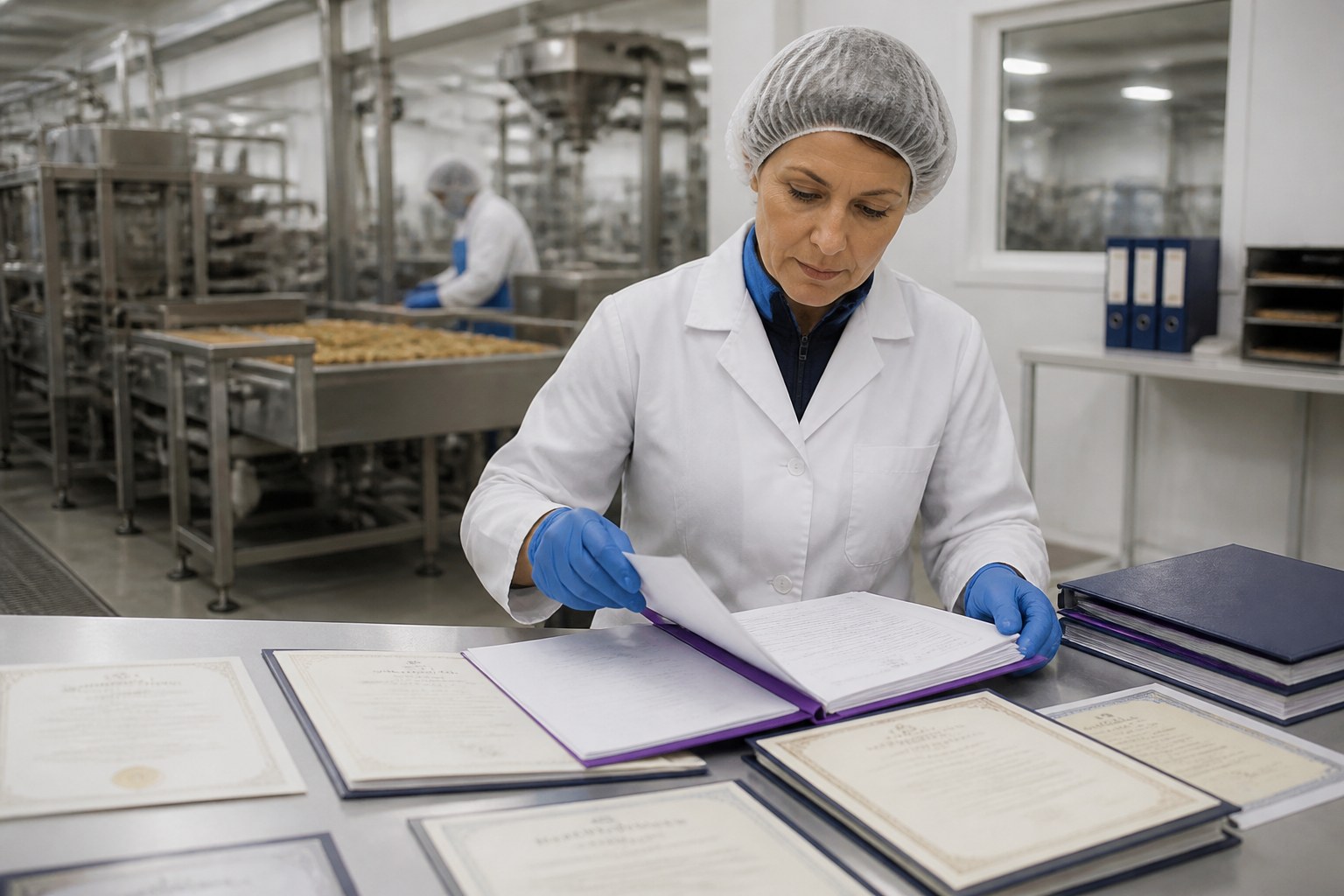
Food quality inspectors help verify that food products, production processes and hygiene routines meet defined quality and safety requirements. Their work connects practical inspection activity with accurate documentation. Depending on the professional setting, the role includes checking raw materials, observing processing steps, examining finished products and recording results.
Inspection work takes place in production areas, laboratories, storage environments or designated quality-control areas. A food quality inspector pays attention to cleanliness, personal hygiene, handling procedures, temperatures, product condition, contamination risks and deviations from documented processes. The exact technical focus depends on the applicant’s training and professional experience.
Documentation is a central part of the occupation. Inspection findings must be recorded clearly, consistently and traceably. Quality records may cover test results, deviations, corrective actions, samples, production batches and follow-up checks. Applicants with experience in food safety systems, hygiene controls, laboratory procedures or production quality management should describe that experience precisely.
The work also includes communication. Inspectors exchange information with production employees, quality teams and other departments when they identify a deviation or need clarification. The practical inspection environment therefore differs from office-based quality administration, although both areas require careful documentation and an understanding of quality procedures.
Which Qualifications and Experience Matter
A strong applicant profile combines food-related training or study with practical knowledge of quality control. Relevant backgrounds include vocational training, technical education or academic study connected with food technology, food science, laboratory work, production quality or hygiene management. The appropriate background depends on the professional level and the duties that the candidate has actually performed.
Technical knowledge matters because food quality inspection involves more than visual checking. Applicants should present their understanding of hygiene procedures, sampling, production controls, quality records and deviation management. Knowledge of food safety principles, internal quality procedures or documented control systems strengthens the professional profile when it is supported by real training or experience.
Professional experience should show what the applicant did, not only the job title. Useful details include the type of food production environment, inspection routines, products or processes handled, records completed, equipment used and cooperation with other teams. Candidates must distinguish between direct inspection work, laboratory work, production work and administrative quality responsibilities.
This guide describes preparation for the occupational group rather than one specific vacancy or employer. East Talent reviews candidate profiles for employment opportunities in Germany and may present suitable applicants to appropriate companies. The application therefore needs to communicate transferable qualifications accurately instead of being built around an invented position.
German Skills for Food Quality Inspection Work
German skills are an important part of a food quality inspector profile. Inspectors need to understand hygiene instructions, production procedures, internal records and information about deviations. They also need to communicate observations with production teams and explain why a control or follow-up action is required.
Language ability has a practical effect on inspection accuracy. Misunderstanding a hygiene instruction, product specification or corrective-action record affects the reliability of quality work. German also supports cooperation in environments where instructions are delivered verbally during production and where records use technical terminology.
Applicants should state their German skills honestly and describe how they use the language professionally. Where applicable, language skills should be presented using recognized levels such as A2, B1, B2 or C1. Candidates should also identify other relevant languages and explain whether they used German in production, laboratory, quality-management or documentation contexts.
No unsupported mandatory language level applies to every food quality inspector position. The strength of a candidate profile comes from an accurate description of actual language ability, professional vocabulary and experience with German-language instructions or records.
Recognition of Foreign Qualifications
Applicants should distinguish professional recognition from employment-related qualification requirements. Regulated professions are legally protected. Anyone who wants to work in Germany in a regulated profession generally requires the relevant recognition or professional licence. Health professions and other legally protected occupations provide examples of regulated areas.
Non-regulated professions are not protected in the same way. This includes many occupations from the dual vocational training system and numerous academic professions. Work in a non-regulated profession is generally possible without formal German professional recognition. That statement does not automatically remove qualification requirements connected with a residence title. employment-related requirements must be examined separately.
For a food quality inspector profile, the classification depends on the actual professional activity and the qualification pathway. Candidates should therefore avoid describing recognition as automatically required or automatically unnecessary. Instead, they should document their education, certificates, professional history and intended occupational profile so the relevant assessment is based on complete information.
Where an official recognition procedure applies, the competent authority examines whether the foreign qualification is equivalent to the relevant German reference profession or whether substantial differences exist. Depending on the case, the result includes full recognition, partial recognition or no recognition. Substantial differences may lead to adaptation training or other qualification measures. Regulated professions may also involve additional professional-licensing requirements.
Documents to Prepare for Your Application
Prepare a clear CV that presents your professional history in a traceable order. Include your contact details, education, training, employment history, relevant technical skills and language information. Each position should show the employer, job title, dates and main responsibilities. The description should make the connection to food quality inspection visible.
Add education and training certificates that support your occupational profile. These documents include relevant vocational qualifications, academic certificates, laboratory or food-safety training and other professional evidence that you actually possess. Do not list qualifications that you have not completed or skills that you cannot explain in practice.
Evidence of professional experience strengthens the application when it describes responsibilities rather than only employment dates. Supporting documents may include employment references, certificates of employment or other records from previous professional activities. The exact documents required depend on the relevant application or recognition procedure.
State your German skills and other language skills clearly. Foreign-language certificates may require a German or English translation for a particular procedure. Whether a certified or otherwise formalized translation is required depends on that procedure and should not be assumed universally. An application photograph is not a general requirement.
The following overview helps you check whether your application contains the information that matters most for this occupational group.
Food-related vocational training, academic study, technical education and relevant certificates
Shows the knowledge base behind your food-quality profile
Professional experience
Inspection routines, production environment, samples, quality records and responsibilities
Allows your practical suitability to be assessed from documented experience
German skills
Language level and professional use in instructions, records or team communication
Shows how you understand procedures and communicate inspection findings
Recognition and supporting documents
Certificates, employment evidence, translations where required and recognition information where relevant
Provides a complete basis for professional and procedural assessment
How to Present Food Quality Inspection Experience
Describe inspection routines in concrete terms. Explain whether you checked incoming materials, production stages, finished products, storage conditions, hygiene practices or samples. Mention the type of control you performed and how you recorded the result. Use only responsibilities that belong to your real experience.
Production-environment details make the profile easier to assess. Identify whether you worked in food manufacturing, processing, packaging, storage, laboratory or another related setting. Explain your contact with production equipment, sampling tools, measuring instruments, quality records or internal control procedures when those details are accurate.
Show how you handled deviations. Relevant experience includes identifying non-conforming products, recording findings, informing responsible teams, supporting corrective actions and completing follow-up checks. Do not present yourself as responsible for decisions that belonged to another department. A precise description is more credible than a broad claim of responsibility.
Cooperation is also relevant. Food quality inspectors work with production employees and quality colleagues to clarify findings and maintain consistent procedures. Describe the teams you worked with and the information you exchanged. Include experience with audits, inspections or quality meetings only when you actually participated in those activities.
Working Conditions and Employment Information
Before accepting an employment offer, review the essential terms of the employment contract. The contract should identify the parties, the start date, any fixed term, the probationary period, the workplace, the duties, remuneration, working hours, holiday entitlement and notice periods.
Food quality inspection involves practical production environments as well as documentation. The working location, schedule, protective clothing, access to production areas and division between inspection and administrative duties belong to the employment information that applicants should understand before signing. These details differ between employment relationships and must not be assumed in advance.
Pay is normally stated as gross pay. Gross pay is not the same as net pay because taxes and social-insurance contributions are deducted according to the individual situation. The amount paid into a bank account therefore differs from the contractual gross amount. Additional supplements or bonuses depend on the employment relationship and applicable rules.
Tariff agreements and works agreements may contain additional provisions on pay, working time or holidays. Applicants should read the contract and any referenced provisions carefully and ask for clarification about terms they do not understand. This review protects the candidate from confusing a gross figure with the actual amount received.
Preparing for Jobs Throughout Germany
Applicants using East Talent’s candidate route apply for employment opportunities in their professional group, not for one named vacancy or one specific employer. Suitable candidates may later be introduced to companies in Germany whose requirements match their profile. The initial application must therefore present the candidate’s qualifications broadly and accurately.
Candidates must remain open to jobs throughout Germany. A preferred location may be part of a personal discussion, but the application should not suggest that employment is available only in one city or region. Geographic flexibility expands the range of employment opportunities considered for a food quality inspector profile.
Prepare information that allows your profile to be assessed across different food-production environments. Include your training, inspection experience, product or process knowledge, documentation skills, German ability and recognition status where relevant. Explain your professional strengths without claiming experience that belongs to another occupational group.
This approach also supports transparent communication. The employment contract is concluded with the future employer, not automatically with East Talent. The candidate’s task is to provide complete information so that professional suitability, documents and language skills are assessed correctly.
A Practical Application Checklist
Start by collecting your certificates and arranging them in a clear order. Include food-related education, technical training, laboratory or hygiene certificates and other qualifications relevant to inspection work. Keep the original documents available and prepare readable copies or scans.
Update your CV so that every position includes the employer, job title, dates and responsibilities. Highlight inspection routines, quality records, hygiene controls, sampling, production environments and cooperation with other teams when these belong to your experience.
Record your language skills accurately and use recognized levels where applicable. Add information about professional use of German, such as reading hygiene instructions, completing records or communicating with production teams. Avoid assigning yourself a level that your actual ability does not support.
Clarify your recognition status. If an official recognition procedure applies, organize the documents required for that procedure and keep information about the outcome or current stage consistent across your application. Remember that professional recognition and employment-related qualification requirements are separate questions.
Finally, check that your application information is complete, truthful and suitable for employment opportunities throughout Germany. A precise profile gives the assessment a reliable basis.
Next Step for Applicants
Food quality inspector applicants should present a documented combination of food-quality knowledge, practical inspection experience, German skills and complete qualification information. The strongest application explains what the candidate has actually done and connects that experience with the requirements of professional food-quality work.
East Talent’s application route is designed for candidates seeking employment in Germany within their professional group. It is not an application for a named vacancy or a specific employer. Submit accurate information about your qualifications, experience, language skills and documents, and remain open to employment opportunities throughout Germany.
Four short steps. A CV is optional and can be provided in your native language.
Step 1 of 4Profession
East Talent
International recruitment with proprietary software
East Talent combines international recruitment with structured digital processes for handling candidate profiles, attracting employers and evaluating job opportunities.