What Carpenter and Joiner Work in Germany Involves
Carpenter and joiner work combines practical craftsmanship with accurate measurement, material knowledge and technical understanding. Depending on your occupational focus, your tasks involve preparing, shaping, assembling, fitting or installing wooden components and finished products.
You need to interpret technical drawings, follow production or installation instructions and check whether components fit correctly. Preparation includes selecting materials, checking dimensions and planning the work sequence. Production includes cutting, shaping, drilling, joining and finishing. Installation includes transporting, positioning, adjusting and securing wooden elements while protecting surrounding surfaces.
Your candidate profile should describe the areas in which you have actually worked, such as workshop production, interior woodwork, construction-related carpentry, furniture components or installation. Workshop production and on-site fitting require different routines, so explain your experience accurately rather than relying on the general title “carpenter.”
Professional work also involves identifying warped materials, incorrect measurements, damaged surfaces or unsuitable fittings before they affect the finished result. Describe the problems you solved and the level of independence you had. Do not claim experience that your training or practical background does not support.
Qualifications and Experience for Your Candidate Profile
A completed vocational qualification in carpentry, joinery or a closely related occupation provides important evidence of professional preparation. State the exact qualification title, training institution, training period and main practical content.
Describe your work experience through the materials you handled, tools and machines you used, components or products you produced or installed and responsibilities you carried. Employment records, references, project documentation and certificates help make your history understandable across different employment environments in Germany.
Connect your formal training with later duties. If your qualification covered technical drawings, machine operation, assembly, surface treatment or workplace safety, explain how you used these subjects professionally. Experience is not measured only by years worked; the content, complexity and independence of your duties also matter.
If your history includes several related occupations, identify the carpentry and joinery tasks within each position. Construction work, furniture production, interior fitting and workshop duties often overlap, but the exact responsibilities remain important for assessing your occupational profile.
Technical Skills That Strengthen Your Application
Accuracy is central to carpentry and joinery. Explain how you measure materials, transfer dimensions, check angles and identify deviations before assembly or installation. Specific examples demonstrate competence more effectively than general claims about being hardworking or reliable.
State which types of wood, wood-based panels, fittings, surfaces or other materials you handled. Describe whether your work involved cutting, shaping, drilling, joining, sanding, fitting, surface preparation or finishing. Also identify the hand tools, power tools, machines and measuring equipment you used during training or employment.
Technical drawings and measurements deserve specific attention. State whether you read plans, workshop drawings, cutting lists, assembly instructions or installation specifications. Explain whether you calculated dimensions independently or worked from prepared measurements. Distinguish hand-held power tools from stationary workshop machines and list only equipment you have actually used safely.
Quality work includes checking finished joints, correcting alignment, protecting surfaces, keeping the work area organised and preparing components for delivery or installation. These details show how you manage the complete work process and respond to technical problems.
German Language Skills in the Application Process
German skills form part of your candidate profile because carpentry and joinery involve instructions, technical information, coordination and workplace safety. You need to understand information about materials, dimensions, tools, work sequences and safe procedures. Communication with colleagues also affects accuracy and completion of tasks.
Do not describe your language ability only as “basic” or “good.” If you have assessed your German under the Common European Framework of Reference for Languages, state the level, such as A2, B1, B2 or C1. Explain separately whether you understand spoken instructions, communicate in practical situations, read technical information and write basic workplace messages.
There is no single language level stated in the available facts for every carpenter or joiner position. Your information therefore needs to be accurate, verifiable and consistent with your actual ability. Certificates, course records or other evidence support the assessment.
Mention situations in which you used German, including changes to measurements, questions about materials, tool instructions and safety communication. If your German is improving, state the course or learning activity and describe your current level honestly. Technical vocabulary for dimensions, surfaces, fittings, tools and work steps is especially relevant.
Recognition of Foreign Carpenter and Joiner Qualifications
Recognition depends on the legal classification of the occupation and the qualification being assessed. Many vocational occupations within Germany’s dual training system are non-regulated. In a non-regulated occupation, formal German professional recognition is not automatically required for work in the occupation.
This does not reduce the importance of qualification documents. Recognition evidence supports assessment of your professional background, while related to working in Germany requirements are assessed separately. Keep vocational certificates, training records and employment evidence complete and consistent.
The competent authority compares your foreign qualification with the relevant German reference occupation. It examines whether the training is equivalent or whether substantial differences exist. For non-regulated occupations, the result may include full recognition, partial recognition or no recognition. Where substantial differences exist, an adaptation qualification or another permitted measure addresses those differences in the relevant case.
Once all required documents are submitted, the competent authority generally examines an occupational recognition application within about three to four months. Complete documentation supports a clear assessment. Training certificates alone do not show every practical responsibility, so employment records and detailed work descriptions remain valuable. Ensure that translations, dates and names correspond across all documents.
Recognition is one part of your professional profile. It does not replace a clear CV, verifiable work history or accurate German language information. Present these elements together so your formal qualification and practical ability form a coherent occupational background.
Documents to Prepare Before Applying
Prepare a clear CV listing your personal information, vocational training, employment history, language skills and relevant technical abilities. Present employment periods consistently and describe each position with the employer, job title, main responsibilities and workplace focus.
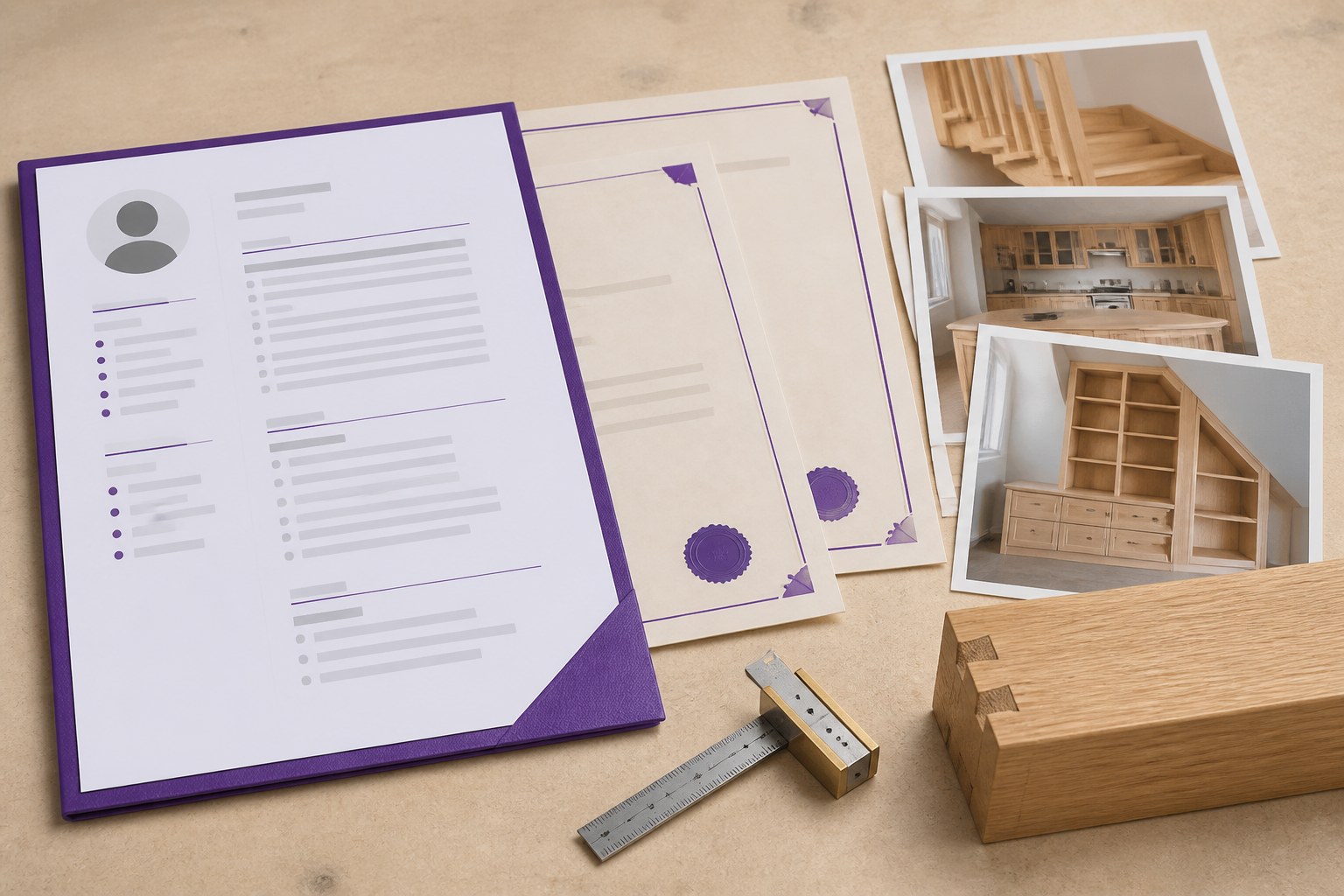
Collect certificates for vocational training, school education and other relevant qualifications. Add employment references or evidence confirming your practical experience. Photographs or records of completed woodwork support your profile when they present your work professionally and contain no confidential information.
Foreign-language certificates may require translation into German or English depending on the procedure. Whether a certified or another formal translation is required depends on the relevant process, so do not assume one rule applies to every document. Keep original documents and organised copies available.
Check names, dates, qualification titles and employers across your CV, certificates and references. If different spellings appear because documents use different transcription systems, prepare a clear explanation. Store digital scans with clear file names and record which documents are originals, copies or translations.
Carpenter and Joiner Application Preparation Overview
Preparation area
What to document
Why it matters for your application
Vocational qualification
Training title, institution, dates and certificates
Shows your formal preparation and supports assessment of your occupational background
Professional experience
Employers, positions, dates, responsibilities and work areas
Makes your practical level and professional development traceable
Technical and practical skills
Materials, measuring methods, tools, machines, assembly and finishing tasks
Demonstrates the work you have actually performed
German language skills
CEFR level where available and practical communication abilities
Shows how you handle instructions, technical information and workplace coordination
Supporting documents
Certificates, references, employment evidence and relevant translations
Provides evidence for your training, experience and application information
How to Present Carpentry Experience in Your CV
Use a clear chronological structure. For every relevant position, state the employer, job title and employment dates. Then describe the materials handled, components produced, tools used, drawings interpreted, installation activities completed and quality checks performed.
Mention the type of work instead of relying on a job title. Explain whether you measured and cut timber, assembled components, installed interior woodwork, fitted hardware, prepared surfaces or completed finishing tasks. Connect each claimed skill with a qualification or position in which you used it.
Avoid vague descriptions such as “I did all carpentry work.” Use action-based wording that shows what you personally did. Do not make team activities appear to be your individual responsibility if you only assisted. If your responsibilities changed, show that development clearly.
Group skills logically into materials, tools, machines, production, installation and quality responsibilities. Identify the work environment in which each skill was gained. Workshop production, interior installation and construction-related work require different routines, and this distinction supports a more accurate assessment for employment opportunities throughout Germany.
Employment Conditions to Understand in Germany
Before entering employment, read the contract carefully. Important information includes the contracting parties, start date, fixed term, probationary period, workplace, duties, pay, working time, holiday entitlement and notice periods. Additional provisions may come from a collective agreement or works agreement.
Pay is normally stated as a gross amount. Gross pay is not the amount transferred to your bank account. Taxes and social insurance contributions affect net pay, and the final amount depends on your individual tax and social insurance circumstances.
For carpentry and joinery work, check that the stated duties match your occupational profile. The wording should clarify whether the work focuses on workshop production, assembly, installation, maintenance or a combination. Review the named workplace, start date and organisation of working time, especially when work takes place at different sites.
Ask about unfamiliar contractual terms before signing. Keep a copy of the signed contract and related documents. Daily travel, accommodation, food and other living costs affect the amount available for your personal budget, so assess the complete package rather than gross pay alone.
Working Throughout Germany as a Carpenter or Joiner
Applicants using the East Talent candidate process apply initiatively for employment in the carpenter and joiner occupational group. At this stage, they do not apply for a named vacancy or a specific employer.
East Talent reviews professional information, experience, German skills and supporting documents. Suitable candidates are considered for appropriate employment opportunities, so your profile needs to communicate your occupational focus clearly.
You must remain open to jobs throughout Germany. The application does not promise a specific city, employer, workplace or position. State your preferences honestly, while understanding that geographic openness is part of the application approach. Do not describe a particular location as guaranteed.
Also state practical restrictions honestly, including whether you need time to relocate or whether certain workplace types are unsuitable. Identify whether you have experience in workshop production, interior joinery, construction-related carpentry, furniture work or installation. Preferences inform your profile, while openness preserves a broader basis for consideration.
A Practical Preparation Checklist for Applicants
Document your vocational training and practical experience. Collect certificates, employment evidence and references, then check that names, dates and job titles are consistent. Identify documents requiring translation for the relevant procedure.
Assess your German skills honestly and record available CEFR information. Note when you use German for spoken instructions, technical information, workplace coordination and safety communication.
Prepare a focused CV rather than a generic employment history. Describe carpentry or joinery tasks, materials, tools, machines, project types and quality responsibilities. Connect every technical claim with actual training or professional experience.
Keep important documents organised and remain open to employment throughout Germany. Before submitting, confirm that your CV includes every relevant position, certificates are readable, references identify your responsibilities and language information reflects your current ability.
Separate confirmed information from personal preferences. Qualifications, employment dates and language certificates are evidence-based parts of your profile. Preferred tasks, workplace conditions and geographic preferences should be identified separately so the assessment remains accurate.
What to Check Before Accepting an Employment Contract
Read the job title and duties carefully. The contract should state what work you perform, where the workplace is located and when employment begins. Check whether the employment has a fixed term and what the probationary period involves.
Review working time, holiday arrangements, gross pay and notice rules. Compare the wording with any applicable collective or works agreement referred to in the documents. Make sure you understand whether additional payments, premiums or other benefits form part of the agreed conditions.
Gross pay is the amount before deductions. Taxes and social insurance contributions reduce the amount paid out, while your individual circumstances determine the final net amount. Do not calculate expected net income from the gross figure alone.
Check whether the duties correspond with your qualifications and experience. If the wording is broad, ask which activities, materials and work environments form the main part of the employment. For installation work at different sites, understand where you report, how working time is recorded and which documents regulate travel or site work.
Consider the practical financial effect of gross pay, deductions, travel costs, accommodation and everyday living expenses together. Request clarification before accepting the contract and keep the complete signed documentation.
Apply now
If you have carpentry or joinery training and verifiable practical experience, prepare your profile with clear documents, precise technical descriptions and accurate German language information. Include the qualifications, tools, materials and responsibilities that reflect your actual background.
Applicants submit their profile through the application form for consideration in the carpenter and joiner occupational group. Keep documents complete and remain open to employment opportunities throughout Germany.
Describe what you produced, installed or maintained, which tools and materials you used and how you checked quality. This provides a stronger basis for considering your profile than a job title alone. Before submitting, check that your CV, certificates, employment evidence and language information are consistent.
Four short steps. A CV is optional and can be provided in your native language.
Step 1 of 4Profession
East Talent
International recruitment with proprietary software
East Talent combines international recruitment with structured digital processes for handling candidate profiles, attracting employers and evaluating job opportunities.