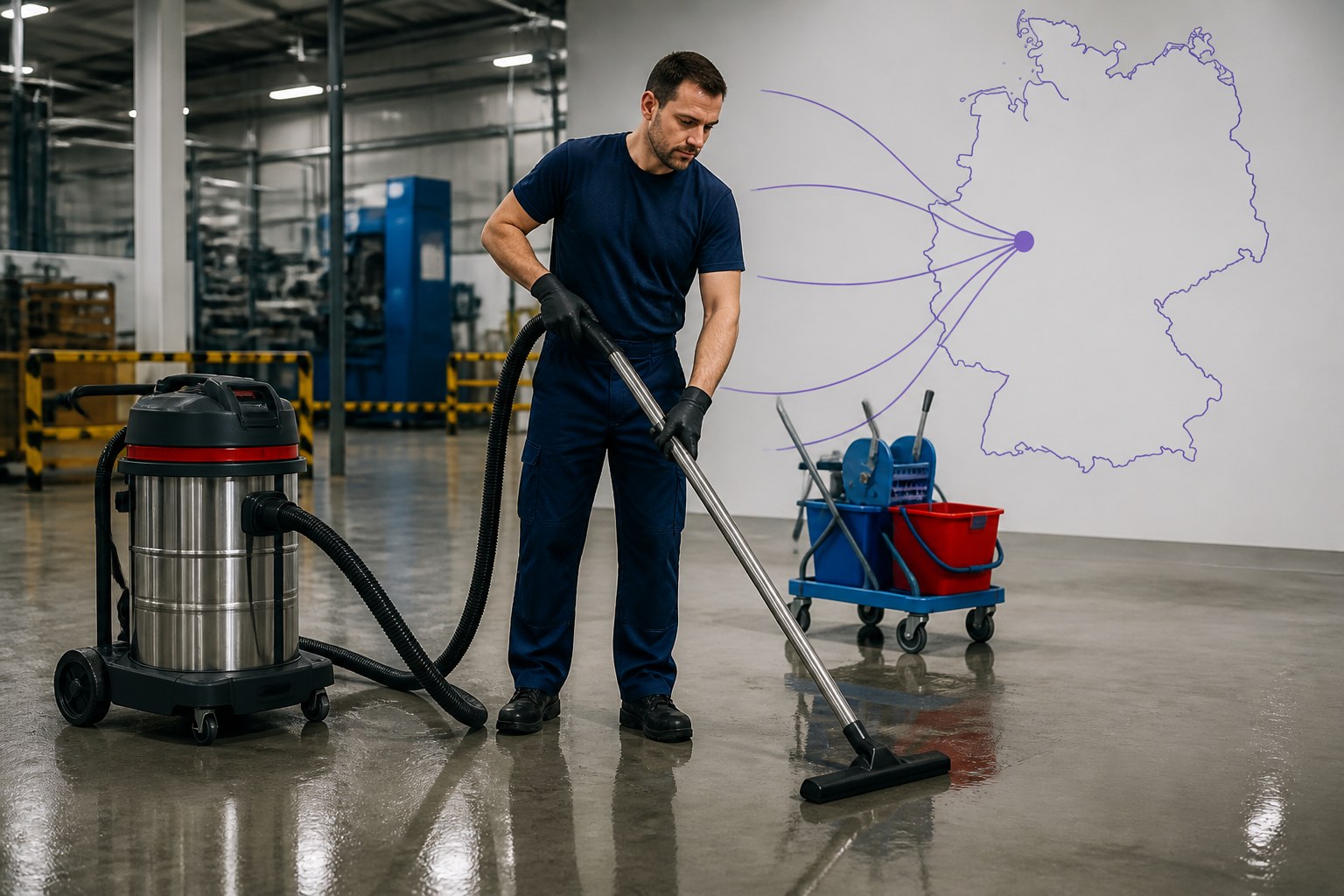
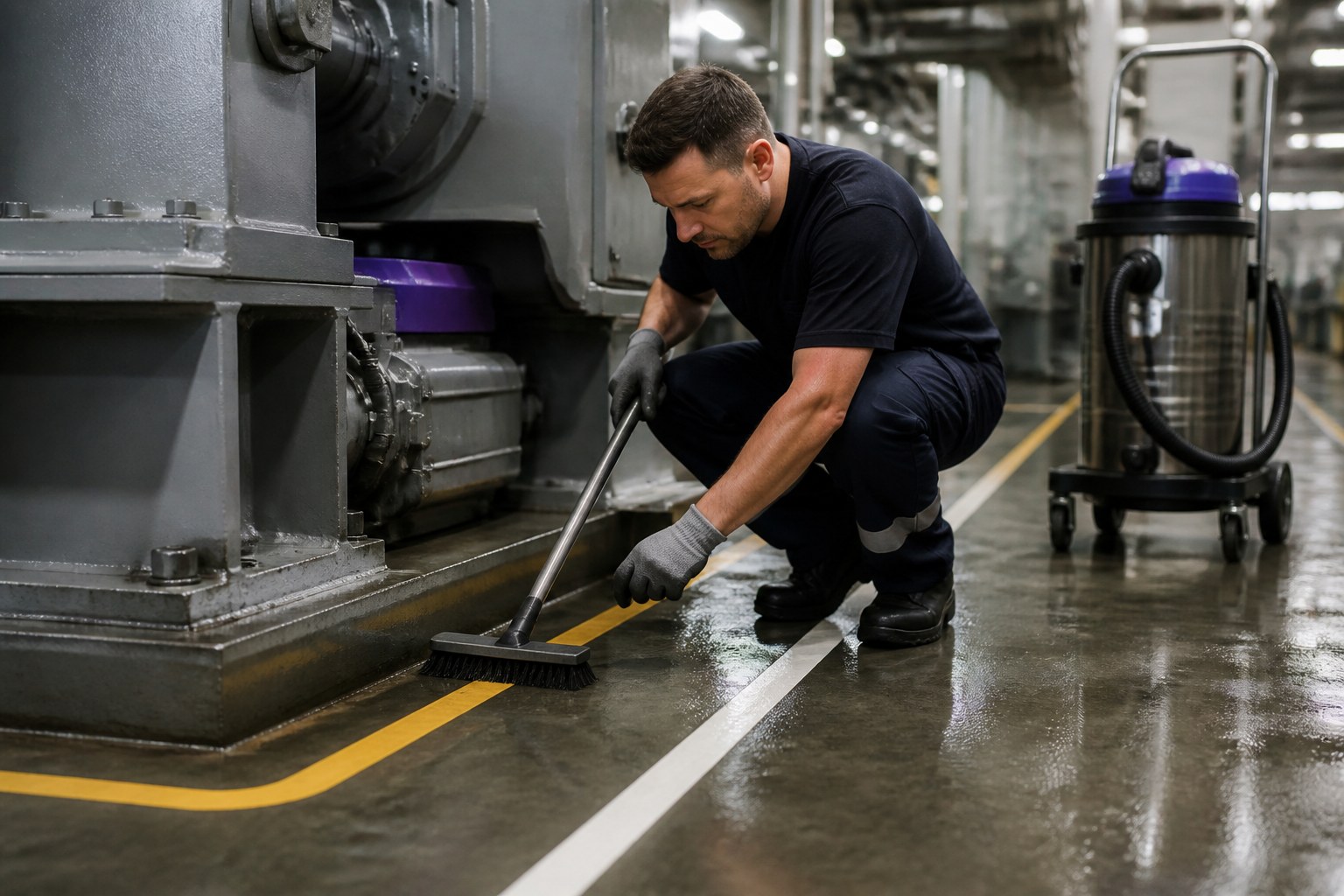
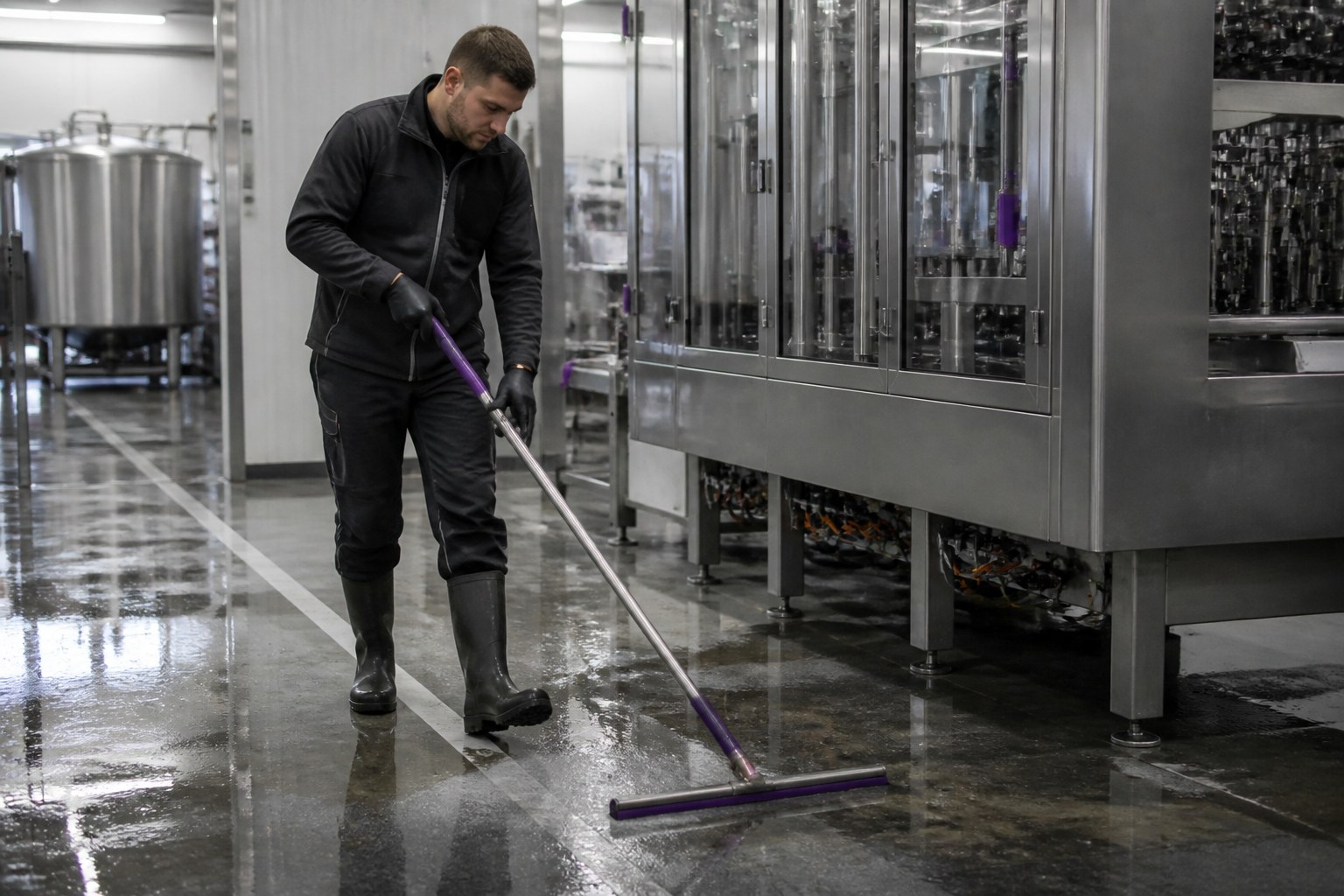
Industrial cleaner work focuses on maintaining clean, orderly and usable production or commercial environments. The work takes place around industrial floors, machinery bases, technical areas and other workplace surfaces that require regular cleaning. Your tasks depend on the working environment, the equipment in use and the responsibilities assigned by the employer.
This occupational field suits applicants who work carefully, follow instructions and complete physical tasks consistently. Practical experience is relevant because industrial cleaning requires more than general household cleaning. You need to show that you understand systematic work, handle cleaning equipment responsibly and maintain attention to detail during repetitive or time-sensitive tasks.
Industrial cleaner jobs in Germany are not limited to one city or region. Applicants using East Talent’s candidate pathway apply for employment opportunities in their occupational group rather than for a specific advertised vacancy. You therefore need to remain open to suitable opportunities throughout Germany.
Which Qualifications and Experience Matter
Your practical work history is one of the most important parts of your candidate profile. Describe previous cleaning employment with the employer’s name, your position, the dates of employment and your main responsibilities. Include industrial, commercial, institutional or other relevant cleaning experience when it reflects the type of work you performed.
Relevant experience includes methodical cleaning of large areas, work around machinery or production environments, use of professional cleaning equipment and compliance with workplace instructions. Do not describe experience only with general phrases such as “cleaning duties.” Explain the environment, the surfaces or areas you cleaned and the way you organized your work.
Formal vocational training is relevant when you have completed training connected with cleaning, facility services or another related field. It is not appropriate to present an unsupported qualification as a mandatory condition for every industrial cleaning role. Applicants without a formal German qualification should document their practical experience clearly and provide certificates or training records that genuinely relate to their background.
A reliable employment history supports the assessment of your profile. Consistent dates and responsibilities across your CV, certificates and other documents make your experience easier to understand. If there are periods without employment, explain them accurately rather than leaving contradictory information in your application.
German Skills for Industrial Cleaning Work
German skills form part of your candidate profile because workplace communication affects daily coordination and safe performance of tasks. You need to understand instructions, communicate with colleagues and supervisors, report problems and follow information connected with the working environment.
Language requirements are not stated here as one fixed level because the appropriate level depends on the duties, workplace communication and relevant employment process. State your German skills honestly in your CV. You may use a recognised framework such as A2, B1, B2 or C1 when that classification accurately reflects your knowledge.
Mention other languages as well, especially when they support communication in your professional history. Language information does not replace practical experience, but it helps create a complete candidate profile. Continued German learning also improves your ability to understand instructions and coordinate routine work after arrival in Germany.
Do You Need Recognition for This Occupation?
The recognition question depends on whether the occupation is regulated. Regulated professions are legally protected, and people who want to work in such professions generally need the required professional recognition or licence. The regulated category includes professions in healthcare and other legally protected fields.
Non-regulated occupations are not legally protected in the same way. Industrial cleaning work belongs to the type of practical occupational activity for which formal German professional recognition is not automatically required as a general rule. This distinction does not remove the need to document your experience, training or other qualifications.
Recognition law and rules for working in Germany are separate questions. The fact that an occupation is not regulated does not automatically mean that no qualification documents are relevant for a related to working in Germany process. The applicable requirements must be assessed separately for your personal situation and intended employment.
If you hold a foreign vocational qualification, keep the original certificate, supporting records and any available evidence of professional experience. A recognition procedure examines whether a foreign professional qualification corresponds to a German reference occupation and whether substantial differences exist. Where a procedure applies, complete documentation supports the assessment.
Documents to Prepare for Your Application
Prepare a clear CV as the central document of your initiative application. It should present your personal details, education, work history, language skills and relevant abilities in a consistent structure. List cleaning experience in reverse chronological order or another format that makes your professional development easy to follow.
Collect school, vocational and higher-education certificates that relate to your background. For industrial cleaning, relevant evidence includes cleaning-related training, facility-service certificates and documents confirming practical work. Employment references or other evidence of work history add detail when they describe your position and responsibilities.
Documents issued in another language may require translation into German or English in a particular procedure. Whether a certified or otherwise formal translation is required depends on the relevant process. Do not assume that every document needs the same form of translation; organize the originals and check the requirements that apply to the document being used.
Include accurate information about your German skills and any other relevant language knowledge. An application photo is not a general requirement. Focus first on complete professional information, readable formatting and evidence that supports the experience described in your CV.
How to Present Your Industrial Cleaning Experience
Describe each relevant position with four basic elements: employer, job title, employment dates and responsibilities. Add the type of workplace, such as a production area, commercial facility or other industrial environment, when that information accurately reflects your experience.
Use specific descriptions instead of unsupported claims. Explain whether your work involved floors, machinery bases, production surroundings, common areas or other defined parts of a facility. Mention professional cleaning equipment only when you actually used it, and describe your experience at an accurate level without adding technical procedures that you did not perform.
Your CV should also show how you work. Reliable attendance, systematic task completion, careful handling of equipment and the ability to follow workplace instructions are relevant qualities when they are supported by your experience. Avoid presenting personal qualities as substitutes for evidence. Connect them with examples from previous employment.
Check every date, job title and responsibility before submitting your profile. Consistency matters when certificates, references and the CV are reviewed together. A transparent profile gives a clearer basis for assessing your suitability for industrial cleaner employment opportunities in Germany.
Employers, positions, dates, workplace environments and cleaning responsibilities
Shows the practical background used to assess your occupational profile
Qualifications and certificates
Cleaning-related training records, vocational certificates and relevant education documents
Supports the qualifications and training stated in your CV
German language skills
An honest description of your German knowledge, with a CEFR level when accurate
Helps assess your ability to understand instructions and coordinate at work
Application documents
Clear CV, certificates, employment references and translations where required
Creates a consistent and reviewable candidate profile
Mobility
Confirmation that you are open to employment opportunities throughout Germany
Matches the nationwide perspective of the candidate pathway
Working Conditions to Understand in Germany
Before entering an employment relationship, read the employment contract carefully. A contract should identify the parties, the start of employment, any fixed term, the probationary period, the workplace, the duties, remuneration, working time, leave and notice periods.
The contract provides the basis for understanding what you are agreeing to do and what the employer agrees to provide. Pay attention to the description of duties and workplace, especially when the role involves work in an industrial or commercial environment. Ask for clarification when a term is unclear before signing.
German employment documents usually state remuneration as gross pay. Gross pay is not the same as the amount transferred to your bank account. Taxes and social-security contributions are deducted according to your personal circumstances, so the net amount cannot be calculated reliably from a gross figure alone.
Social insurance in Germany includes health insurance, long-term care insurance, pension insurance, accident insurance and unemployment insurance. For employment subject to social insurance contributions, registration is generally handled through the employer. Contractual terms, collective agreements and workplace agreements may provide additional rules on pay, working time or leave.
Working Time and Holiday Entitlements
The Working Time Act provides a basic legal framework for daily working time. Under Section 3, daily working time on working days generally must not exceed eight hours. An extension to up to ten hours is permitted when the average does not exceed eight hours per working day within six calendar months or 24 weeks.
This statutory limit is not the same as the regular weekly working time stated in an employment contract. Your contract, applicable collective rules and the actual work schedule provide the relevant information about ordinary working hours. Review those terms carefully, including any arrangements concerning shifts or additional working time.
Employees have a statutory entitlement to paid annual leave. The Federal Holiday Act defines the minimum as 24 working days based on a six-day working week. On a five-day working week, this corresponds to 20 working days. An employment contract or collective agreement may provide more leave.
Understanding these terms helps you evaluate an employment contract without relying on an advertised salary or informal promise. Keep a copy of the signed contract and make sure you understand the stated workplace, duties, working time, leave and notice provisions.
Be Open to Industrial Cleaner Jobs Across Germany
East Talent’s candidate pathway is an initiative application for employment opportunities in your occupational group. You do not apply at this stage for one specific advertised vacancy or one named employer. Your profile is assessed according to your experience, qualifications, German skills and available documentation.
Suitable candidates may later be introduced to companies in Germany whose requirements match their profiles. Because opportunities are located throughout Germany, applicants need to remain open to employment in different regions. Limiting your profile to one preferred city reduces the range of opportunities for which you are available.
State mobility clearly in your application. If you have practical limits that affect relocation, describe them accurately. At the same time, understand that openness to jobs throughout Germany is an important part of this candidate pathway and should be considered before you apply.
A Practical Preparation Checklist for Applicants
Start by writing down every relevant cleaning position, including the employer, dates, workplace environment and main responsibilities. Use this information to create a CV that shows a reliable and understandable work history.
Next, organize certificates, training records, employment references and other evidence of your experience. Keep original documents and clear copies together. Mark documents that need translation and determine the translation format required for the relevant procedure before submitting them.
Record your German skills accurately and update your language information as your knowledge develops. Prepare to explain how you use German at work, including your ability to understand instructions and communicate about routine tasks.
Finally, review employment terminology before you enter an employment relationship. Make sure you understand the parties, start date, workplace, duties, gross pay, working time, leave and notice periods in the contract. Confirm that you are prepared to consider opportunities throughout Germany.
Your Next Step Towards Industrial Cleaner Work
A strong application for industrial cleaner work presents practical experience in a clear and verifiable way. It combines a structured CV with relevant certificates, evidence of employment, accurate German-language information and translations where the relevant procedure requires them.
Formal recognition is generally associated with regulated professions, while non-regulated practical work is not legally protected in the same way. related to working in Germany qualification questions remain separate and require an assessment of the circumstances that apply to you.
East Talent reviews candidate profiles for employment opportunities in Germany. Complete your profile carefully, remain open to opportunities throughout Germany and make sure your documents support the experience you describe.
Four short steps. A CV is optional and can be provided in your native language.
Step 1 of 4Profession
East Talent
International recruitment with proprietary software
East Talent combines international recruitment with structured digital processes for handling candidate profiles, attracting employers and evaluating job opportunities.