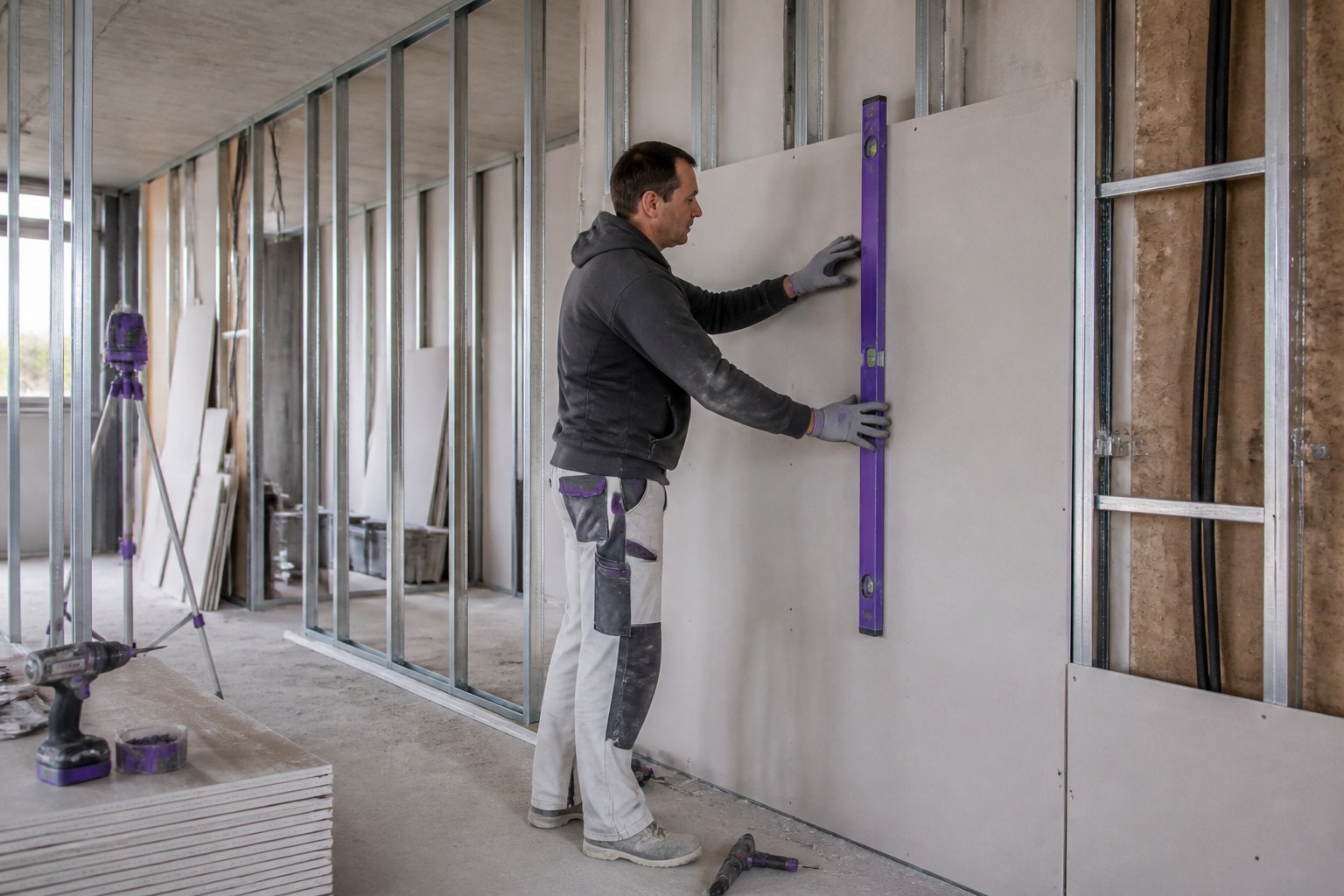
Drywall installers work in interior construction. Their work focuses on creating or adapting interior walls, ceilings and other surfaces with dry construction systems. The occupation combines practical craftsmanship, accurate preparation and careful finishing rather than only the placement of boards.
Typical work starts with measuring the installation area and preparing the working surface. The installer works with construction drawings, dimensions, profiles, boards, insulation materials and fastening systems. Depending on the project, the work includes assembling metal or other substructures, positioning gypsum boards, cutting materials accurately and securing them in the intended arrangement.
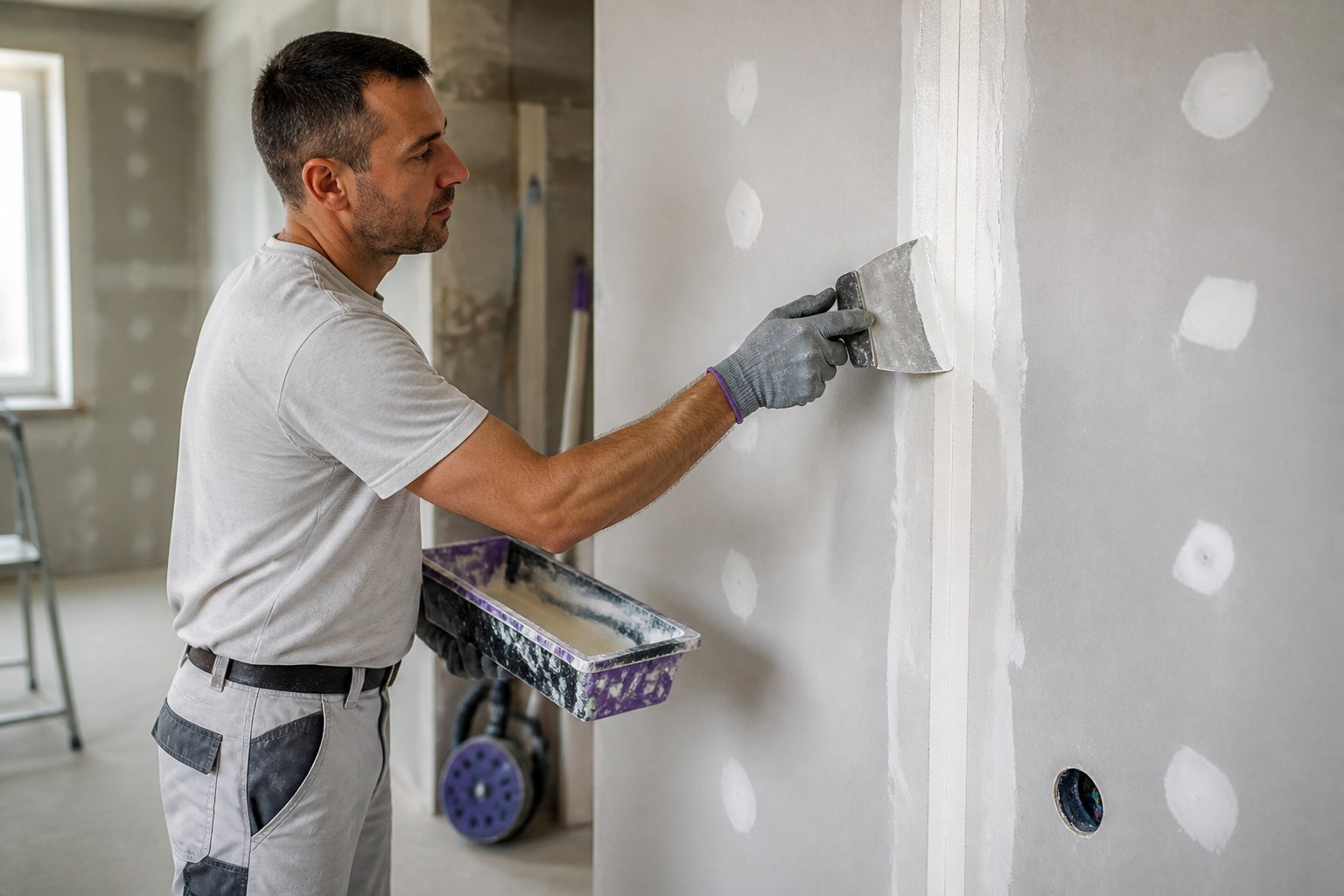
Finishing is an important part of the professional profile. Joints require suitable preparation, reinforcement and filling before the surface is sanded or otherwise prepared for subsequent work. Clean edges, even transitions and accurate alignment affect the quality of the finished interior. Installers also coordinate their work with other construction activities and keep the work area orderly.
The exact materials, tools and construction details differ between projects. Applicants should therefore describe the types of drywall and interior construction work they have actually performed instead of presenting a general list of construction tasks. A clear description of real responsibilities gives their professional profile more credibility.
Skills and Experience Relevant to Drywall Installer Jobs
Applicants for drywall installer jobs in Germany should present practical experience that demonstrates reliable work on interior construction projects. Employers and professional contacts need to understand what the applicant has installed, how independently the work was performed and which stages of the process were part of the applicant’s responsibility.
Accurate measuring is a central skill. Small errors in dimensions, alignment or spacing affect the installation of profiles and boards and create additional finishing work. Applicants should explain their experience with measuring, marking, cutting and checking surfaces. Experience with spirit levels, measuring tools and other equipment belongs in the professional profile when it reflects actual practice.
Material handling also matters. Drywall boards and related materials must be transported, positioned and installed carefully. Candidates should describe their experience with preparing materials, selecting suitable fastening methods and maintaining a clean installation. A credible profile distinguishes between tools and techniques used personally and tasks performed by other workers.
Finishing quality is another important area. Applicants should document experience with joint preparation, reinforcement tape, joint compound, sanding and surface preparation where these tasks formed part of their work. The ability to produce smooth transitions and clean corners demonstrates attention to detail and practical control of the installation process.
Safe work practices are essential in interior construction. Candidates should show that they understand the importance of suitable protective equipment, safe handling of tools and materials, orderly work areas and compliance with instructions. They should not claim safety certificates or technical authorisations that they do not hold.
The following fact is relevant when professional recognition is needed for a candidate’s qualification. It is separate from any assessment of residence or employment requirements.
A strong application connects practical experience with evidence. Job titles alone do not show whether an applicant worked on substructures, board installation, insulation, ceilings, partition walls or finishing. Employment references, certificates and a detailed CV make the experience easier to assess.
Qualifications and Recognition of Foreign Training
Applicants should collect evidence of vocational training, certificates and relevant professional experience before applying. Documents from a vocational school, training centre or previous employer help establish the applicant’s technical background. Where formal training is limited, a clearly documented employment history remains important because practical drywall experience is a central part of the occupational profile.
Drywall installation is associated with the skilled trades and interior construction. The legal treatment of a profession depends on the specific occupation and activity. Non-regulated occupations are not legally protected in the same way as regulated professions. In a non-regulated occupation, formal German professional recognition is not automatically required simply to perform the work.
This distinction does not settle residence or employment requirements. Qualification evidence may still be relevant to a residence procedure or to the assessment of a candidate’s professional profile. Professional recognition and requirements for working in Germany are separate matters and require separate examination.
When a recognition procedure applies to a foreign vocational qualification, the responsible authority compares the qualification with the corresponding German reference occupation. The authority assesses the submitted documents and examines whether relevant differences exist. The result depends on the qualification and the evidence submitted.
Candidates should submit complete and consistent documents. Differences between the CV, certificates and employment history create avoidable questions. Names, dates, positions and responsibilities should therefore be written consistently across the application documents. If a document is not available, the applicant should explain this accurately instead of replacing it with an unsupported claim.
German Language Skills for Drywall Installers
German belongs in the candidate profile because drywall installation takes place through coordinated practical work. Applicants need to understand instructions, communicate with supervisors and colleagues, clarify measurements and report problems. Communication also supports coordination with other trades working in the same interior construction environment.
Language skills are particularly relevant when instructions concern dimensions, installation sequences, materials, access restrictions or changes to the work process. Safety information also needs to be understood accurately. A candidate who can explain a technical issue clearly gives supervisors more reliable information about progress and risks.
Applicants should state their German language skills honestly. Where available, language knowledge should be recorded using a recognised level such as A2, B1, B2 or C1. A certificate provides useful evidence, but practical communication ability also matters. Candidates should not claim a level that they cannot use in workplace conversations.
No universal language level is stated here for every drywall installer position. The relevant point for an initiative application is the candidate’s actual ability to communicate in German and the evidence available for that ability. Applicants who are still learning German should describe their current level and ongoing learning accurately.
Documents to Prepare for Your Application
A clear CV is the main document for presenting a drywall installer profile. It should show personal details, vocational training, employment history, language skills and relevant technical abilities. The work history should be arranged in a way that allows the reader to follow the applicant’s development without guessing which tasks belonged to which period.
For every relevant employment period, include the employer, position, dates and main responsibilities. Describe drywall and interior construction tasks specifically. Examples include measuring, assembling profiles, installing boards, preparing surfaces, filling joints, sanding, installing ceilings or working with insulation, but only include tasks performed in reality.
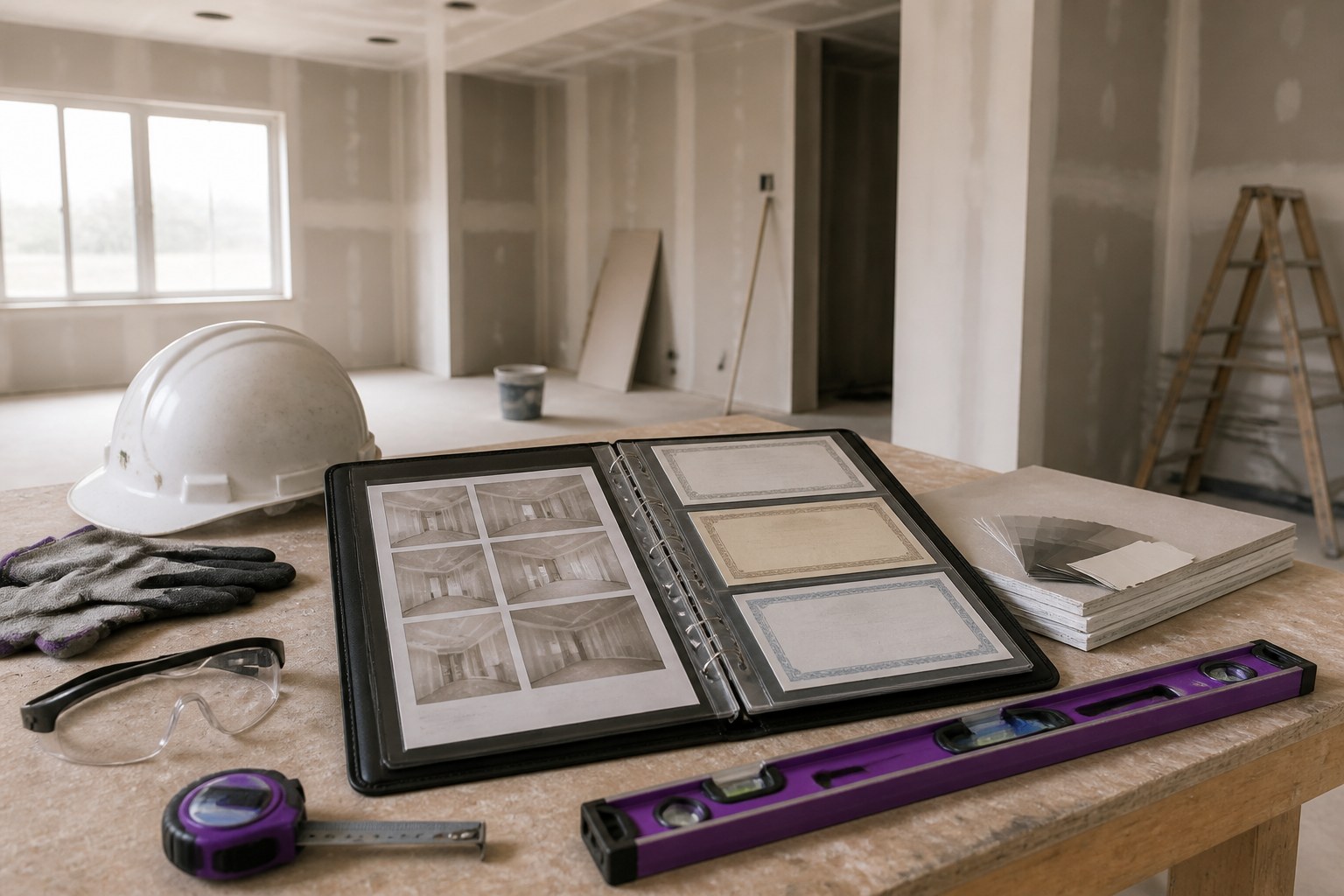
Training certificates, vocational qualifications and relevant course certificates should be collected in readable form. School or training documents are useful where they explain the applicant’s technical background. Employment references and confirmation letters also help document practical experience. Applicants should organise the documents so that the professional history and supporting evidence correspond.
Language certificates should be added when available. If documents are written in another language, a translation into German or English is useful and may be required in a particular procedure. Whether a certified or otherwise formal translation is required depends on the procedure. Applicants should not assume that every document needs the same type of translation.
A photograph is not a general requirement for an application. The focus should remain on the candidate’s professional evidence, practical experience, language skills and complete documentation. A concise application is more useful than a long document containing unclear or repeated information.
Employment history, references and a description of drywall tasks
Record employers, dates, positions, responsibilities, tools and techniques truthfully
Vocational training and certificates
Training certificates, vocational documents and relevant course evidence
Arrange readable copies and explain missing documents accurately
German language skills
Language certificate or an honest description of the current level
State the level clearly and relate it to workplace communication
Employment and application documents
CV, school or training documents and translations where required
Check that names, dates and responsibilities match across all documents
How to Apply for Drywall Installer Work in Germany
The East Talent application is an initiative application for employment opportunities in the drywall installer occupational group. Candidates do not apply at this stage for a named vacancy or for a preselected employer. They present their qualifications, experience, German skills and relevant documents for professional assessment.
East Talent reviews the candidate profile and the documents required for the employment process. The assessment focuses on whether the applicant’s practical background, qualifications, experience and communication skills fit the occupational group. Suitable candidates are subsequently introduced to appropriate companies in Germany.
Applicants must remain open to employment opportunities throughout Germany. A preference for a particular location may be relevant as personal information, but the application must not be based on an expectation of work in one specific city. Geographic flexibility gives the professional profile a broader basis for possible employment opportunities.
Candidates should provide truthful information from the first application. False descriptions of tools, qualifications, language skills or responsibilities create problems during later assessment. Accurate information about experience also helps identify which types of drywall work match the candidate’s actual abilities.
The process requires patience and organisation because professional documents, language evidence and any separate recognition or residence matters follow their own requirements. Applicants should keep copies of submitted documents and remain available to clarify dates, duties or certificates.
What to Check Before Starting Work
Before starting employment, applicants should understand the main information in the employment contract. The contract should identify the contracting parties, the start date, the activity, the work location, working time, remuneration, leave and notice periods. It should also state whether the employment is fixed-term and whether a probationary period applies.
The described work should correspond to the candidate’s understanding of the drywall installer role. Ask for clarification when the contract uses broad wording that does not explain the practical duties. The work location is also important because construction work may involve changing project locations. Applicants should understand what the contract states before accepting it.
Remuneration is normally stated as a gross amount. Gross pay is not the same as the amount transferred to the bank account. Taxes and social insurance contributions are deducted according to the individual situation, so the net amount cannot be calculated reliably from the gross amount alone.
Social insurance in Germany includes health, nursing care, pension, unemployment and accident insurance. For employment subject to social insurance contributions, registration is generally handled through the employer. The exact deductions and the resulting net amount depend on personal tax and social insurance circumstances.
Applicants should also look for information about additional payments, allowances or bonuses. Such payments depend on the individual employment relationship or applicable rules and should not be assumed without clear contractual information. Collective agreements or works agreements may contain additional provisions concerning pay, working time or leave.
How to Strengthen Your Drywall Installer Profile
Start by creating one consistent record of your professional history. List each employer, position, period of employment and main responsibility. Then connect each period with available evidence such as a certificate, reference, employment confirmation or training document. This structure makes gaps and missing documents visible before the application is submitted.
Describe projects and tasks precisely without inventing details. Explain whether you installed partition walls, ceilings, boards, profiles or finishing systems, and identify the tools and techniques used. If you worked under supervision, state that accurately. Professional credibility depends on a realistic description of independence and responsibility.
Organise training certificates and translations in a logical order. Keep the original documents and readable copies. Where a procedure requires a translation, arrange an appropriate translation and retain the related documents. The required form of translation depends on the procedure, so applicants should not assume that an informal translation satisfies every authority.
Record German language skills with an available certificate or recognised level. In addition, prepare to describe how you use German in practical situations, including understanding instructions, discussing measurements and communicating safety information. Language learning should continue when the current level does not yet support workplace communication.
Finally, remain geographically flexible across Germany. An initiative application concerns opportunities in the occupational group rather than a guaranteed city or employer. A candidate who presents a complete professional profile and accepts consideration for employment opportunities throughout Germany is better prepared for the next stage.
Start Your Application for Drywall Installer Jobs
A strong drywall installer profile combines practical interior construction experience with clear evidence. Your application should show what you have installed, which finishing tasks you have performed, how you work safely and which qualifications support your experience.
A traceable CV, organised certificates, reliable employment information and honest German language details help East Talent assess your profile. Keep your options open across Germany because the initiative application concerns employment opportunities in the occupational group, not a preselected city or employer.
If your documents are incomplete, prepare the missing evidence before applying where possible. Clear information gives the professional assessment a sound basis and helps prevent avoidable delays caused by unclear dates, unsupported claims or inconsistent documents.
Four short steps. A CV is optional and can be provided in your native language.
Step 1 of 4Profession
East Talent
International recruitment with proprietary software
East Talent combines international recruitment with structured digital processes for handling candidate profiles, attracting employers and evaluating job opportunities.