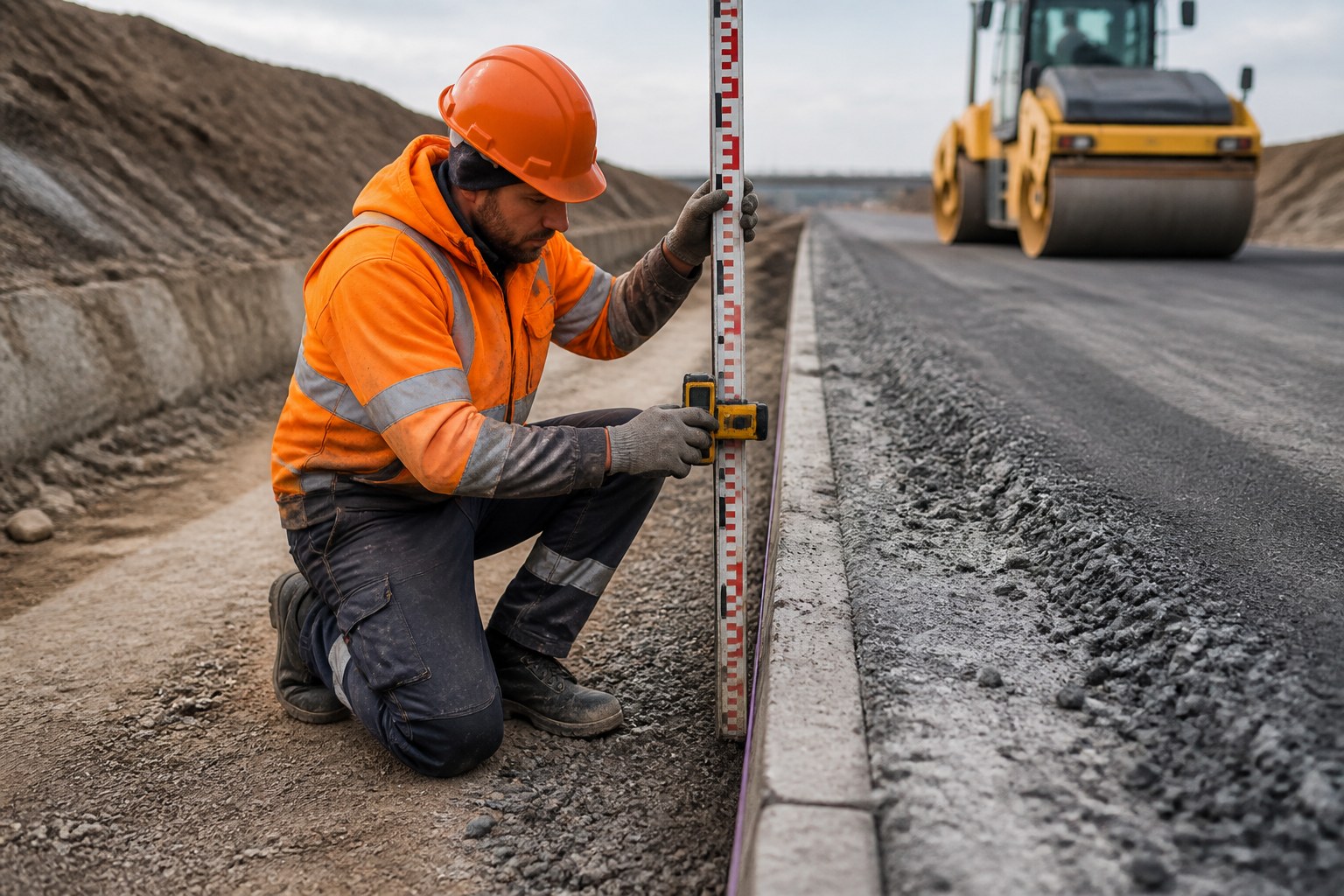
Road builders work on the construction, maintenance and repair of transport infrastructure. Their working environment includes road construction sites, prepared subgrades, compacted surfaces, drainage areas, kerbs and layered roadway structures. The work combines physical activity with accurate execution of technical instructions.
Typical responsibilities include preparing and securing work areas, checking construction surfaces, handling materials, supporting earthworks and installing or finishing road layers. Depending on previous training and experience, road builders also work with measuring equipment, compaction equipment and other construction machinery. The exact tasks assigned to a worker depend on the professional profile and the work organisation of the employing company.
Applicants should present themselves as construction professionals rather than relying only on the job title “road builder”. Practical experience with road construction procedures, site safety, materials, tools and technical instructions gives your profile substance. Evidence of the tasks you performed is more informative than a short statement that you worked in construction.
East Talent candidate applications are not tied to one named vacancy, employer or city. Applicants should therefore remain open to employment opportunities throughout Germany. This geographic flexibility is part of preparing a realistic professional profile for work in the German construction sector.
Which Qualifications and Experience Matter
Relevant vocational training is an important part of a road builder profile. Include the name of your training, the occupation or qualification, the training institution and the period of completion. If your qualification has a different title in your home country, describe the practical content as clearly as possible.
Professional experience is equally important. A useful profile explains the type of road construction work you performed, the materials and equipment you handled, and the responsibilities you carried on site. Experience with site preparation, surface work, paving-related activities, drainage, kerbs, earthworks or compaction belongs in the description when it reflects your actual background.
Construction-site procedures also matter. Employers and reviewing organisations need to understand whether you followed technical instructions, worked with measurements, coordinated with other trades and observed safety procedures. Do not claim responsibility for machinery, processes or certificates that you did not use or complete.
There is no single fixed qualification or experience threshold stated here for every road builder candidate. The strength of your profile depends on the combination of training, practical responsibilities, technical knowledge, documented experience and language information. A clear description allows your professional background to be assessed without unsupported assumptions.
How to Present Your Road Construction Skills
Your CV should make your road construction experience easy to understand. List each relevant employer, your job title, the employment period and your main duties. Describe the work itself instead of using broad wording such as “general construction tasks”.
For example, state whether your work involved preparing ground, laying or finishing road surfaces, installing kerbs, supporting drainage work, operating or assisting with construction equipment, checking levels or compacting materials. Use only details that match your actual experience. Specific descriptions help distinguish road construction work from unrelated building or general labouring activities.
Explain the working environment as well. Mention road construction sites, maintenance projects, public infrastructure work or other relevant settings when these form part of your history. If you worked as part of a team, describe your position within that team and the instructions or responsibilities you handled.
Training records, employment certificates and reference documents strengthen the information in your CV. Keep dates consistent across your CV and supporting documents. If exact dates are unavailable, do not invent them; explain the period accurately using the information you possess.
Your profile should also identify relevant technical and safety knowledge. This includes familiarity with site procedures, protective workwear, construction plans, measurements, materials or equipment where applicable. A road builder application is stronger when it shows what you know and what you have actually done.
German Language Skills for Your Candidate Profile
German belongs in your candidate profile because communication is part of safe and coordinated construction work. Instructions, site information, safety communication and everyday cooperation require language skills that are presented clearly and honestly.
The available facts do not establish one profession-specific German level for every road builder position. Do not insert a language level that you have not achieved. Instead, state your current knowledge directly and explain how you use German in practical situations, such as understanding instructions, communicating with colleagues or discussing work steps.
You may describe your knowledge with clear CEFR information such as A2, B1, B2 or C1 when that classification reflects your actual level. If your language skills are still developing, include the language courses or learning activities that form part of your preparation. Also list other languages that are relevant to your professional communication.
Language information should be consistent throughout your CV and application documents. Honest, precise information gives East Talent a reliable basis for reviewing your profile together with your qualifications, experience and documents.
Recognition of Foreign Qualifications
Recognition of a foreign qualification is a separate issue from residence and employment requirements. These areas must not be treated as interchangeable. A recognition decision does not by itself describe every requirement connected with working or residing in Germany.
German law distinguishes between regulated and non-regulated occupations. Regulated professions are legally protected, and professional practice requires the relevant recognition or professional authorisation. Road construction occupations are assessed in the context of their professional classification; candidates should not assume that every construction-related title has the same recognition status.
For a non-regulated occupation, formal German professional recognition is not required in the same way as for a regulated profession. Qualification evidence may still matter for a residence title or another administrative procedure. The relevant requirements must therefore be checked separately for the candidate’s situation.
A recognition authority examines whether a foreign qualification is equivalent to the relevant German reference occupation and whether substantial differences exist. The possible result includes full recognition, partial recognition or no recognition for non-regulated occupations. Where substantial differences exist, an adaptation qualification or another specified qualification measure addresses those differences in the applicable case.
Prepare certificates, training records and employment evidence before asking questions about recognition. Complete and consistent documents make it easier to identify the qualification content and determine which procedure is relevant to your professional background.
Road Builder Application Preparation Overview
Preparation area
What to provide
Why it matters for your application
Professional background
Road construction duties, site experience, materials, tools and equipment used
Shows the practical scope of your experience beyond the job title
Qualifications and certificates
Vocational training records, education certificates and examination documents
Provides evidence of your formal professional background
German language information
Honest description of your German skills or an accurate CEFR level such as A2, B1, B2 or C1
Explains your communication profile for work in Germany
Employment history
Employers, job titles, employment periods and main responsibilities
Allows your experience to be checked and understood clearly
Application documents
CV, employment evidence, relevant translations and an application or motivation letter where appropriate
Creates a complete and consistent candidate profile
Documents to Prepare Before Applying
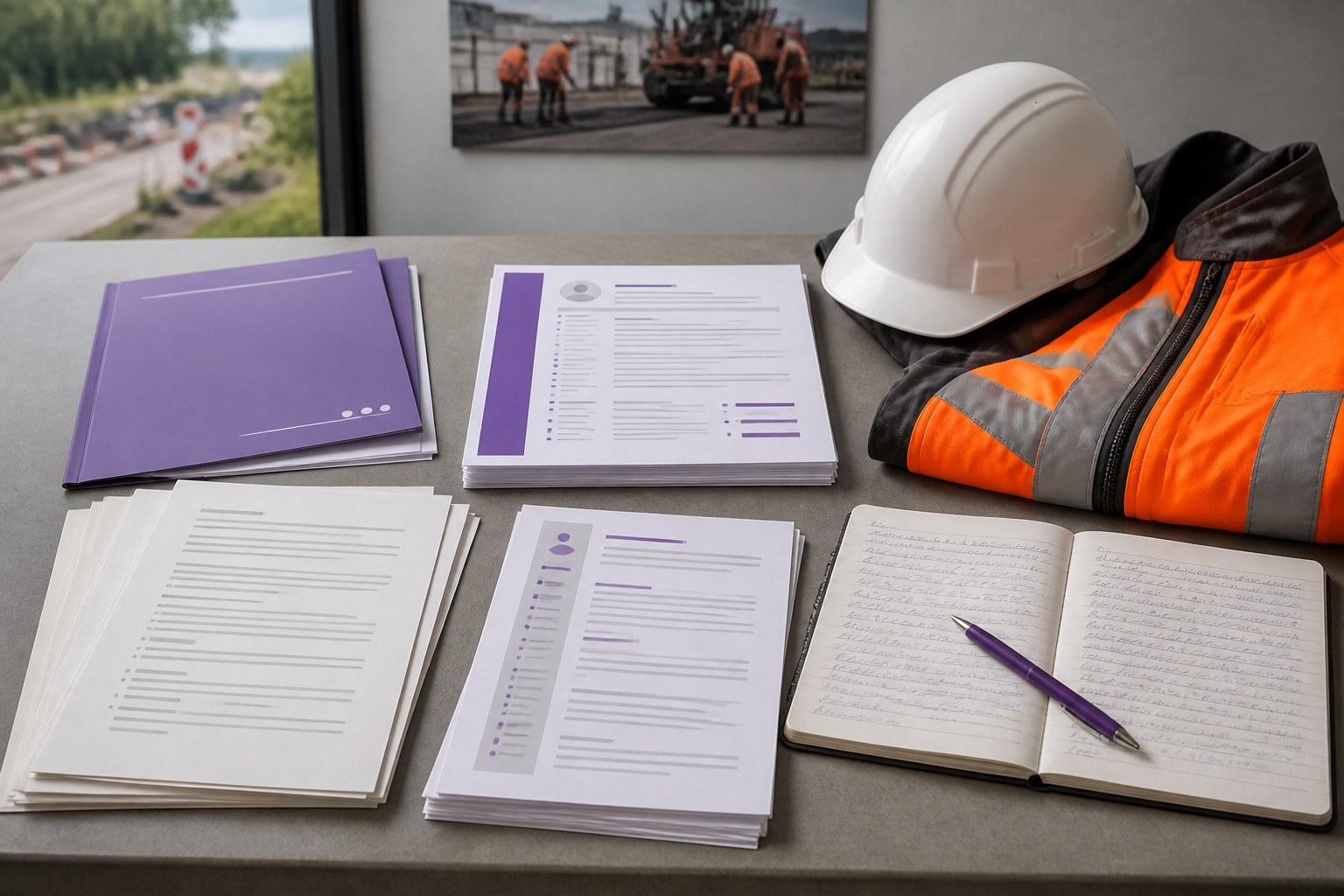
A complete application profile starts with a clear CV. It should include your contact details, training, employment history, language knowledge and relevant technical or safety skills. Present employment periods and responsibilities in a consistent order so that your experience is easy to follow.
Prepare education and vocational training certificates, examination records and other documents that demonstrate your professional background. Employment certificates or reference documents add evidence about your duties and experience. When a document is not available, do not replace it with an invented statement; identify the missing document and explain what alternative evidence exists.
Foreign-language certificates may require translation into German or English depending on the procedure. Whether a certified or otherwise formalised translation is required depends on the relevant process, so this point must not be generalised. Keep the original document together with any translation.
Language information should appear in the CV and in any additional application document. An application or motivation letter is useful when the process requires one, especially when it allows you to explain your road construction background, professional objectives and readiness to work in Germany. A photograph is not a general application obligation.
Organise digital copies with clear file names and check that scans are complete and readable. Your documents should tell one consistent story: the qualification, the work history, the language profile and the responsibilities you are prepared to perform.
Working Conditions to Check Carefully
Before accepting employment, review the employment contract carefully. It should identify the contracting parties and state the start date, any fixed term, the probation period, the work location, the duties, the remuneration, working time, holidays and notice periods. These details define the practical framework of the employment relationship.
The work location deserves particular attention for road construction workers because projects and construction sites may differ from the address used for administrative purposes. Clarify where the work takes place and how the stated location relates to your everyday travel and accommodation arrangements.
Check whether the duties match your professional profile. The contract and related information should make clear whether your work focuses on road construction, maintenance, site preparation, surface work or other construction activities. Do not rely only on an informal job title when reviewing contractual responsibilities.
Remuneration is normally stated as gross pay. Net pay is the amount remaining after the applicable taxes and social-insurance contributions have been deducted. The net amount therefore does not equal the agreed gross amount, and it cannot be calculated from gross pay alone without considering personal tax and social-insurance circumstances.
Possible supplements or bonuses depend on the employment relationship and applicable rules. Collective agreements or company agreements may contain additional provisions on pay, working time or holidays. Read these terms before accepting employment and keep a copy of the documents you sign.
How to Apply Through East Talent
East Talent’s candidate model is based on a proactive application for employment in your professional group. You do not apply at this stage for a named vacancy or a specific employer. Instead, East Talent reviews your professional qualification, road construction experience, German skills and relevant documents.
Suitable candidates may subsequently be introduced to companies in Germany whose requirements match the candidate profile. This means that your application should describe your complete professional background rather than target one assumed position. Include the road construction tasks you have performed, the equipment or procedures you know and the documents that support your statements.
Applicants must remain open to employment opportunities throughout Germany. A preferred city may be relevant to your personal planning, but the application does not promise employment in one particular location. Geographic openness gives your profile a realistic basis for consideration across the German market.
The quality of your application depends on the information you provide. Submit an accurate CV, relevant certificates, employment evidence, language information and translations where the applicable procedure requires them. Do not present unverified qualifications or responsibilities as completed facts.
Before submitting your application, check that your CV presents your road construction experience in a clear and chronological way. Each relevant employment period should show the employer, job title, dates and main duties. Remove vague descriptions that do not explain your practical responsibilities.
Collect your vocational training certificates, education documents and employment evidence. Compare the names and dates in your documents with the information in your CV. Consistency matters when your professional qualification is reviewed.
Record your German skills honestly. Use a CEFR level such as A2, B1, B2 or C1 only when it accurately describes your knowledge. Add a short explanation of your practical communication abilities and list relevant language learning activities.
Consider whether recognition of your foreign qualification is relevant to your professional and administrative situation. Recognition, requirements for working in Germany and employment requirements are separate questions. Prepare the documents needed to clarify each issue rather than assuming that one decision covers all of them.
Prepare translations where the applicable procedure requires them, while keeping the original certificates available. Finally, confirm that you are open to employment opportunities throughout Germany. A complete profile, realistic expectations and accurate documents provide the strongest foundation for your application as a road builder.
Create your profile
Registration with East Talent
Four short steps. A CV is optional and can be provided in your native language.
Step 1 of 4Profession
East Talent
International recruitment with proprietary software
East Talent combines international recruitment with structured digital processes for handling candidate profiles, attracting employers and evaluating job opportunities.