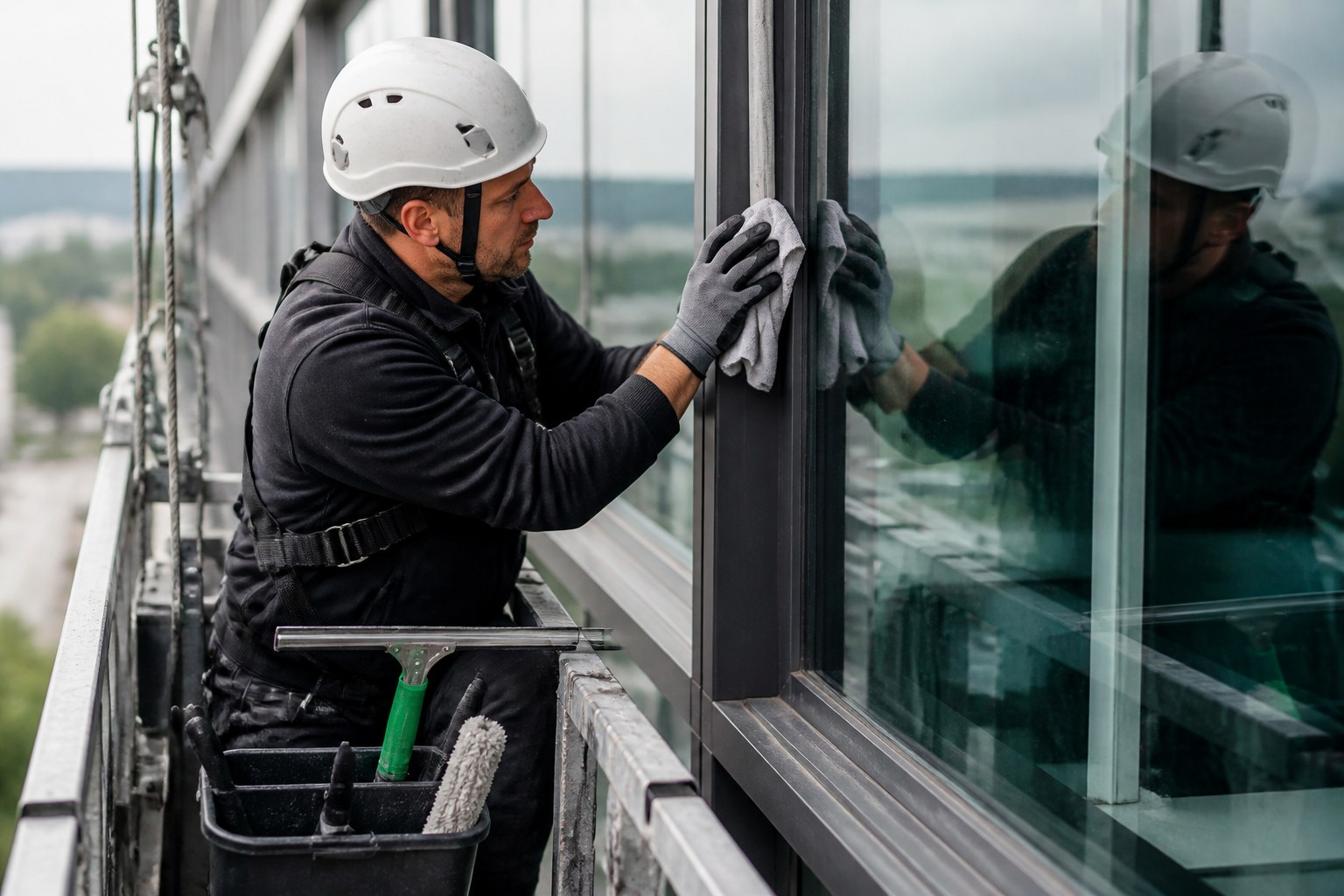
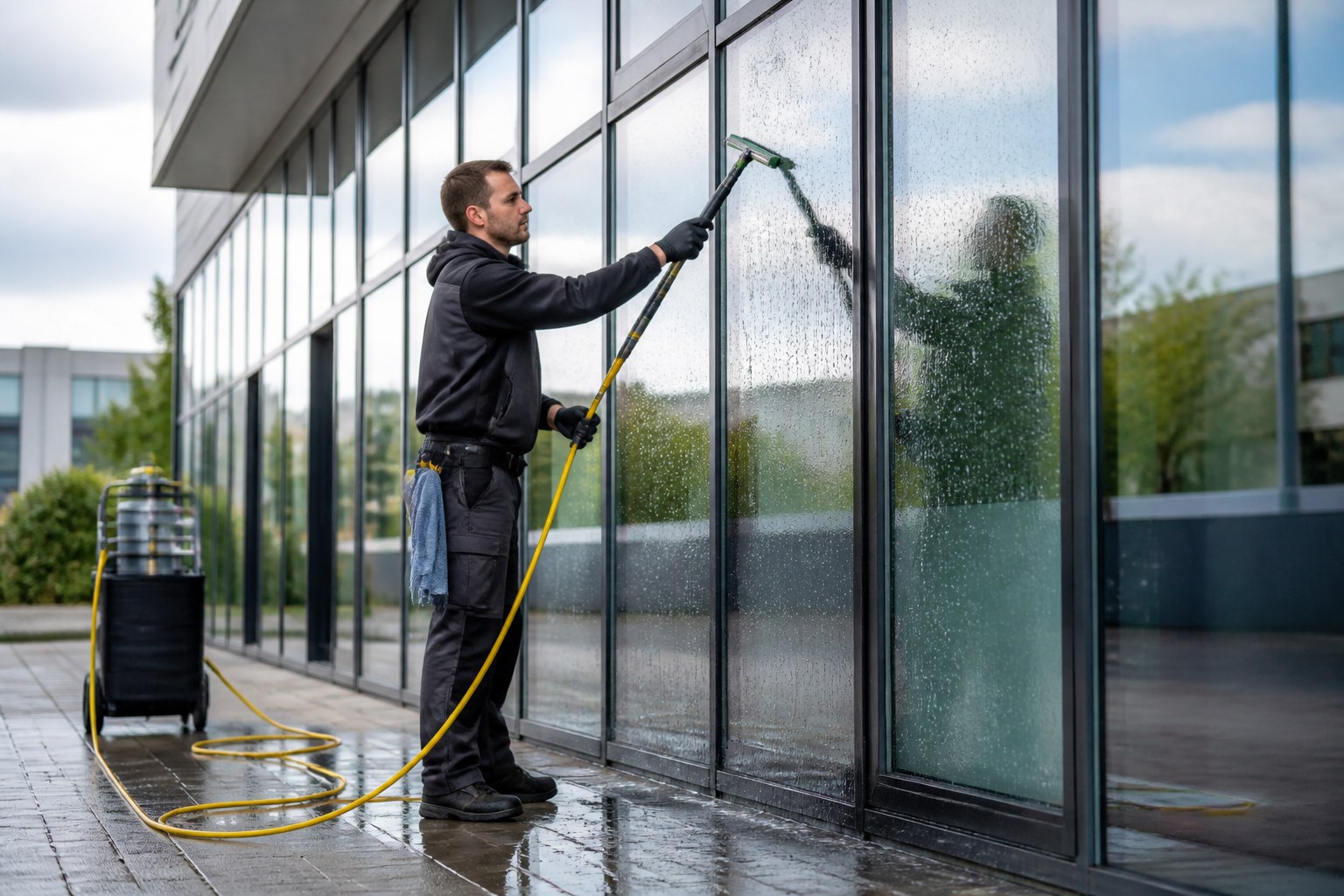
Window cleaners maintain the appearance, cleanliness and usability of glass surfaces in private, commercial and other buildings. Their work involves cleaning windows, glass doors, large panes, frames, edges and related surfaces. The exact combination of tasks depends on the working environment, but the occupation always requires careful practical work and attention to visible results.
Typical activities include preparing cleaning equipment, removing dirt from glass, applying suitable cleaning solutions, using squeegees or water-fed equipment and drying surfaces without leaving marks. Frames, corners and edges also require attention because a clean pane does not produce a complete result when surrounding areas remain dirty. Different surfaces require suitable methods, and careless handling of tools or chemicals damages glass, seals, frames or nearby materials.
Some cleaning work takes place at ground level, while other assignments involve difficult-to-reach areas or larger glass facades. Safe access, stable equipment and compliance with work instructions are essential. Applicants should describe the types of surfaces, buildings and equipment they have actually worked with instead of presenting general claims that they cannot support. Experience with access systems, poles, ladders or water-fed equipment deserves separate mention when it forms part of the applicant’s real work history.
A window cleaner also checks the finished work. This inspection identifies streaks, water marks, remaining dirt or missed areas before the task is considered complete. Reliable quality control matters because customers, colleagues and supervisors notice both the visible result and the way the work is performed. A careful final inspection also reduces complaints and prevents the need to repeat completed work.
The work often requires preparation before cleaning begins. The cleaner assesses the surface, protects nearby areas, arranges equipment and confirms that access is safe. Afterward, tools are cleaned and stored, waste water and materials are handled responsibly, and any damage or unusual condition is reported. These practical habits show professional reliability beyond the cleaning movement itself.
Skills and Experience That Strengthen Your Profile
Practical experience is central to a strong window cleaner profile. Relevant experience includes cleaning glass surfaces, frames and other building areas, handling professional equipment, preparing work areas and completing tasks independently. Experience with commercial buildings, larger panes or difficult access is worth describing when it forms part of your actual background.
Careful working methods strengthen an application. Window cleaning requires precision because streaks, scratches, remaining dirt and damage to surrounding surfaces reduce the quality of the result. A strong profile therefore explains how you organise the work, protect nearby areas, inspect cleaned surfaces and respond to problems. Attention to detail matters at every stage, from selecting the cleaning method to checking the final edge of a pane.
Physical reliability is also relevant. The work involves standing, reaching, moving equipment and repeating practical cleaning movements. Applicants should give an accurate account of their experience and working capacity without exaggerating qualifications or claiming equipment experience they do not possess. Describe the physical tasks you performed regularly and distinguish them from occasional assistance.
Safe handling of equipment is particularly important when work involves access systems, poles, ladders or other tools. Employers need candidates who follow instructions, identify unsafe situations and communicate clearly when a task requires clarification. Independent work does not mean ignoring safety procedures; it means carrying out agreed tasks responsibly and reporting issues promptly. Familiarity with protective clothing, gloves and safe positioning is relevant evidence of a responsible working method.
Your application becomes more useful when it distinguishes between cleaning tasks you performed regularly and tasks you only observed or supported. State the equipment you used, the surfaces you cleaned, the size or type of work environment and the responsibilities you held. Clear evidence is more valuable than a long list of unsupported skills.
Customer and team communication also form part of the occupational profile. A cleaner may need to explain access problems, report damage, coordinate work with colleagues or confirm that an area is ready for use. Reliability includes arriving prepared, following agreed procedures and informing the responsible person when the planned method is unsuitable. These behaviours belong in your work history when they reflect your actual experience.
Qualifications, Training and Recognition
Window cleaning belongs to a practical occupational field. This article does not establish one specific mandatory German qualification for every window cleaner position. Relevant preparation therefore focuses on your real practical ability, previous work and evidence of the tasks you have completed.
Professional recognition and immigration or employment requirements are separate issues. Regulated professions are legally protected, and work in such a profession requires the relevant recognition or professional authorisation. Non-regulated occupations are not protected in the same way. Window cleaning should not automatically be treated as a regulated profession merely because the work is performed professionally.
The fact that an occupation is not regulated does not automatically remove every qualification requirement connected with residence, employment or a particular administrative procedure. Qualification evidence still matters when your documents and professional background are reviewed. Keep certificates, employment records and other proof of experience available so that your profile is assessed accurately.
If you completed vocational training or another relevant course, list the qualification, training institution, dates and main content. If you learned the occupation through work experience, explain the practical route clearly. Do not describe informal experience as a formal qualification, and do not omit substantial experience simply because you do not hold a certificate.
Recognition of a foreign qualification involves reviewing the content and level of the education or training documented in your file. The result depends on the qualification and the responsible process. Your documents should therefore present the original qualification clearly, together with translations or additional evidence when the responsible procedure requests them. Do not state that a qualification is recognised before an official assessment confirms that result.
Training related to safe equipment use, occupational safety, cleaning chemicals or access methods strengthens your documentation when the training is genuine and recorded. Include the course name, provider, completion date and subject matter. Short internal instructions and substantial vocational training are different forms of evidence; describe each accurately rather than combining them into one qualification.
German Language Skills for Daily Work
German is an important part of your candidate profile because window cleaners need to understand instructions, coordinate access and discuss the condition of surfaces. Language skills also support communication about equipment, safety, schedules and unexpected problems.
Daily work often involves interaction with colleagues, supervisors, property contacts or customers. You need to understand what area requires cleaning, which surfaces need special care and whether access arrangements have changed. Clear communication reduces mistakes and supports safe task planning. It also helps you report broken equipment, blocked access, damage or a result that does not meet the expected standard.
This article does not establish a single mandatory German language level for all window cleaner opportunities. Your actual language ability should be presented honestly. You may describe your skills using recognised levels such as A2, B1, B2 or C1 when those levels accurately reflect your knowledge.
If your German is still developing, focus on practical communication that you already manage: understanding instructions, asking questions, reporting completed work and explaining a problem. Continue improving vocabulary related to cleaning equipment, surfaces, access, safety and working time. English or another language may support communication in some workplaces, but it does not replace the value of usable German in your candidate profile.
Avoid listing a language level only because it appears favourable. Explain how you use German in real situations, such as reading short instructions, discussing a cleaning sequence or speaking with a supervisor. If you hold a language certificate, include its level and date. If your skills come from work or daily life, describe that background clearly and separately from formal certification.
Language preparation should continue after the application is submitted. Practise words for glass, frames, dirt, water marks, protective equipment, access and hazards. The ability to understand a short safety instruction and repeat it accurately has direct practical value, especially when several people work in the same building.
Documents to Prepare for Your Application
Prepare a clear CV that presents your practical background in a way that is easy to assess. Include your personal details, employment history, positions, main tasks, education or training and language skills. For each relevant job, identify the employer, your position and the work you performed.
Describe window cleaning experience with concrete information. Mention glass surfaces, frames, facades, access equipment, cleaning systems and inspection duties when these formed part of your work. Explain whether you worked alone, as part of a team or under supervision. The purpose is not to create an impressive-sounding profile; it is to show what you genuinely know and do.
Employment references, certificates and other evidence support the information in your CV. Useful documents include training certificates, work references and important school, vocational or higher-education certificates. Keep original documents and clear copies organised so that you provide the relevant evidence when required.
Foreign-language certificates may require translation into German or English depending on the relevant procedure. A certified or otherwise formal translation is not a universal requirement for every document and situation. Check the requirements of the procedure that applies to you before paying for a translation.
A professional photograph is not a general requirement for an application. Concentrate first on accurate information, readable formatting and a complete description of your practical experience. Review dates, employer names, job titles and contact details carefully before submitting your documents.
The dates in your CV should form a consistent timeline. Explain longer periods without employment briefly and accurately, especially when you used that time for training, language learning or practical work. If an employer reference uses a different job title from your CV, describe the tasks so that the difference is understandable. Consistent information makes the assessment of your experience more reliable.
Scan documents clearly and use simple file names. Keep a personal copy of every document submitted. If a document is missing, state that fact instead of replacing it with an unsupported claim. Additional information about equipment, safety training or access work belongs in the CV or an accompanying explanation when it helps assess your actual professional background.
Window Cleaner Application Preparation Checklist
Application area
What to prepare
Why it matters
Practical experience
Types of glass, frames, buildings, equipment and access methods you have actually worked with
Shows the scope of your hands-on ability and prevents unsupported claims
Certificates and references
Training certificates, employment references and evidence of relevant work experience
Supports the professional information stated in your profile
German language skills
Your honest language level and examples of workplace communication you manage
Helps assess your ability to understand instructions and report problems
CV and personal details
Employers, positions, dates, tasks, education, training and contact information
Allows your experience to be reviewed clearly and accurately
Availability and mobility
Your availability and openness to employment opportunities throughout Germany
Supports consideration for suitable opportunities in different locations
Working Conditions to Check Before Accepting a Contract
Before accepting employment, read the contract carefully. It should identify the contracting parties and provide information about the start of employment, any fixed term, the probationary period, workplace, duties, pay, working time, holiday entitlement and notice periods.
Check whether the described duties match the work you discussed and whether the workplace or work locations are clearly understandable. Window cleaning may involve movement between sites, so access arrangements, travel requirements and the organisation of daily work deserve careful attention before you agree to the contract.
Pay is normally stated as a gross amount. Gross pay is not the same as the net amount transferred to your bank account because taxes and social-security contributions are deducted according to your personal circumstances. Do not calculate your available income from a gross figure alone. Housing, transport, food and other living costs also determine the amount remaining after payment arrives.
German social insurance includes health, long-term care, pension, accident and unemployment insurance. In a social-insurance-covered employment relationship, registration is generally handled through the employer. The contract or applicable collective arrangements may also contain rules on pay, working time or holidays.
German working-time and holiday rules provide an important framework, but the legal maximum working time is not identical to the regular weekly working time agreed in a contract. Read the stated schedule, breaks, additional hours and holiday arrangements carefully. Ask for clarification before signing anything you do not understand.
For window cleaning, inspect the practical working conditions described in the agreement. Clarify whether equipment and protective clothing are provided, who organises travel between work locations, how additional hours are recorded and who gives safety instructions. These points affect both your daily routine and your actual income and responsibilities.
Do not rely only on verbal explanations. Important promises about duties, pay, working time, travel or accommodation belong in written documents. If the wording is unclear, request an explanation before signing. Keep the final contract and any related written arrangements with your personal records.
Applying for Opportunities Throughout Germany
East Talent accepts initiative applications from candidates seeking employment in their occupational group. You are not applying for a named vacancy or a specific employer at this stage. Your profile is reviewed on the basis of your professional qualifications, practical experience, German skills and the documents available for assessment.
Suitable candidates may later be introduced to companies in Germany whose requirements match their profile. This means your application should describe your actual abilities rather than target an invented position. Explain the window cleaning work you perform confidently, the equipment you have used and the responsibilities you have held.
Applicants must remain open to employment opportunities throughout Germany. Do not present only one preferred city or assume that a suitable opportunity exists in a particular location. Nationwide mobility gives your profile a broader basis for consideration and reflects the way candidate applications are handled.
Your application should also state relevant availability and practical limitations honestly. If you need further training on particular equipment, say so. If you have experience with difficult access, commercial buildings or team coordination, include that information. Accurate details help the assessment focus on realistic employment opportunities.
For broader information about employment in Germany, the Jobs in Germany section provides additional candidate-focused context. Your window cleaner application should remain specific to your own experience, documents and language skills.
A nationwide application does not require you to hide personal circumstances. State restrictions that affect your availability, travel or working capacity clearly. At the same time, separate a genuine limitation from a preferred location. Applicants who remain open to suitable opportunities throughout Germany give their professional profile a wider basis for review.
Update your information when your situation changes. New equipment training, improved German skills, an additional reference or a newly completed recognition process belongs in an updated profile. Accurate updates prevent decisions from being based on outdated documents.
A Practical Preparation Plan for Window Cleaner Applicants
Start by recording your practical experience. List the types of glass and frames you cleaned, the tools and systems you used, the environments in which you worked and the quality checks you completed. Separate regular responsibilities from occasional support tasks.
Next, organise certificates, references and other documents. Make sure dates and names match the information in your CV. If documents are not in German or English, identify whether a translation is required for the procedure concerned rather than assuming that every document needs formal certification.
Describe your German skills honestly and connect them with workplace communication. State the level you use, if known, and explain whether you understand instructions, discuss access, report problems and communicate with customers or colleagues.
Prepare a readable CV with accurate personal details, employment history, tasks, training and language skills. Review the difference between gross and net pay and learn which contract details require your attention before accepting an employment offer.
When your documents are ready, submit an initiative application through the application form. Apply for jobs in Germany through our application form. Remain open to opportunities throughout Germany and keep your profile updated if your experience, German skills or available documents change.
Before submitting, compare every statement in the CV with your supporting evidence. Remove vague claims, correct inconsistent dates and explain practical experience in clear terms. A short, accurate description of equipment and responsibilities gives a stronger basis for assessment than a long list of general qualities.
Use the preparation process to identify gaps. Missing references, unclear training records or limited German vocabulary do not need to remain hidden; they show where further preparation is useful. Continue collecting evidence and improving job-related communication while your profile is being reviewed.
Your goal is a reliable professional profile that shows what you have done, what you understand and which documents support your account. Practical experience, honest language information, organised records and openness to employment throughout Germany create a clear foundation for further consideration.
Create your profile
Registration with East Talent
Four short steps. A CV is optional and can be provided in your native language.
Step 1 of 4Profession
East Talent
International recruitment with proprietary software
East Talent combines international recruitment with structured digital processes for handling candidate profiles, attracting employers and evaluating job opportunities.