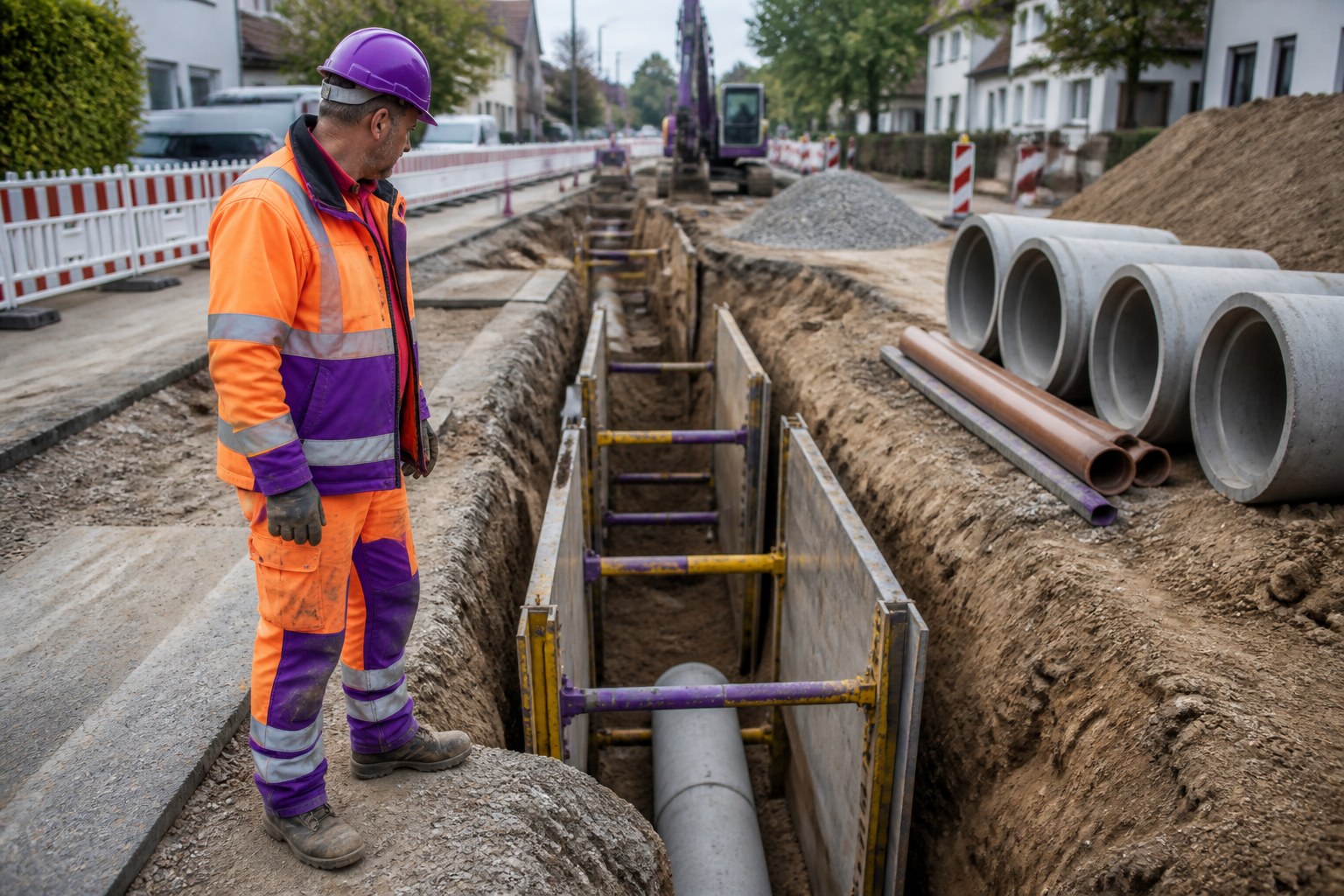
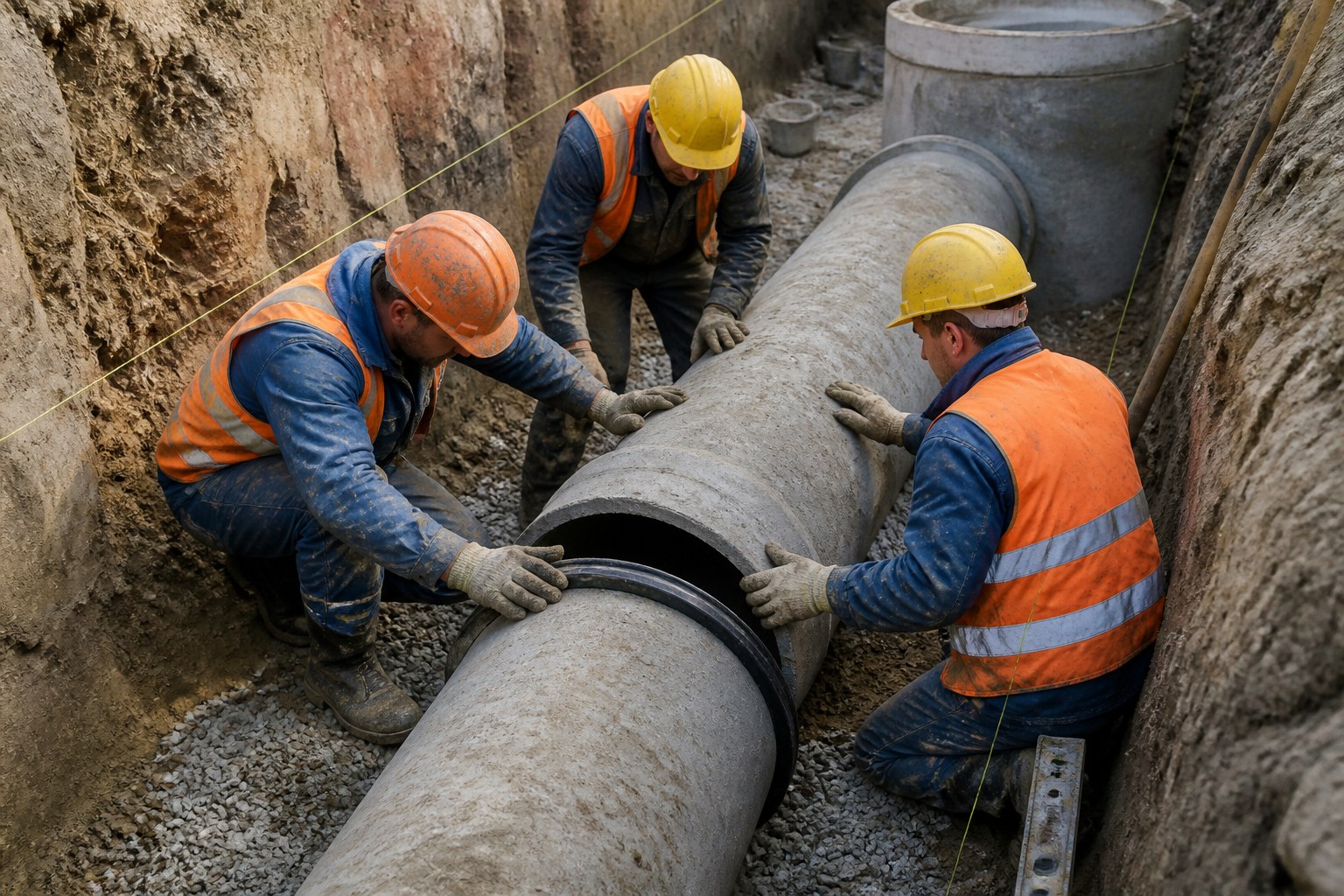
Sewer construction workers build, repair and maintain underground infrastructure for wastewater and drainage systems. Their work takes place on construction sites where trenches, pipes, connections and other underground components must be installed or prepared accurately.
Typical activities include preparing work areas, supporting pipe installation, aligning or connecting pipe sections, carrying out excavation-related work and assisting with drainage infrastructure. The work requires close coordination with construction workers, machine operators, supervisors and technical site staff.
Sewer construction is physically demanding. Workers spend substantial time outdoors, work in changing weather conditions and perform tasks in or near trenches and restricted construction areas. Careful preparation, reliable teamwork and compliance with site safety procedures are essential because underground construction involves heavy materials, moving equipment and changing ground conditions.
Ground preparation, bedding, pipe positioning, connection work, inspection and backfilling follow a practical order. Errors in alignment, levels or connections affect later construction steps and create additional work for the wider site team. Candidates should therefore present careful, technical work rather than describing the profession only as general manual labour.
Applicants should describe the tasks they actually performed. Experience with pipe work, trench work, drainage projects, repairs, construction materials and equipment gives employers a clearer view of the professional profile. New installations, repairs, maintenance and replacement work should be distinguished because they represent different types of experience.
Qualifications and Practical Experience
Relevant vocational training in construction, civil engineering or infrastructure work strengthens an application for sewer construction work in Germany. Training related to pipe installation, road construction, underground construction or drainage systems is also relevant when it matches the candidate’s experience.
Practical experience is particularly important. Candidates should describe the construction projects they worked on, the materials they handled and the responsibilities they carried. Experience with sewer lines, drainage systems, water pipes, utility trenches or underground infrastructure provides useful evidence of professional suitability.
Present experience with machinery and tools precisely. State which equipment you operated or supported, how long you used it and which tasks you completed. Do not list machinery that you only observed or used briefly. Accurate information protects professional credibility and supports assessment for suitable employment opportunities.
Applicants without a formal qualification should document their practical construction experience carefully. Employment evidence, project descriptions and references provide important context. Formal recognition and related to working in Germany qualification requirements are separate issues and require separate review.
Training records should identify the subject, duration and issuing institution when available. Short courses, equipment instruction and safety training belong in the profile when they relate directly to previous duties. Candidates should also distinguish between assisting with a task and performing it independently.
Technical Skills That Strengthen Your Candidate Profile
Sewer construction depends on accuracy. Pipe sections, connections and underground routes must be handled according to the technical information available on site. Candidates should explain their experience with measurements, alignment, levels, construction drawings or other site information only where these activities formed part of their work.
A strong profile describes how the candidate prepared tools and materials, checked work steps, coordinated with colleagues and reported problems. Experience with repairing, replacing or installing underground components is relevant when the description reflects actual responsibilities.
Safety awareness is central to underground construction. Mention responsibilities involving protective equipment, safe work areas, trench-related precautions, traffic protection, machinery coordination or site instructions when these belong to your experience. Do not claim formal safety qualifications without the relevant certificate or training record.
Teamwork is a daily requirement. Sewer construction workers coordinate with colleagues performing excavation, pipe laying, surveying, transport and reinstatement work. Clear communication, punctuality and the ability to follow instructions demonstrate professional reliability.
Candidates should mention quality checks that formed part of their responsibilities, such as checking material positions, identifying visible defects, keeping the work area organised and reporting unexpected ground or pipe conditions. Explain cooperation with surveying or machine-operating personnel accurately instead of claiming tasks performed by others.
German Language Skills on Construction Sites
German language skills support safe and effective work on construction sites. Workers need to understand instructions, communicate with colleagues and report hazards, delays or technical problems. Language also supports coordination when several trades work in the same area.
Candidates may encounter plans, work instructions, safety information, delivery documents and records that require careful reading or explanation. Clear communication reduces misunderstandings during time-sensitive work.
Applicants should state their language skills honestly in the CV. If certificates are available, include the level and issuing institution. A certificate provides evidence, but practical communication ability also matters. Candidates should develop vocabulary for tools, materials, measurements, safety instructions and construction activities.
No single language level is assigned here as a universal requirement for every sewer construction opportunity. German communication forms part of a credible professional profile and directly supports safe teamwork. Practise confirming an instruction, asking about a measurement, reporting damaged material, describing a hazard and explaining that a work step is complete.
Experience in multilingual construction teams is worth mentioning. It shows familiarity with coordination across language backgrounds, but it does not replace German skills. Other languages remain useful when they support teamwork, while German is important for communication with supervisors, colleagues and site personnel in Germany.
Documents to Prepare for Your Application
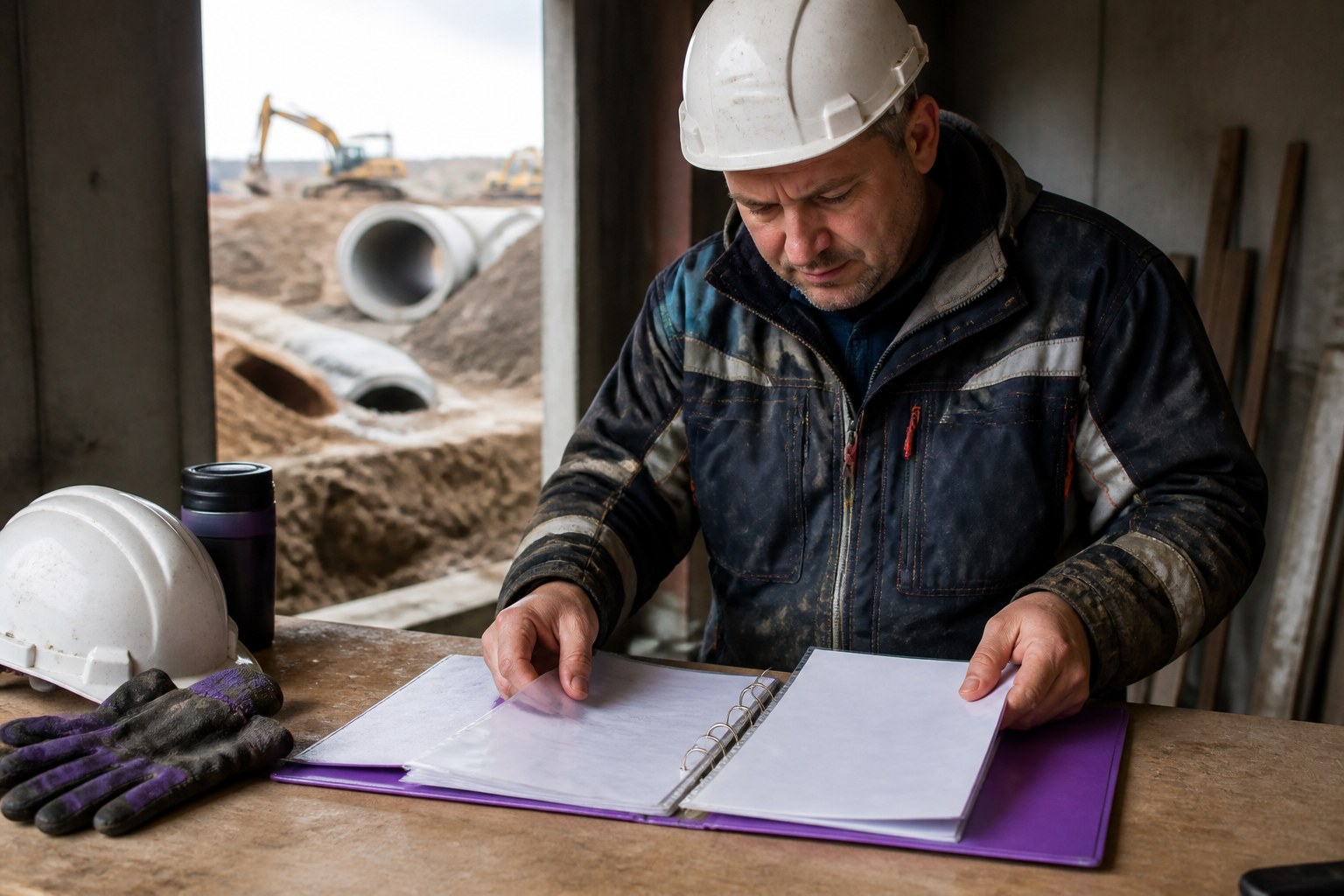
Prepare a clear CV in English or German that presents construction experience in chronological order. Include contact details, employment history, vocational training, certificates, language skills and relevant technical abilities.
For every important position, state the employer, job title, employment period and main responsibilities. Describe the construction environments in which you worked, such as sewer projects, drainage work, pipe installation, trench work or other underground infrastructure. Use specific descriptions instead of a general list of construction duties.
Collect vocational certificates, training records and relevant school or technical education documents. Also prepare employment evidence where available, including employer confirmations, reference letters or other records explaining previous work. Foreign-language documents may require translation into German or English when relevant to the procedure. Whether a certified or otherwise formal translation is required depends on the procedure.
Include language certificates when available. Keep digital copies of all documents and check that names, dates and job titles are consistent across the CV, certificates and employment records. A useful folder separates identity information, professional qualifications, employment evidence, language records and translations.
Employment evidence is especially valuable when it explains the actual work performed. A document that only states a broad job title provides less information than a confirmation describing sewer construction, drainage, pipe installation, trench work or related duties. Do not submit altered certificates, inflated job titles or unsupported responsibilities.
Sewer Construction Worker Application Preparation
Preparation area
What to present
How to prepare
Professional experience
Sewer, drainage, pipe, trench or other underground construction work
List employers, positions, dates, project types and actual responsibilities
Qualifications and certificates
Vocational training, technical education and relevant safety or equipment records
Collect certificates, employment evidence and consistent digital copies
Language and communication
German skills, other languages and experience following site instructions
State language levels honestly and develop construction and safety vocabulary
Application documents
CV, education records, certificates and relevant translations
Check names and dates, organise files clearly and translate foreign-language documents when relevant to the procedure
Recognition of Foreign Qualifications
Sewer construction work must not automatically be treated as a regulated profession. Whether formal recognition is required depends on the specific profession, qualification and legal context. Non-regulated professions are not protected in the same way as regulated professions, but this does not automatically remove qualification requirements connected with residence or employment.
Recognition authorities compare a foreign vocational qualification with the relevant German reference profession. They examine the submitted documents and determine whether the qualification is equivalent or whether substantial differences exist. Possible outcomes include full recognition, partial recognition or no recognition for non-regulated professions.
If substantial differences are identified, an adaptation qualification or another approved qualification measure addresses those differences in cases where this route applies. Regulated professions also have professional authorisation requirements. Candidates should distinguish three questions: what practical experience they have, whether their qualification requires formal recognition and which qualification evidence is relevant to their residence and employment situation.
Submit complete and consistent documents for any formal procedure. The responsible authority decides the outcome; an article about sewer construction work does not establish an individual recognition result. Keep certificates, subject information, training records and employment evidence together, and explain discrepancies in names or dates with supporting evidence.
Practical experience remains important when a formal qualification is assessed. A qualification document explains structured training, while employment records show how the candidate applied knowledge on construction sites. Both types of information contribute to a complete professional profile.
Working Conditions and Employment Documents
Before starting employment in Germany, candidates should understand the main terms of the employment relationship. An employment contract should identify the parties, start date, possible fixed term, probationary period, place of work, duties, pay, working time, leave and notice periods.
The work location is important because sewer construction projects take place at changing construction sites. Candidates applying through East Talent must remain open to employment opportunities throughout Germany rather than limiting their profile to one preferred city or region.
Pay is normally stated as a gross amount. Gross pay is not the same as the net amount received after taxes and social insurance contributions. The individual net amount depends on personal tax and social insurance circumstances. Supplements or bonuses depend on the employment relationship and applicable rules.
Working time, leave, contract duration and notice periods must be understood from the employment documents and applicable arrangements. Collective agreements or company agreements may contain additional provisions. Candidates should read these terms carefully before accepting employment and keep a copy of the signed contract.
Moving for employment creates expenses such as travel, accommodation, a deposit and everyday living costs. These costs affect the amount available after relocation and belong in personal planning. Candidates should also clarify how the place of work is defined, whether work takes place at changing sites and which duties belong to the position.
Applying for Sewer Construction Work Across Germany
East Talent’s candidate application is an initial application for employment opportunities in the candidate’s professional group. It is not an application for a named vacancy or a specific employer. Candidates present their qualifications, experience, language skills and documents for professional assessment.
East Talent reviews the candidate profile and the documents required for possible placement. Suitable candidates may subsequently be introduced to companies in Germany whose requirements match the professional profile. Applicants should therefore describe their experience accurately and provide complete documentation from the beginning.
Applicants must be open to employment opportunities throughout Germany. Limiting an application to one preferred location reduces the range of opportunities for which the profile is considered. Mobility expectations should be discussed realistically, including the practical consequences of changing construction sites or moving for employment.
A strong application does not promise a particular employer, location, salary or employment outcome. It gives decision-makers reliable information about the candidate’s qualification, project experience, equipment knowledge, language skills and document status.
Applicants should be prepared to answer questions about previous projects. Useful answers identify the type of infrastructure, their own duties, the tools or equipment involved and the team structure. Openness to employment throughout Germany also requires realistic planning for travel, accommodation and relocation.
How to Present Your Construction Experience Clearly
Organise your CV so that a reviewer understands your construction experience quickly. Start with your most recent position and describe each employer, role, employment period and main project activities. Use short, factual descriptions of the work you actually performed.
Separate different types of experience where possible. Identify sewer and drainage work, pipe installation, trench preparation, road construction, repairs, concrete or reinstatement work. If you worked across several areas, explain the main tasks connected with each area.
List tools, machinery and technical procedures precisely. Include measuring, alignment, pipe connections, material handling, site preparation or construction documentation when these activities were part of your job. Describe safety responsibilities, teamwork and communication with supervisors or other trades.
Certificates and employment evidence should support the CV. Add language information and explain whether you worked in multilingual teams or followed instructions in German. Clear evidence is more useful than broad claims such as “experienced in all construction work.”
A project-based description presents practical experience clearly. State whether the work involved new construction, repair, replacement or maintenance, then identify your own responsibilities and the materials or infrastructure involved. Avoid unexplained gaps or overlapping dates, and explain when several short projects formed part of one employment relationship.
The strongest profile is specific without becoming unnecessarily long. Each position should answer three questions: what type of work was performed, what responsibility did the candidate carry and what evidence supports the description?
Preparing for Employment in Germany
Before applying, collect your CV, vocational certificates, employment evidence, language information and relevant translations. Check every date, job title and employer name for consistency. Prepare a short explanation of your most relevant sewer, drainage, pipe or underground construction experience.
Review professional qualifications separately from recognition or related to working in Germany questions. Keep documents in a clear digital folder and retain the original records. Continue improving German vocabulary for construction materials, tools, safety instructions and teamwork.
Assess your mobility realistically. Applicants for sewer construction work must be open to employment opportunities throughout Germany. This expectation concerns the geographical scope of possible employment and does not guarantee a particular location.
A complete and honest profile gives East Talent the information needed to assess your professional group. It also prepares you for later discussions about duties, working location, contract terms and required documents. Before submitting the application, ensure that a reviewer can identify the type of construction, your responsibilities, the length of experience and the available evidence.
The final review should cover professional experience, qualifications, German communication and documentation. It should also confirm that you are open to employment opportunities throughout Germany. This checklist creates a reliable basis for the initial assessment and later conversations about suitable employment.
### Apply now
Apply for jobs in Germany through our application form.
Create your profile
Registration with East Talent
Four short steps. A CV is optional and can be provided in your native language.
Step 1 of 4Profession
East Talent
International recruitment with proprietary software
East Talent combines international recruitment with structured digital processes for handling candidate profiles, attracting employers and evaluating job opportunities.